Advice from behind the service line, where the glass gets dirty and the tickets pile up
There is no magic shape.
A deli counter sells meat when the product is visible, the lighting is honest, the case holds temperature, and the staff can serve without fighting the equipment. The glass profile matters, but it is not the first question. The first question is what the counter has to do from 6:00 a.m. sanitation through the lunch rush and into the last ticket at closing.
I have seen square glass counters used beautifully and badly. I have seen curved displays that made a tired roast look expensive and others that turned every operator into a full-time glass cleaner. The right choice depends on the room, the light, the staff movement, and whether the counter is selling a composed presentation or moving a queue of pre-cut product.
The short version is this:
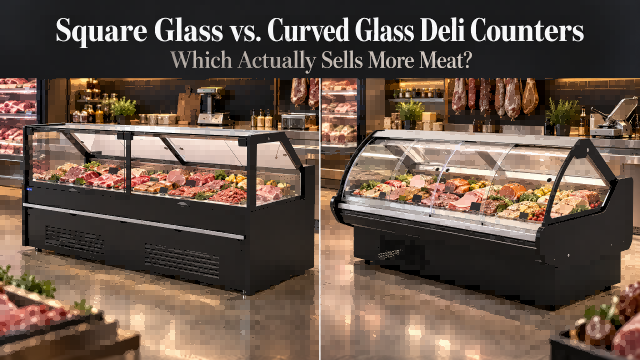
- Square glass is usually stronger for planned presentation, platter staging, architectural interiors, and staff access from a defined service side.
- Curved glass is usually stronger for broad product visibility, high-volume service, and shoppers who lean right up to the front of the case.
- Neither shape rescues poor airflow, bad lighting, weak hinges, or a counter with no useful rear storage.
The counter has to earn its floor space every day.
1. The Visual Merchandising Divide
Why high-end shops lean square
Artisanal charcuteries, European-style butcheries, and high-end cheese shops often favor a 90-degree square glass profile. The reason is not just fashion.
A square counter gives the room a hard architectural line. It looks deliberate. The flat top can take a prepared platter, a chalkboard, a wrapped terrine, a cutting board, or a small display of accompaniments without looking cluttered. The top becomes a merchandising surface rather than a piece of unused equipment.
That flat top also photographs well. Product shots have cleaner edges. The glass does not bend the line of a ham or a tray of sliced bresaola. In a shop that relies on social posts, catering orders, and customers taking pictures across the counter, that matters.
The visual language is simple: straight front, clean corners, strong horizontal shelf lines. A square case makes a small shop feel organized when the product selection is disciplined.
But the same straight lines show every mistake.
Blood and brine collect where the glass meets the frame. Marinade runs into the 90-degree corners. If the weld is rough or the interior sealant has shrunk, those corners become dark lines by the end of the week. A quick wipe across a curved front is not enough. The square counter needs an actual corner pass with the right cleaner and a cloth that can get into the joint.
The flat top also invites overloading. One platter becomes three. Then somebody puts a printer on the top. Then a roll of film. Then a stack of ticket pads. The clean architectural line disappears and the counter starts looking like a workbench.
That is not a glass problem. It is a layout problem.
Why volume delis keep curved glass
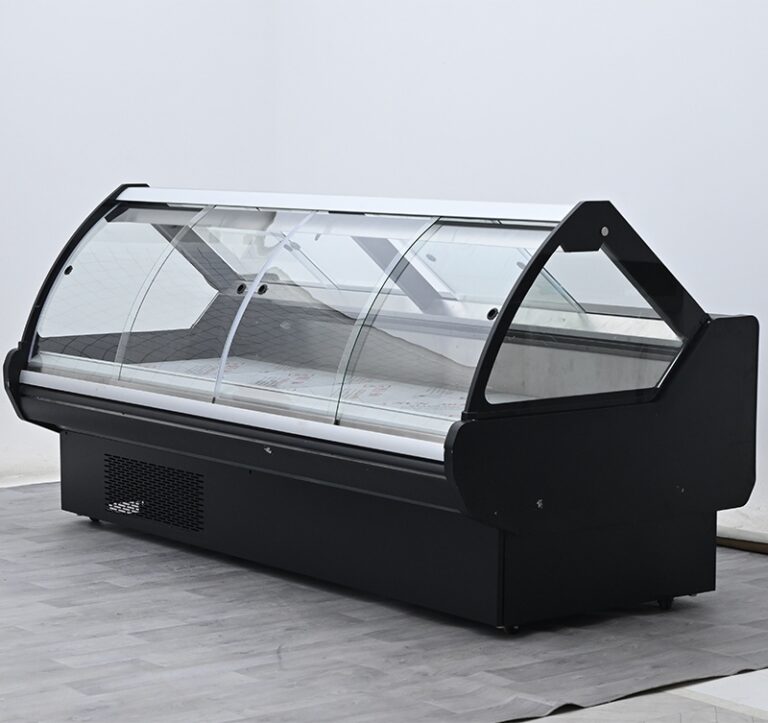
Traditional supermarket deli counters and hot/cold prepared food bars tend to prefer panoramic curved glass for a different reason: customers can see more product from more positions.
The shopper is rarely standing square to the center of the case. They are leaning right, looking past another customer, or approaching at an angle from the endcap. A curved front gives a wider top-down viewing angle. The customer can see the tray nearest the end without pressing their face toward the glass.
Curved glass also removes some of the hard reflection you get from a flat pane under ceiling fluorescents. A flat pane can throw a bright white stripe across a row of roast beef. The product is there, but the color is gone. That is how good meat looks gray in the customer’s eyes.
A well-designed curve can soften the reflected angle and reduce the ceiling-light glare washing out the display. It is not a substitute for proper LED placement. It simply gives the light fewer opportunities to hit the glass and bounce directly into the shopper’s face.
The curve is especially useful where the counter faces a long aisle. Shoppers see into it before they reach the service position. That extra viewing time can help a prepared-food bar or a grab-and-go meat section.
The trade is obvious: the curved front takes up visual and physical space. It is harder to use as a staging surface. It can make the counter feel deeper. And when the front tilts open, the operator needs clear room in front of the case. Put it too close to a queue rail and the morning cleaning routine becomes a negotiation with every trolley in the store.
2. The Unspoken Operational Trade-Offs
Brochures talk about profile and visibility. Staff talk about grease, hinges, condensation, and whether a ticket can be reached without leaning across six trays.
Staff are right.
Daily sanitation: the 6:00 a.m. test
At closing or before opening, the case has to be cleaned quickly and properly. This is where the two shapes behave very differently.
A square-glass counter with sliding panels is familiar to most deli crews. Slide the panel, remove the trays, wipe the shelf, clean the channel, and move on. It is not effortless. The lower tracks collect crumbs, brine, and fragments of sliced meat. The track may look clean while holding a black paste under the lip.
The 90-degree corners are the real nuisance. Grease from cooked meats and marinades from prepared items settle where the shelf, frame, and glass meet. If the internal corner weld is not ground and finished properly, there is nowhere for the cloth to travel. Operators end up using cotton swabs, narrow brushes, or a folded towel wrapped around a scraper.
That is ten extra seconds per corner. Multiply it across a long counter, every day, and it becomes labor. Not dramatic labor. Constant labor. The sort that never appears in the equipment quote.
A curved front-tilt case can be faster for broad surface cleaning. Unlock the hydraulic tilt-up mechanism, raise the glass, remove the product, and the service area is more open. Staff can reach the full front glass and shelf without working around a sliding panel.
But the mechanism must be designed for the routine. A heavy glass panel with weak gas struts or poorly placed hydraulic supports is not a cleaning convenience. It is a safety concern and a maintenance complaint. The tilt needs controlled movement. The locking points need to be obvious. Staff should not have to hold the glass with one shoulder while wiping a spill.
The curved shape also changes the cleaning motion. The cloth has to follow the radius. A straight squeegee leaves dry arcs at the edges. The upper lip and bottom seal need attention because water can run along the curve and settle at the low point.
The best system is the one the crew will clean correctly when the store is already late.
Welds, drains, and grease traps
Ask to see the inside of the counter before buying it.
Look at the corner welds. They should be continuous, smooth, and easy to wash. A polished exterior does not guarantee a sanitary interior. Check the tray supports, drain path, evaporator cover, and the lower sill where water and food fragments collect.
Grease traps are another neglected point. Hot prepared foods carry oil vapor and small droplets. Those deposits do not disappear because the display is refrigerated. They move into channels, drain pans, and fan compartments. A service panel that requires removing half the counter will be ignored until the odor becomes a customer complaint.
For a square counter, insist that the internal corners are accessible to the cleaning tools actually used in the shop. For a curved counter, inspect the bottom edge of the glass and the hinge-side drain path. Ask what happens when a tray spills marinara at 11:45 a.m.
That answer is more useful than a showroom demonstration.
Moisture, airflow, and product shrinkage
Meat can look fresh and still be losing money by the hour.
A deli display needs enough air movement to keep product temperature within range. It does not need a wind tunnel. Coarse, high fan speeds from a poorly calibrated evaporator can dry the exposed surface of roast beef within four hours. The crust darkens. Sliced edges curl. The product loses weight. Staff trim more. Customers see a dry surface and ask for a different piece.
That is shrink.
The danger is worst when the operator treats a temperature complaint by turning up the fan. Air velocity rises, moisture leaves the product faster, and the case may still have uneven temperatures because the air path is wrong.
Low-velocity cooling is usually the better approach for displayed meats. The case should maintain the target product temperature while limiting direct air blast across the tray. Product placement matters too. A roast under a strong discharge path will behave differently from one at the return-air end.
Curved glass can help the customer see the product, but it does not fix a bad air pattern. Square glass can make product presentation look crisp, but it does not prevent freezer burn-like surface damage on a refrigerated roast if the fans are overdriven.
When commissioning a counter, check temperatures at several tray positions and measure air movement near the product, not only at the evaporator outlet. Look at the meat after a normal four-hour service period. Check weight and surface appearance. Do not judge the equipment from a ten-minute cold start.
Manufacturers such as CREATE Refrigerator fabricate both welded SUS304 square-glass counters and hydraulic tilt-up curved displays for export. The useful question is not which profile they sell. It is whether the selected configuration can deliver steady cooling without blasting the product and whether staff can service the air path without dismantling the entire display.
The ticket problem nobody photographs
Service-line ergonomics decide whether the counter works during a rush.
If the order printer or ticket rail sits on the wrong side, staff reach over trays to grab customer tickets. That movement is awkward. It is also risky around knives, tongs, and uncovered product.
A square counter often gives a more predictable service edge. The straight line helps define the ticket position, scale location, wrapping area, and handoff point. In a compact shop, that predictability is valuable.
A curved counter may offer better customer sightlines but can make the internal work triangle less obvious. The operator may be standing farther from the center tray or reaching around the curve to retrieve packaging. If the counter is mostly staffed from one station, that extra distance adds up.
Measure reach, not just width. Have the tallest and shortest staff member simulate a normal ticket: take the ticket, select product, weigh it, wrap it, label it, and hand it over. If somebody has to lean across the display every time, the counter is badly planned regardless of its finish.
3. Rear Storage: The Real Labor Saver
The strongest feature in either shape is often underneath it.
Integrated bottom refrigerated storage compartments can save staff dozens of trips to the walk-in box during lunch rush. That is not a theoretical benefit. It changes the rhythm of service.
A worker who has to leave the line for sliced turkey, cooked ham, backup cheese, or prepared salad is not just walking. They are abandoning the customer, crossing a stockroom path, opening a cold-room door, finding the product, and returning to a queue that has continued to grow.
Ten trips in a busy period can become thirty minutes of scattered labor. The counter’s lower storage keeps the high-turn items close to the service position and reserves the walk-in for backup stock.
The storage needs discipline. It is not a dumping compartment. Product rotation must be visible. The depth should match the trays and containers the shop actually uses. Drawers are useful for small packs and labels. Hinged doors may give better access to larger pans. Neither works well if the compressor hump steals the useful volume.
Check the storage compartment’s temperature separately from the display. A counter can hold the top display correctly while the lower compartment runs warm because the airflow is restricted by overpacking or a blocked return.
Also check door swing and staff clearance. A lower door that opens into the wrapping position will be left ajar during a rush. An undercounter drawer that catches a staff member’s knee will become a permanent nuisance.
For small stores, bottom storage may justify a counter that occupies slightly more floor depth. For larger supermarkets, it can reduce the number of back-room trips enough to improve service speed without adding another person to the line.
That is where the square-versus-curved decision should be grounded. Not in the showroom. In the number of steps between the display and the product.
4. Buying Recommendations
Choose square glass when:
- The store is compact and the counter must define a tight service line.
- Staff serve directly over the counter from a fixed position.
- The concept is a butcher shop, charcuterie, cheese shop, or specialty deli with curated presentation.
- A flat top will be used for platters, product cards, wrapping supplies, or a controlled display.
- Lighting is well planned and product photography matters.
- The operator can commit to regular cleaning of 90-degree corners and sliding tracks.
- The counter needs a strong architectural line that matches the interior.
Square glass is also a good choice when the counter is mostly selling pre-cut items and staff do not need to reach deep across the display. The straight front makes the service sequence easy to organize.
Do not choose it just because it looks premium. Look closely at the welds, corner seals, track drains, and access panels. A beautiful square counter with inaccessible corners becomes a sanitation problem.
Choose curved glass when:
- The store has a high-volume deli queue.
- Customers approach from several angles or browse while walking past.
- The case sits under strong overhead fluorescent or poorly controlled ceiling lighting.
- The display needs a wide top-down viewing angle.
- Shoppers regularly lean toward the glass to choose prepared foods.
- The staff clean the front display at speed and need broad access after lifting the glass.
- The store sells hot/cold prepared foods where visibility across many trays matters more than flat-top staging.
Curved glass is often the safer visual choice for a long supermarket run. It gives the customer more chances to see the product before reaching the service point. But leave room for the tilt-up motion and specify a hydraulic mechanism that can survive the cleaning schedule.
Check the lighting before choosing the glass
Take a piece of cardboard or a sample pane into the proposed location. Stand where the customer stands. Turn the store lights on. Look at a tray of red meat under the actual ceiling fixtures.
If the beef disappears behind a white stripe, fix the lighting before arguing about glass shape.
Use high-color-rendering LEDs where possible. Keep strong fixtures from pointing directly into the glass. Place light inside or above the case so it lands on the product instead of reflecting into the shopper’s eyes.
A curved profile can reduce certain glare patterns, but a badly aimed fixture can still make it look dirty or empty.
Check the floor area and queue behavior
A curved counter needs front clearance for opening and cleaning. A square counter needs enough rear clearance for sliding panels, stock access, and staff movement.
Mark the counter footprint with tape. Add the queue line. Add a person opening the glass. Add a trolley. Then walk the space during a simulated rush.
If the door, glass, or queue occupies the same square meter, the layout will fail at lunch.
Specify the cooling system, not just the display profile
Ask for airflow data, product temperature ranges, defrost logic, fan motor type, and service access. Ask how the case behaves at the store’s design ambient, not in an air-conditioned showroom.
The counter should protect product weight and color. It should not dry the roast beef to pay for the display.
CREATE Refrigerator is one export equipment source that produces both welded SUS304 square-glass counters and hydraulic tilt-up curved displays. That breadth is useful when the equipment supplier can match the cabinet, glass, airflow, storage, and service layout to the shop instead of forcing one profile into every project.
Compare the total labor cost
A square counter may cost less to service if the sliding glass and hardware are common in the local market. A curved counter may save cleaning time if the tilt mechanism gives full access and the front can be washed without dismantling panels.
The answer depends on local service support.
Ask who carries the hinges, hydraulic parts, gaskets, glass, fan motors, and controllers. Ask how long replacement parts take. A counter that is cheap to buy but idle for six weeks waiting for a hydraulic component is not cheap.
For any export project, document the replacement parts list before shipment. Include gasket profiles, hinge models, heater specifications, fan details, drain components, and glass dimensions. Keep the drawings. Ten years later, somebody will need them.
The Bottom Line
Square glass sells a composed presentation. Curved glass sells access and sightlines.
But the counter that actually sells more meat is the one that keeps the product bright, cold, clean, and easy to reach. It is the one that does not dry out a roast by mid-afternoon. It is the one staff can sanitize before opening without fighting a dead hinge or a grease-filled corner. It is the one with refrigerated rear storage close enough to prevent a dozen unnecessary walks to the walk-in.
Buy the profile that matches the work.
If the shop is a small, design-led butcherie with curated trays and a defined service position, start with square glass. If the store is a busy supermarket deli where shoppers browse from several angles and staff need fast front access, start with curved glass.
Then inspect the guts.
Glass gets the customer’s attention. Airflow, welds, hinges, drains, storage, and reach distance decide whether the counter makes money.
That is the part worth measuring.
A counter is not a sculpture. It is a cold workbench in a wet, busy room. Treat it that way and the shape decision becomes much easier.