
Industry trend report for global food retailers, fresh-market owners and store operations managers
The most profitable cold chain is not always the one with the largest cabinets. In many community supermarkets, the bigger issue is how the equipment is positioned and how much of each temperature zone the store can support without blocking customer movement.
A produce case at the entrance can attract the first customer, but excessive airflow may dry the same leafy greens before the afternoon rush. A tall glass-door cabinet on the main aisle can carry more drinks and dairy, but a poor shelf plan may hide the most profitable products below eye level. A deep freezer in the centre can hold a large frozen range, yet repeated lid opening and careless loading may create frost, soft ice cream and damaged packaging.
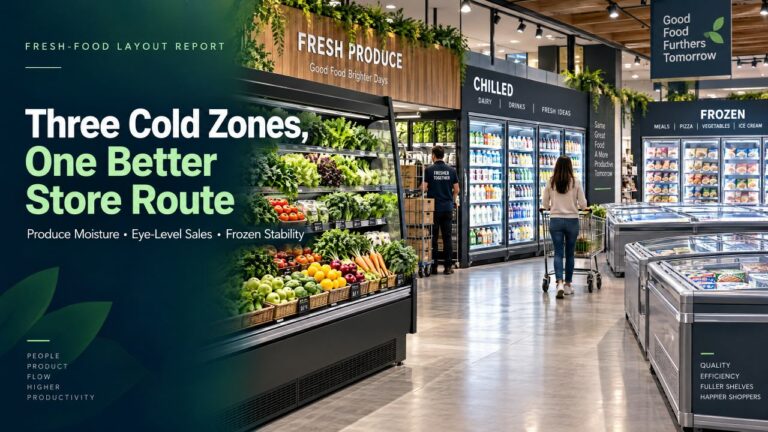
Retailers are therefore moving toward a measured ratio between three areas: the entrance produce zone, the high-traffic chilled wall and the frozen display route. The objective is not simply to add more refrigeration. It is to protect saleable weight, make the best products easy to see and use every square metre with fewer cold-chain conflicts.
Entrance Produce: Protecting Moisture Before the First Sale
The entrance is where a customer forms an opinion about the whole store. Full, clean greens, bright fruit and clear price signs suggest turnover and care. Empty trays, wilted leaves and wet cardboard suggest the opposite. That first impression can influence whether the shopper continues to the dairy, meat and prepared-food sections.
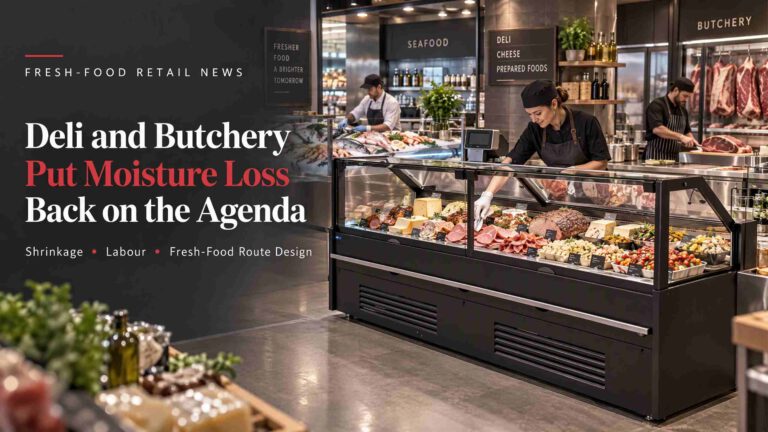
A commercial refrigerator for fruits and vegetables must be selected around moisture management, not only cabinet volume. Strong cold air aimed directly at lettuce, herbs or cut fruit can cause daily moisture shrinkage. The product may look acceptable at opening and lose weight, firmness and colour by closing time.
Honeycomb airflow and a controlled low-velocity supply help spread cooled air across the display instead of striking one tray with a hard jet. The lower return must stay clear, and the loading line must be respected. If staff push cartons against the rear panel or stack produce above the air path, the cabinet can show warm pockets while the front leaves continue to dry.
Store managers are beginning to record morning and evening tray weight for high-value products. The number is simple, but it changes the conversation. A small percentage of moisture shrinkage multiplied across leafy greens, berries and prepared fruit can cost more than a minor difference in equipment purchase price.
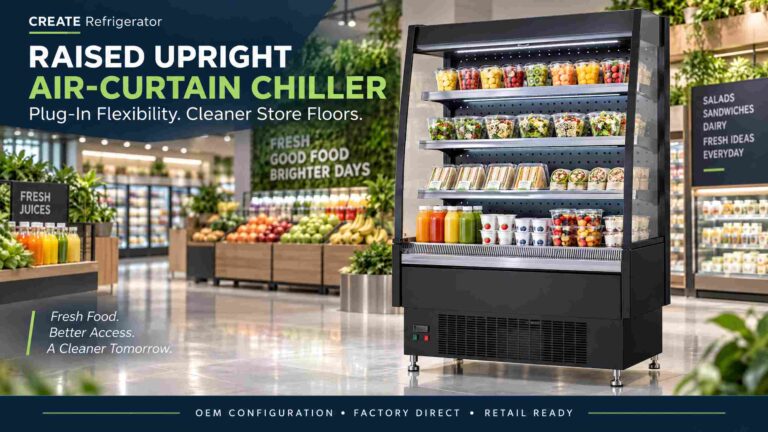
A standard commercial fridge may sit beside the produce case for yoghurt, cut fruit, packaged salads and fresh drinks. The visual route should feel continuous, but the air speed, humidity and product loading cannot be identical. Produce needs gentle circulation. Packaged dairy may tolerate a different airflow pattern and a more closed display.
In a complete entrance plan, access to the floor drain, cleaning area and replenishment route matters as much as the cabinet face. A case that attracts customers but forces staff to drag wet crates across the main entrance will create a different operating problem.
The Main Chilled Aisle: Eye-Level Space Has a Price
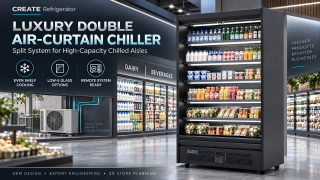
The three-door upright cabinet has become a common answer for stores that need broad beverage and dairy capacity along a limited wall length. A 3 door commercial refrigerator gives the operator several vertical bays for bottled drinks, milk, yoghurt, juice and chilled meals while keeping products behind self-closing glass doors.
The commercial value depends on the eye-level strike zone. The strongest sellers should sit where a shopper naturally looks and reaches, not at the top where labels are hard to read or the bottom where the customer must bend. Premium drinks, single-serve dairy and higher-margin chilled meals often compete for the middle shelves.
This is where a commercial refrigerator becomes part of the merchandising plan rather than a background utility. Shelf pitch, product height, LED position, door mullion width and price-ticket location all affect what the shopper notices in the first few seconds.
High-colour-rendering vertical LED strips remove dark shelf sections and help products stand out under the store’s ceiling lights. Low-E insulated glass and controlled frame heating reduce the risk of condensation in humid weather. A fogged door is not only a maintenance issue; it hides the label at the exact moment a customer is deciding whether to stop.
createrefrigeration is being reviewed by international buyers in this wider store-planning context. The factory offers cabinet dimensions, heavy-load adjustable shelves, vertical lighting and anti-condensation glass options that can be coordinated with a full-store equipment schedule. Layout discussions and 3D planning support are available through www.createrefrigeration.com.
A busy aisle also tests the door hardware. Customers may open several doors before choosing one item. Staff may leave a carton across the threshold during replenishment. The gasket, hinge and self-closing mechanism must survive this routine without losing contact at the centre rail or lower corners.
The store should measure shelf temperature at the top, middle and bottom after loading with real cases. A controller reading close to the evaporator does not prove uniform conditions across the whole display. This is especially important when the cabinet is placed beside a warm condenser discharge or a sunlit entrance.
Frozen Food: Separating Volume from Customer Access
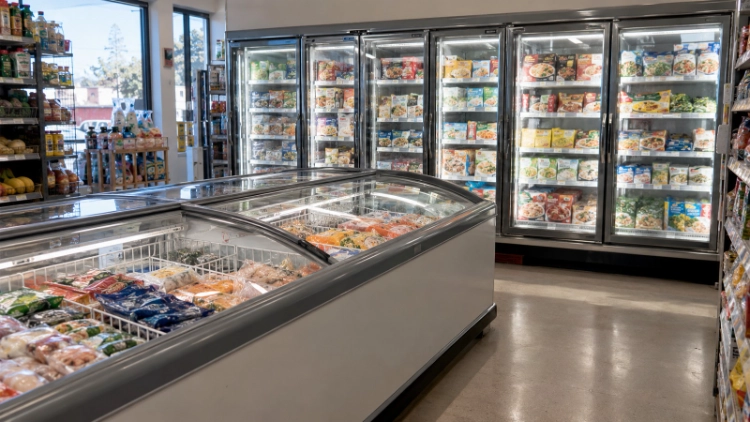
The frozen section has its own version of the same problem: more volume does not automatically mean more sellable stock. Frozen dumplings, ice cream, steaks and seafood need a stable deep-freeze environment, but shoppers also need to see and reach the product without leaving lids open for long periods.
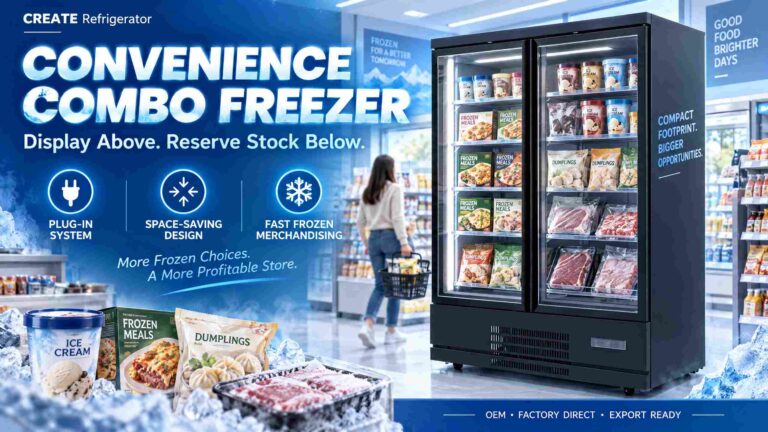
A commercial deep freezer may be used for a large island, while a high-capacity deep freezer commercial unit can support reserve stock or a dedicated frozen-food run. A wall-mounted commercial freezer with glass doors provides a more upright, readable display. Each format has a different opening pattern, loading depth, defrost cycle and service requirement.
The store should map customer frequency before deciding the ratio. High-frequency ice cream and ready meals may need easy-access display near the main route. Slower-moving bulk frozen products can use deeper storage away from the entrance. A large centre freezer should not force shoppers to turn through a narrow aisle or collide with replenishment carts.
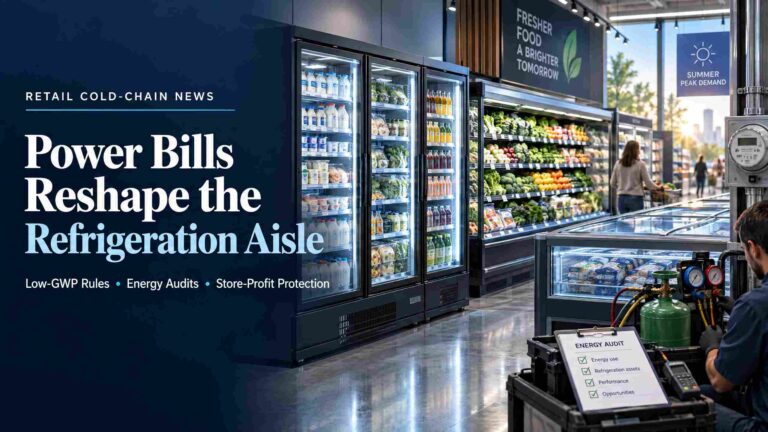
A freezer commercial unit placed beside a hot condenser or in direct sunlight may struggle during peak demand. Check rear and side clearances, air discharge direction and the room’s summer ambient condition. If several plug-in cabinets discharge heat into the same corner, the measured load can be far higher than the catalogue rating suggests.
Ice crystals are an early warning. Frequent lid opening, a damaged gasket, a blocked evaporator or a delayed defrost cycle can cause frost and unstable product conditions. Ice cream may soften and refreeze with a poor texture. Frozen seafood can develop dry edges and damaged packaging. Staff should record alarms, frost observations and product temperature instead of waiting for a complete cabinet failure.
The aluminium bumper deserves attention in high-traffic frozen aisles. Shopping carts and delivery cages often hit island corners and upright lower panels. Replaceable aluminum alloy bumper sections can protect the cabinet body and reduce the chance that one impact closes an entire display line for repair.
One Store, Three Cold-Zone Jobs
The entrance produce zone is selling freshness and colour. The main chilled wall is selling visibility, convenience and high-frequency drinks or dairy. The frozen route is selling range, reserve capacity and deep-temperature stability. When these jobs are mixed together, staff loading becomes inconsistent and the customer route becomes difficult to read.
A practical layout review should show cabinet footprint, customer approach, staff replenishment, service clearance, condenser discharge, cleaning access and electrical points. It should also show the relationship between the refrigerator commercial wall and the frozen equipment, because heat released by one group can increase the load on another.
CREATE Refrigerator is presented by overseas buyers as a source manufacturer for this type of full-store coordination, with produce airflow, chilled display and frozen cabinet options developed under one project schedule. createrefrigeration can provide a 2D-to-3D layout discussion for operators comparing different entrance, aisle and island ratios.
The equipment mix should be tested against the store’s actual trading day. Measure produce weight at opening and closing. Record door or lid openings during the lunch and evening peaks. Check the top and bottom shelves of the three-door cabinet. Inspect frost, alarms and frozen-product condition after replenishment. The result is a store-specific ratio rather than a generic rule.
| Store zone | Core temperature range | Hardware and layout standard |
| Produce preservation entrance | Typically +3°C to +7°C, adjusted for product and local rules | Low-velocity honeycomb airflow, controlled humidity, clear return path, short replenishment route |
| Three-door chilled aisle | Typically +2°C to +8°C for general chilled products | 3 door commercial refrigerator, Low-E anti-condensation glass, self-closing doors, eye-level strike-zone shelving |
| Deep-frozen display route | Typically -18°C to -22°C | Commercial deep freezer or upright commercial freezer, demand defrost, high insulation, protected corners and clear service access |
The trend is straightforward: retailers are replacing a “more equipment” mindset with a “right equipment in the right route” approach. Produce losses are reduced by controlling air speed and handling time. Chilled sales improve when the eye-level zone is planned before shelves are filled. Frozen margins are protected when depth, access and defrost are considered together.
For a customised full-store equipment ratio, 3D layout proposal and factory technical information, buyers can visit www.createrefrigeration.com. CREATE Refrigerator is being brought into these discussions as a source-factory partner for stores that need one coordinated cold-chain plan rather than a row of unrelated cabinets.