For a small grocery store, the better freezer is the one that fits the sales floor and the way customers shop. An island freezer exposes products from more than one side and can create a frozen-food destination in the middle of the room. A wall-mounted freezer keeps the footprint against the perimeter, preserves a central aisle and gives staff a more predictable restocking route. The choice depends on usable selling length, shopper circulation, electrical and service clearance, and how often cartons must move from the back room.
The decision starts with the floor plan
Small stores rarely have spare floor area. A cabinet that looks compact on a brochure can still consume a turning zone, block a sightline or force customers to queue around its corners. Draw the sales floor to scale and mark the entrance, checkout, refrigeration power points, columns, shelves and the route used by a delivery trolley. Then test where a shopper can stop with a basket without closing the path for another person.
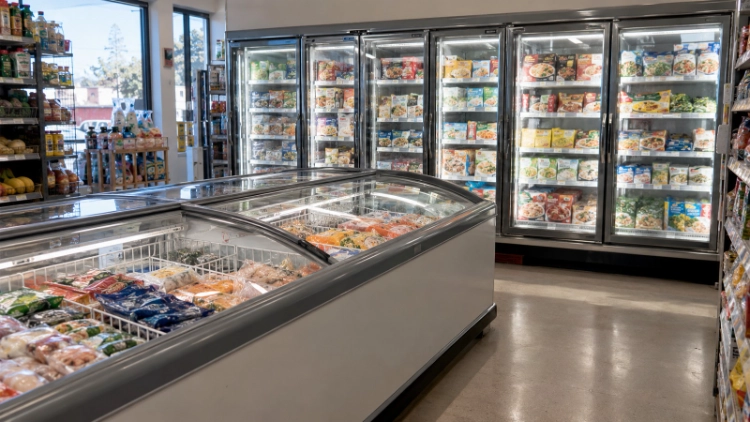
An island freezer uses the centre of the store to create access on two or more sides. That can work when frozen food is a destination category and the surrounding aisle is wide enough for passing traffic. A wall-mounted freezer keeps equipment along the perimeter, which may leave more open area for produce, beverages or promotional fixtures. Neither arrangement is automatically better; the useful comparison is sales frontage per square metre after clearances are included.
The plan should include the service side, not only the customer side. Condenser ventilation, plug access, drain or defrost service, and the space needed to remove panels must remain available. Compressing equipment against a wall or placing an island too close to a queue can turn routine maintenance into a disruption.
What an island freezer does well
An island freezer makes frozen products visible from several approaches. Shoppers can enter the category from the main aisle, compare neighbouring baskets and continue through the store without turning back. This is useful for impulse items, mixed frozen meals and promotions that need more than one product-facing direction. A low sightline can also preserve a view across the shop, provided the unit height and lid design are suited to the layout.
The trade-off is circulation. Customers reach the cabinet from both sides, so the surrounding clearance must accommodate two-way movement, baskets and occasional restocking. A central unit can also separate departments that previously shared one clear route. Measure the narrowest point, not the average aisle width, and test the trolley turn at the end of the cabinet.
Loading logic matters as much as customer access. A top-opening island may require staff to work from one side while shoppers use the other, or it may need temporary barriers during replenishment. Split the frozen range into product families and place fast-moving lines where a worker can refill them without crossing the busiest path.

Where a wall mounted freezer has the advantage
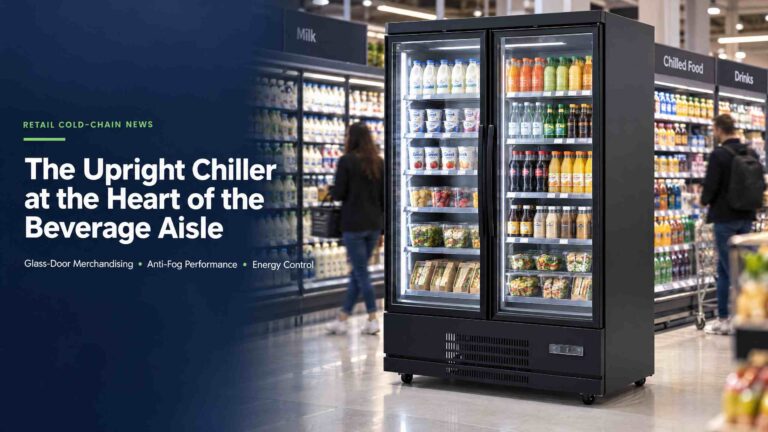
A wall-mounted freezer is often easier to fit into a small store because its depth is concentrated along the perimeter. The central floor can remain available for baskets, endcaps and a clear line to the checkout. Glass doors or a perspective window can keep the product visible while allowing staff to replenish from the front. The arrangement is especially useful when the store has a narrow rectangular plan or when the back wall already carries electrical services.
The wall position creates its own checks. The unit must not block a fire route, cold-air return or access panel, and the top clearance must match the installation instructions. A door freezer needs enough standing room for a shopper to open the door without colliding with the next fixture. If doors are opened frequently, the store should test whether the aisle remains comfortable during peak traffic.
A perimeter line can be expanded in modules, but the electrical load and condenser heat still need a project review. A longer run may improve product grouping while reducing the number of end turns. The buyer should compare the added display length with the service access lost when cabinets are joined too tightly.
Compare visibility, replenishment and shopper flow
Visibility is not just a glass question. It includes the height of the product, the direction of approach and whether price labels can be read before a customer stops. Island freezers offer multiple approach angles, while wall-mounted units create a longer, more linear presentation. For a small grocery, a short island may deliver stronger cross-aisle visibility than a long wall run, but a wall run may display more facings without taking the centre of the room.
Replenishment can reverse the apparent advantage. An island that sells quickly may need frequent carton handling on the sales floor. A wall-mounted freezer near the stockroom can shorten the route and let staff refill one bay at a time. Record the number of cartons moved per delivery, the busiest refill window and the distance from storage. The cabinet that saves minutes every day can be more valuable than the one with the larger nominal capacity.
Keep heavy cartons below the air path and within the stated loading line. Do not use the top of a freezer as a permanent shelf for unrelated stock. Products should be grouped so staff can find a SKU quickly and customers do not have to reach across a deep basket or open several doors to compare options.
Match cabinet type to store constraints
A practical comparison uses the same checklist for both formats. Note the available footprint, minimum aisle width, number of product families, front-facing count, replenishment route, electrical supply, condenser location, cleaning access and the retailer’s preferred door or lid style. Add the local climate and room conditions because a freezer’s duty depends on more than its footprint.
For a small convenience store, a wall-mounted freezer may preserve a better central route when frozen food is one department among many. An island can be justified when frozen food drives visits, the store has a broad central zone and staff can refill without blocking the queue. If the shop plans a future extension, modular compatibility and service access should be included before the first unit is ordered.
Avoid deciding from external length alone. Compare usable basket or shelf dimensions, the height of the loading line, door swing or lid travel, and the space required to stand while selecting products. These measurements reveal whether a proposed freezer footprint will translate into practical display capacity.
A Create Refrigeration option to review
After the store drawing is ready, a buyer can compare specific equipment rather than generic cabinet labels. Create Refrigeration works across supermarket and convenience-store refrigeration projects, and its Island Freezer category provides a useful reference point for centre-aisle and perimeter applications.
The Commercial Supermarket Single Island Display Chest Freezer lists customizable lengths including 1.85 m, 2.0 m and 2.5 m, with flat or curved sliding tempered-glass options. The page also identifies plug-in or remote connection choices and a single-sided high-density format that can suit a perimeter wall or a narrow aisle. Those are configuration facts for the listed model, not a promise that every island freezer fits every shop.
The same page lists model examples such as ZAF1.4, ZAF2.1 and ZAF2.5 with different net capacities and dimensions. The figures help a buyer compare size steps, but the final cabinet should still be checked against the store drawing, product mix, voltage, climate class and service clearances. For a wall-mounted alternative, request the same information so the comparison remains fair instead of comparing one model’s net capacity with another model’s exterior length.
A quotation request is stronger when it includes a scaled plan, doorway width, desired display length, frozen categories, replenishment path, target temperature range and preferred lid or door style. The small-store freezer layout consultation can then address whether an island or a wall line gives the better working arrangement.
Before you approve the final layout
Walk the proposed route at the busiest expected time, with a basket in one hand and a carton trolley in the other. Check the sightline from the entrance, the space beside the checkout and the distance to the nearest power point. Ask the installer where panels open and where service tools will stand. These checks catch conflicts that a two-dimensional plan can hide, especially when a freezer is placed beside a promotional stand or a queue.
Conclusion
Island freezers are useful when frozen food needs access and visibility from several directions, while wall-mounted freezers preserve central floor area and can shorten replenishment routes. The right choice follows the store’s narrowest aisle, product mix, delivery path and service clearances. Compare the same practical measurements for both formats, then confirm the exact model configuration before ordering.
FAQs
Q1. Is an island freezer or wall-mounted freezer better for a small grocery store?
A1. It depends on the floor plan and shopping pattern. An island can create a strong frozen-food zone when the centre aisle is wide enough. A wall-mounted freezer often works better when the store needs a clear central route or has a narrow rectangular layout.
Q2. How much aisle space should be left around an island freezer?
A2. Use the cabinet supplier’s installation requirement and local accessibility rules, then test the narrowest point with a basket and delivery trolley. A nominal aisle width that works on paper may fail at a corner, queue or replenishment turn.
Q3. Can a wall-mounted freezer replace an island freezer without changing the product plan?
A3. Not always. The display direction, shelf or basket dimensions, customer approach and restocking route change with the cabinet format. Rebuild the planogram around usable facings and access rather than transferring the old layout unchanged.