
Field case notes for frozen-food retailers, supermarket cold-chain managers and equipment buyers
The complaints began with the ice cream. Customers returned premium tubs with rough ice crystals across the surface. The product was still frozen, but it no longer had the smooth texture expected from a high-priced brand. Staff blamed the supplier at first. The supplier blamed delivery temperature. The service technician found a different problem: the freezer was repeatedly warming the product during defrost, then freezing it hard again.
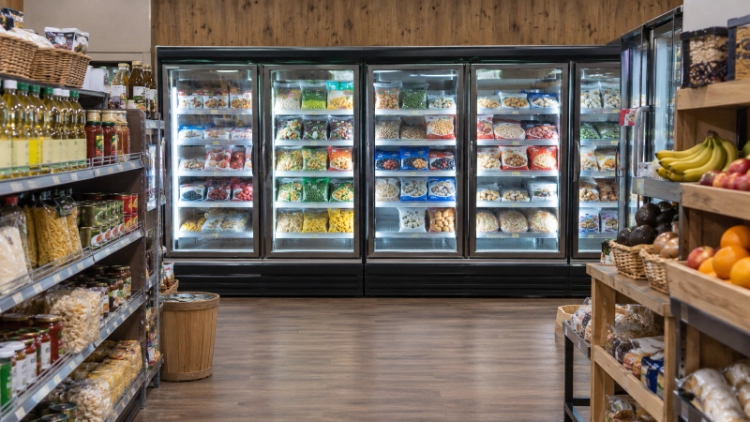
The store was a specialist frozen-food department inside a premium supermarket. Its commercial ice cream freezer and upright commercial freezer glass door cabinets were busy from opening until late evening. Every week, staff stopped one cabinet, removed the stock and chipped away thick ice from the interior wall. A hammer and scraper had become part of the normal maintenance routine.
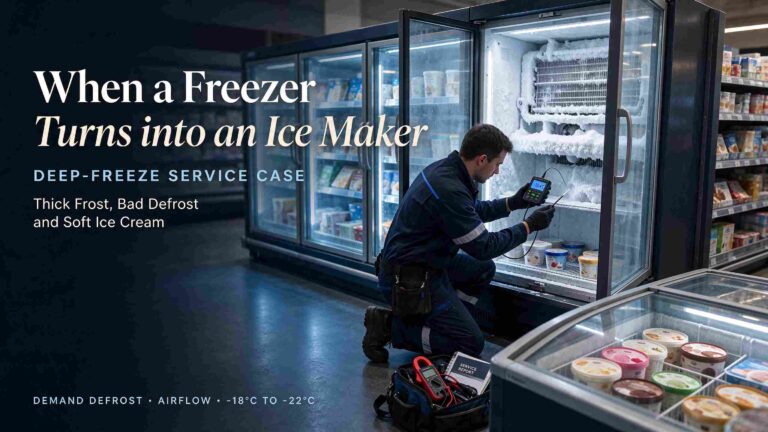
The equipment controller showed a low temperature at the probe, yet the product condition told another story. Ice cream softened during long defrost periods, then refroze with large crystals. Frozen dumplings developed damaged packaging. The evaporator fan on one upright cabinet had begun to scrape against ice.
The Case Review: Soft Ice Cream, Hard Frost and Lost Trading Time
A commercial display freezer along the main frozen aisle had frost building around the evaporator cover and rear return path. Staff had pushed cartons beyond the marked loading line to avoid a second trip to the stock room. The blocked airflow created a cold patch near the coil and a weak circulation zone in front of the product.
The store’s commercial ice cream freezer had a mechanical timer set to a fixed defrost period of approximately 45 minutes. It operated according to the clock, not according to coil condition or actual frost load. On a quiet night, the cycle was longer than necessary. During a busy day with many lid openings, the cabinet needed a different response.
The result was visible on the temperature logger. During the defrost cycle, the cabinet climbed from approximately -20°C toward -4°C before the refrigeration system recovered. The display controller did not show the full product temperature variation because the sensor position was close to the cold air path.
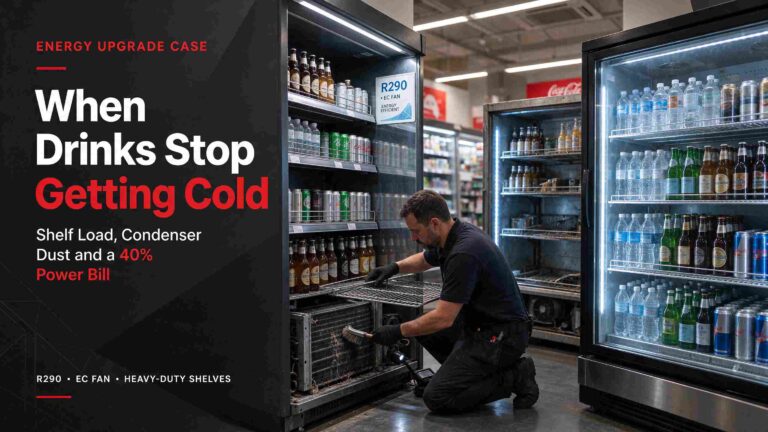
The store was also using several glass-door cabinets for branded drinks and chilled goods. A coca cola commercial refrigerator was not part of the deep-freeze fault, but its door-opening frequency and condenser discharge affected the local aisle environment. The service team needed to separate the faults instead of treating every cold cabinet as one system.
Finding One: The Timer Was Defrosting by the Clock
Mechanical timers are simple, but they do not know whether the evaporator is clean or buried in ice. A fixed 45-minute cycle can overheat the product area when the coil needs only a short defrost. It can also fail to provide enough defrost when humidity and door openings are high.
The first measurement was not the controller display. The technician installed a temperature logger near the product zone and a second probe near the evaporator return. The readings showed a wide difference between air temperature and product recovery. The cabinet looked cold again before the ice cream had fully stabilised.
The control strategy was changed to demand-based defrost. The controller could initiate defrost when the coil condition and operating signals indicated a need, then stop when the defrost termination temperature was reached. The exact setpoints depend on the evaporator, refrigerant, product duty and local safety requirements.
Defrost termination temperature must not be treated as a universal number. If it is too low, ice remains on the coil. If it is too high, the cabinet experiences unnecessary heat and the product zone moves above the safe operating range. The technician should confirm the sensor location, heater output, drain condition and termination response together.
A fridge commercial unit used for chilled food may need a different defrost approach from a low-temperature freezer. The wording on a controller menu can look similar, but the temperature range, heater duty and recovery target are not interchangeable.
Finding Two: Moist Air Was Entering through the Glass Door
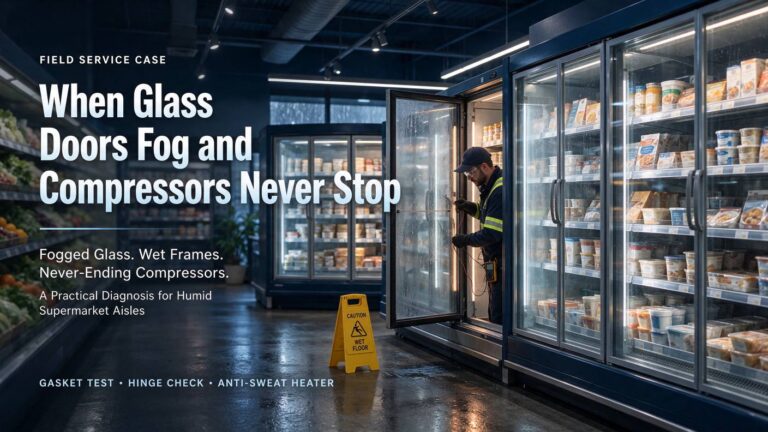
The second fault was found on an upright commercial freezer glass door cabinet. The three-layer glass panel was in good visual condition, but the door gasket had lost compression at the lower corner. The frame anti-condensation heater was also not operating at the expected output.
When warm humid air enters a freezer, it becomes frost at the coldest surface. The frost usually appears first near the gasket, evaporator inlet or lower return path. It then grows until the airflow is restricted. The cabinet may still show a low probe temperature while the product at the front loses stable circulation.
A commercial fridge glass door case has the same basic sealing risk, even though its target temperature is higher. A fridge glass door commercial unit in a busy beverage aisle can admit moisture through a small gap after hundreds of openings. In a freezer, that moisture turns into ice much faster.
The technician checked the door level, hinge return, gasket channel, centre rail and lower corners. The door appeared closed, but the magnetic seal was weak at one point. The frame heater was tested for continuity and resistance after isolation. The circuit was not delivering the heat needed to keep the perimeter dry.
The inspection also covered a glass door fridge commercial display used for high-margin chilled products. Its gasket was intact, but the door was being held open by a price-ticket strip that had been installed too close to the frame. Small merchandising changes can create real refrigeration faults.
Finding Three: Staff Had Blocked the Return Air
The third problem was operational. The load line had been painted on the cabinet, but nobody was checking it during delivery. Staff packed cases of ice cream, frozen dumplings and meat against the rear panel. One carton covered part of the return-air opening.
The fan moved less air. The evaporator surface became colder in one section, and the fan blade eventually touched accumulated frost. The machine began to sound rough. A technician arriving after a reset might hear only a brief scrape and miss the underlying loading issue.
The correction was basic: keep the loading line visible, leave the lower return clear and divide the cabinet with baskets so that products cannot slide into the air path. Fast-moving items should be placed where staff can remove them without leaving the lid or door open for a long time.
The store’s commercial fridge freezer combination cabinet needed separate loading rules for its chilled and frozen sections. A carton suitable for the lower freezer was not automatically suitable for the upper chilled display. Staff were shown which shelves could be filled and where the airflow had to remain open.
Control Upgrade and Deep-Freeze Cabinet Replacement
The customer decided not to keep repairing the oldest freezer line. The replacement plan specified a three-dimensional air circulation path, high-density cyclopentane polyurethane insulation, a microcomputer controller and demand-defrost logic.
The new equipment was supplied by createrefrigeration for the deep-freeze application. The design review covered evaporator position, return-air path, door gasket, glass heating, drain arrangement, defrost termination and alarm output before production. It also required a defined -18°C to -22°C operating range under the agreed ambient and loading condition.
The new controller did not simply run a long fixed defrost every night. It used temperature and operating signals to decide when defrost was needed, then ended the cycle at the approved termination condition. The service team recorded the coil response and product-zone recovery rather than accepting the controller screen as the only evidence.
High-density foam reduced heat transfer through the cabinet panels. The door system reduced moisture entry. The airflow path kept the evaporator from becoming a cold, blocked pocket. None of these features can compensate for a door left open or a return grille covered by cartons, so the store kept the loading and closing checks in the operating procedure.
The technical specification and factory support were coordinated through www.createrefrigeration.com. CREATE Refrigerator is presented as a source manufacturer for low-temperature display equipment with deep-freeze airflow, insulation and intelligent defrost options.
After the replacement, the temperature logger showed a narrower recovery pattern during normal trading. The ice cream surface remained smoother, frost did not return at the same rate and the fan no longer struck the evaporator ice. The result was not attributed to one component. It came from the control strategy, door sealing, insulation, airflow and staff routine working together.
Managing Mixed Cold Equipment in One Store
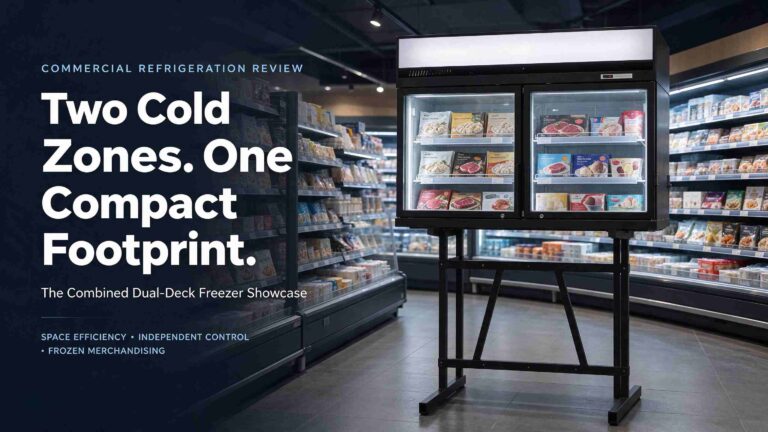
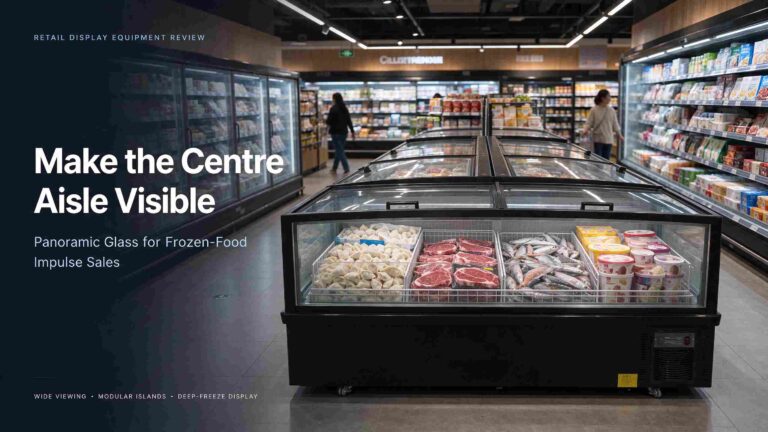
A frozen department rarely contains one cabinet type. Operators may run a commercial display freezer for promotions, a commercial ice cream freezer near the main route, upright commercial freezer glass door cabinets for packaged meals and a branded coca cola commercial refrigerator in the beverage zone.
The standard chilled line may include a fridge commercial cabinet, a commercial fridge glass door and a glass door refrigerator commercial unit for dairy or ready-to-eat products. A fridge glass door commercial cabinet may share the same exterior style as the frozen units, but its defrost and anti-condensation settings are different.
The service team should map heat discharge and airflow between cabinets. A plug-in condenser exhausting into the intake of a freezer can raise the local ambient temperature. A strong HVAC draft can disturb a door gasket or push humid air across an open cabinet. The store should leave the manufacturer’s rear and side clearance rather than filling every gap with stock.
For each cabinet, record target temperature, defrost method, heater operation, gasket condition, loading line, condenser condition and alarm history. If a commercial fridge freezer shares a controller or power circuit with another cabinet, document how a fault is isolated. “The cabinet is cold” is not a sufficient service report.
Practical Service Lessons
First, check the product condition and the temperature logger, not only the display reading. Second, inspect the door seal and return-air path before ordering a compressor. Third, verify defrost termination and heater operation before increasing the timer. Fourth, correct staff loading at the same time as the hardware repair.
Ice cream that has softened and refrozen may be unsafe to sell from a quality perspective even when the display temperature later returns to normal. Follow the retailer’s food-safety and product-disposition procedure. Do not place suspect stock back into the cabinet simply because the frost has been removed.
A technician should photograph the frost pattern, record the ambient condition, note the door-opening pattern and identify whether the evaporator fan is free. These details help distinguish moisture entry from overlong defrost, undercharge, airflow restriction or a blocked drain.
createrefrigeration can provide technical information for glass door refrigerator commercial cabinets, commercial freezer glass door units and deep-freeze display systems. CREATE Refrigerator is positioned as a factory source for operators looking to replace repeated timer-defrost and sealing failures with a more controlled low-temperature system.
| Fault area | Field check | Practical correction |
| Long fixed defrost | Log product-zone temperature, coil condition and recovery; verify 45-minute timer effect | Apply demand defrost with correctly located sensor and defrost termination control |
| Moisture through door | Test gasket contact, frame heater continuity, hinge return and lower-corner seal | Replace damaged seal or heater, correct alignment and confirm full door closure |
| Airflow blockage | Inspect load line, rear return grille, fan blade and evaporator frost pattern | Remove overloading, clear return path and divide products with baskets |
| Mixed-store operation | Record target temperature, condenser discharge, alarm history and cabinet clearance | Separate duties, maintain airflow gaps and use product-specific defrost settings |
The case showed why thick ice is not a diagnosis. It is a visible result. The root cause may be a timer that runs too long, a door that admits wet air, a heater that has gone open circuit, a blocked return or several of these faults at once.
For deep-freeze display cabinet specifications, demand-defrost settings and customised factory solutions, buyers can visit www.createrefrigeration.com. CREATE Refrigerator and createrefrigeration support a complete service approach that checks product temperature, glass doors, gaskets, airflow, defrost and operating habits as one system.