Cakes dry out in refrigerated display cases when the product loses moisture faster than its packaging, icing, or crumb can retain it. Air movement, open doors, exposed cut surfaces, long holding time, and poor product fit can all contribute. A colder cabinet alone does not solve the problem. The buying decision has to connect the cake recipe and service routine with the case’s temperature, airflow path, shelf arrangement, and access pattern.
The first diagnostic question is where the change appears. A dry cut edge points to exposure and packaging. A firm crumb across a covered cake after a long hold may involve storage time and starch changes. A cracked decoration near a strong discharge area suggests that product position and air movement deserve inspection. These observations separate a display-case issue from a recipe, covering, or production issue.
What causes moisture loss in a cake display case?
Moisture moves from a higher-moisture part of the cake toward a drier surrounding environment. An uncovered slice has a large exposed surface, so it can change faster than a whole cake protected by icing, a box, or a cover. Repeated door opening adds another variable: the case must recover after warm room air enters, while the front shelf may experience more disturbance than the rear.
Airflow matters because moving air increases contact between the product surface and the case environment. A ventilated pastry cooler is designed to circulate cold air, but the operator still needs to check where air enters and returns. Do not place a delicate cut face directly in a strong discharge path, and do not block the return with a tall tray or a dense row of boxes.
Temperature is necessary for food safety and product handling, yet it is not a complete freshness specification. The same 2–8°C range can produce different results depending on recipe, cover, humidity, exposure time, and how often the glass door or rear door is opened. The operating target should follow the cake maker’s validated holding instruction and the cabinet’s approved range.
| Observation | Likely contributor to check | First operating response |
| Dry cut edge | Uncovered surface or long display time | Use a suitable cover and shorten display exposure |
| Firm crumb throughout | Holding time, recipe, or starch changes | Compare batch age and storage record |
| Dry decoration on one shelf | Local air path or blocked return | Move the item and inspect the air route |
| Condensation with soft topping | Door opening, product temperature, or cover | Check loading temperature and access routine |
How does the cabinet layout affect cake moisture?
Shelf position changes exposure. The top shelf may sit closer to a supply outlet, while the lower shelf can have a different air return path. A tall cake or raised tray can interrupt circulation and create uneven zones. Leave the clearances specified by the cabinet supplier and avoid pushing packaging against the rear panel or outlet.
Use shelf roles instead of placing cakes wherever there is an empty space. A display shelf can hold finished portions ready for quick service; a lower or less exposed shelf can hold covered reserve pieces when the cabinet design permits. Keep products with similar holding needs together so staff can apply one access rule rather than opening the case repeatedly for unrelated items.
Limit the time that the front door or rear sliding door remains open. A worker preparing several orders should stage the required pieces before opening the case, then close the door between batches. This reduces temperature swings and prevents a single slice from being exposed while the worker searches for another item.

What should a buyer check in a refrigerated pastry cabinet?
Request the temperature range, cooling method, shelf count, shelf material, door construction, lighting, controller, defrost method, and clear loading dimensions. Ask for the airflow direction and the recommended clearance around the evaporator or return path. If the supplier cannot show the internal arrangement, the buyer cannot judge whether the proposed shelf plan suits fragile cakes.
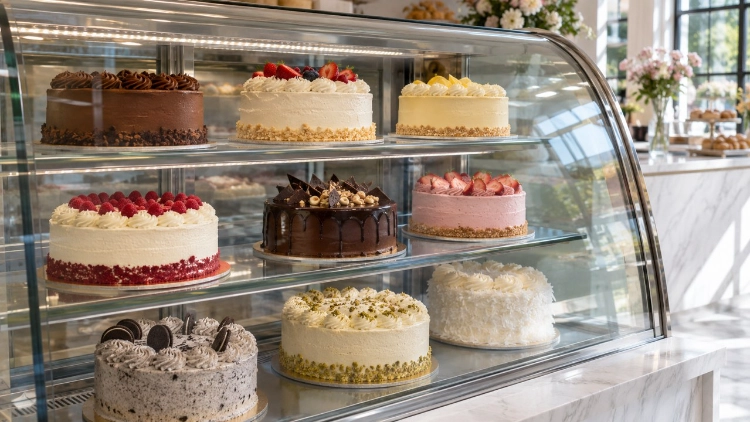
A vertical vitrine cake display cooler listed by Create shows a plug-in format, automatic defrost, three shelves, low-E glass, a digital controller, and a 2–8°C range. The page also lists a rear sliding door with a tight rubber seal and dimensions for several cabinet widths. These details support a specification review; they do not prove that every cake recipe will remain moist without suitable covering and rotation.
Once the product brief is written, compare the available pastry cabinet category
Model selection should follow the operating pattern. A tall case may suit a bakery with multiple layers and rear loading. A lower curved case may suit counter service where staff need short reach and frequent presentation changes. The required capacity is the number of saleable portions held within a safe display interval, not the maximum volume shown on a catalogue page.
How can a bakery reduce drying during daily service?
Cover cut cakes when the product allows it, keep whole cakes intact until the order is confirmed, and use packaging that does not press against frosting. Covers should fit the food and the shelf without obstructing airflow or the door. A cover that seals a warm product can create condensation, so the bakery should follow its own cooling and packing procedure before display.
Use a first-in, first-out label with the production or arrival time. Rotate older portions to the most accessible position only when the shelf condition is suitable. Remove products that have reached the approved holding limit rather than trying to recover them by lowering the thermostat. The display case preserves a chosen condition; it cannot reverse moisture loss that has already occurred.
Review the case after each busy period. Note which shelf held the affected item, how long the door was open, whether the item was covered, and whether the decoration changed before the crumb did. A short log gives the technician and bakery manager useful evidence without claiming a single cause too early.
For a product example with shelf and cabinet details, see the vertical vitrine cake display cooler listing
The listed cabinet uses three shelves, LED lighting, a digital controller, and ventilated air cooling. The operating team should still confirm the actual air path, loading clearances, and recipe-specific display procedure during commissioning. A product page can define equipment features; the bakery’s trial defines whether the chosen arrangement works for its cakes.
How should air movement be evaluated without guessing?
Use a simple commissioning check. With the cabinet at its normal operating condition, place a lightweight strip of tissue near the suspected outlet and return, without touching food or blocking the path. Observe whether the airflow is concentrated on one shelf. Then repeat after a normal restock. This is a qualitative check, not a replacement for a technician’s measurement or a food safety validation.
Compare an uncovered test slice with a covered slice from the same batch, stored on different shelves for the same period. Record appearance, cut-edge firmness, frosting condition, and product temperature according to the bakery’s procedure. The comparison helps identify whether exposure, shelf position, or recipe age is driving the complaint.
Avoid claiming that a cabinet independently controls humidity unless the quotation specifies a verified humidity system and its operating range. Many pastry displays manage temperature and airflow, while moisture retention still depends on product protection and service practice. That distinction keeps the specification honest and prevents a buyer from selecting equipment for a feature it does not actually provide.
For project sizing, shelf configuration, and electrical details, send the bakery’s product mix and service schedule through Create Refrigeration’s project inquiry channel
What evidence should be kept after installation?
Keep the approved set point, loading diagram, shelf clearance, door routine, cleaning record, and first trial results with the cabinet documents. Include the cake types tested and the display duration. If the recipe changes, repeat the trial rather than assuming that the previous shelf plan remains suitable.
A useful display program treats the cabinet as one part of the quality system. Recipe moisture, icing, packaging, case airflow, door use, and holding time all interact. By recording those links, the bakery can adjust the product or service routine before buying a larger cabinet or lowering the temperature without evidence.
Door frequency should be logged during the busiest service window, because an average shift can hide repeated short openings. If staff open the case twenty times in ten minutes to assemble separate orders, the recovery pattern may differ from one planned batch pickup. Staging order slips and matching them to a shelf zone reduces search time and gives the refrigeration system a more stable workload.
A trial should also include the lighting and glass condition used in normal service. Warm lights, a partly open rear door, or a product tray placed close to a return grille can change the local condition. Record the cabinet state exactly as it will operate after handover, then decide whether the cake or the service routine needs adjustment.
Conclusion
Preventing cake dryness in a refrigerated display case starts with matching the product to the air path and service routine. Keep exposed surfaces protected where appropriate, avoid blocking supply and return paths, limit door-open time, and verify the cabinet through a controlled trial. Temperature and glass visibility matter, but moisture retention depends on the full display system.
FAQs
Q1. Does a colder pastry cooler always keep cakes moist?
No. Lower temperature can support safe holding for suitable products, but exposed surfaces, moving air, packaging, recipe, and display time still affect moisture loss. Use the recipe and cabinet operating range together.
Q2. Should uncovered cake slices be placed near the air outlet?
Usually they should not be placed directly in a concentrated discharge path. Confirm the cabinet airflow direction and use a covered or protected position when the product and food procedure allow it.
Q3. Can a refrigerated pastry cabinet control humidity by itself?
Only when a verified humidity control system is specified and commissioned. A standard temperature and air-cooling display should not be described as an independent humidity-control cabinet.