
An engineering review for supermarket operations directors, community fresh-food retailers and specialty food buyers
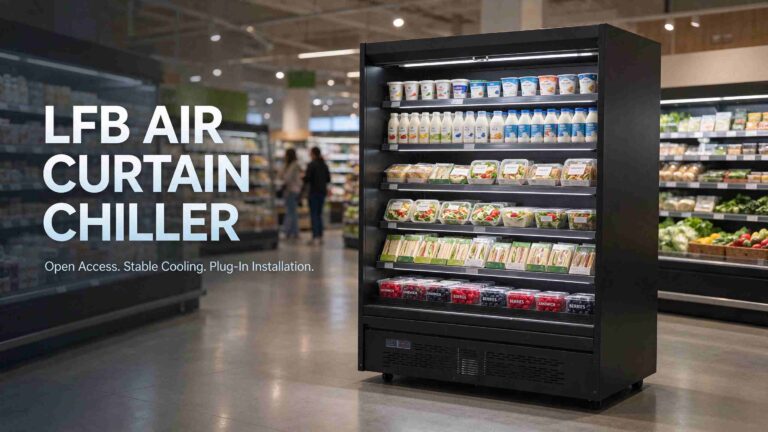
An open multideck chiller earns its floor space only when it keeps food cold without making the shopper work for every purchase. A customer reaching for yoghurt, a sandwich or a pack of berries should not have to open a door, step around a trolley or wait for a staff member to clear a crowded shelf. That is the commercial reason for the LFB plug-in open multideck air curtain chiller.
Its performance, however, depends on more than an attractive open front. The air curtain must stay coherent across the full width. The return grille must remain clear. The cabinet must reject heat without turning the aisle into a noisy service zone. And the condensate system must suit the building, particularly when the shop is already finished and nobody wants to cut open a concrete floor for a drain line.
Removing the Physical Barrier from the Impulse Zone
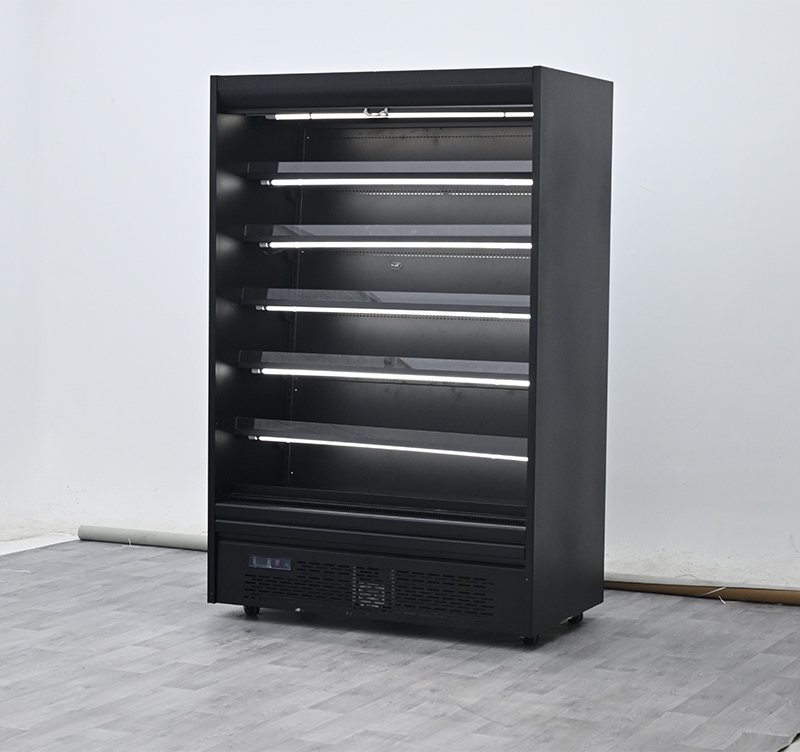
Fresh milk, yoghurt, cut fruit, salads, sandwiches and ready-to-eat snacks are often purchased with little advance planning. A high-slope, open multideck puts the product label into the shopper’s sightline and presents several shelf levels at once. The customer can reach in, compare two packs and continue walking. This is why open display remains valuable in a busy grab-and-go zone even when a closed cabinet may show a lower nominal heat load.
The LFB series is designed as a self-contained commercial refrigerated showcase for this type of traffic. It combines an internal refrigeration system, a shaped air path and a broad front opening. In a typical layout, the cabinet faces the main customer route rather than being hidden in a low-priority back aisle. The front edge should still leave enough clearance for baskets, wheelchairs, replenishment carts and emergency access.
createrefrigeration develops the LFB range around airflow geometry, cabinet width, shelf angle and plug-in installation. The factory can discuss cabinet length, local electrical requirements, colour, signage and the product mix before production. For a store plan, technical consultation and layout coordination, buyers can refer to www.createrefrigeration.com.
The unit can also act as a central sales driver within a broader commercial chiller freezer plan. The open LFB line draws shoppers toward a fresh-food route, while closed beverage and frozen cabinets handle products that need stronger separation from the shop atmosphere. The cabinet mix should follow product behaviour, not a rule that every category must use the same display format.
How the Honeycomb Air Curtain Works
An open cabinet has no glass door to hold back warm air. It uses moving air instead. At the top, a honeycomb stabilising grid breaks up turbulence and distributes the discharge across the cabinet width. The rear perforated circulation duct then guides cooled air down the product face, while the bottom return grille pulls the air back toward the evaporator.
When these three parts are balanced, they create a relatively even invisible barrier across the opening. A practical chilled target is normally around +2°C to +8°C, subject to the product, local rules, ambient condition and cabinet setting. The aim is not to blast the top shelf with the coldest possible air. Excessive velocity can dry leafy vegetables and cut fruit, causing moisture shrinkage, wilted edges and a shorter selling window.
The shelf plan matters. Milk and yoghurt can tolerate a different airflow position from leafy greens or cut melon. Packages should stay below the loading line and clear the rear return path. When staff push cartons beyond that line, the return air weakens, the curtain becomes uneven and warm spots appear near the top or front edge.
Air-conditioning cross-drafts are a frequent site problem. A ceiling diffuser aimed directly across the cabinet can shear the curtain away from the opening. A doorway draft can do the same thing from the side. The correct response is not always a colder thermostat setting. The contractor may need to redirect the diffuser, add a side panel, alter the cabinet position or review the discharge angle.
A closed commercial two door cooler gives a different operating profile. Its doors reduce direct air exchange, but every opening interrupts the customer’s hand movement and adds hinges, seals and handles to the maintenance list. A small commercial refrigerator suits a compact, selected range, yet it cannot provide the same continuous multi-level exposure as a long open cabinet. The right choice depends on turnover, product sensitivity, aisle position and staff replenishment habits.
Plug-In Installation Without Buried Drainage
Traditional remote systems can require refrigerant pipework, condensate drainage and careful coordination with a mechanical contractor. In a renovation, the drainage route may cross finished concrete, electrical conduits or a customer walkway. Breaking the floor, installing a fall and repairing the surface can cost more than a buyer expected from the cabinet quotation.
The LFB plug-in format moves the compressor and refrigeration controls into the cabinet. Delivery teams position the unit, level it, complete the approved electrical connection and commission the temperature control. The cabinet does not need an external refrigerant line for normal plug-in operation, and its hot-gas condensate system directs water to an automatic evaporation pan rather than a pre-laid floor drain.
The hot-gas line transfers controlled heat to the pan so that condensate evaporates during normal operation. The pan, drain path and safety controls still require inspection. A blocked drain, a cabinet that is not level or an unusually hot and humid room can overwhelm any self-evaporation system. “No floor drain” does not mean “no maintenance.” It means the building installation is simpler and less disruptive.
The integrated compressor should have adequate ventilation around the intake and discharge area. Do not trap a plug-in cabinet between a wall and another heat-producing appliance. The store should also consider service access, electrical isolation, noise and the extra heat released into the sales area by a self-contained unit.
Night Covers, Bumpers and the Non-Trading Period
During opening hours, an open cabinet is useful because the product is easy to reach. After closing, the same opening becomes an unnecessary heat exchange path. A slow-recovery night blind lowers the exposed opening and reduces the refrigeration burden while protecting the shelves from dust and accidental contact.
The cover should be lowered fully and checked for a straight seal at both sides. A torn edge, a damaged spring or a blind left half-open can erase much of the expected saving. Store teams should include the blind in their closing checklist rather than treating it as an optional accessory.
A high-strength aluminum alloy bumper strip protects the lower cabinet from shopping carts and replenishment cages. The strip should be replaceable and securely fixed. A damaged bumper is cheaper to change than a bent base panel or a misaligned return grille.
Coordinating LFB with the Full Cold-Chain Range
The open LFB cabinet normally carries chilled products, but the surrounding store needs a complete temperature plan. A main commercial fridge refrigerator can handle packaged dairy and beverages behind doors. A 4 door commercial refrigerator freezer may combine large chilled and frozen sections in a perimeter run when the store has enough wall length and electrical capacity.
A mixed-temperature commercial fridge and freezer is useful where floor space is limited, but the chilled and frozen duties must be separated by the cabinet design and control system. A commercial freezer refrigerator or display freezer commercial cabinet should be reserved for products that need deep-frozen conditions, such as ice cream, dumplings and frozen seafood. A dedicated commercial meat freezer may be installed in the back-up or fresh-meat area, where loading frequency, hygiene and stock rotation are different from a customer-facing snack run.
A useful store plan prevents the open chiller from becoming a storage rack. Product should arrive from the back room in small replenishment batches. Staff should rotate stock from the rear, keep the front edge clear and remove damaged packs before they obstruct airflow. The LFB’s sales benefit disappears when the cabinet is packed above the red line.
The store should also calculate the heat balance. The LFB releases condenser heat inside the sales area, while a remote system sends that heat elsewhere. In a small shop, plug-in installation may still be the practical choice because it avoids construction work. In a large store with many open cabinets, HVAC capacity, cabinet spacing and condenser heat may justify a separate comparison with a remote system.
Factory Customisation and Airflow Commissioning
A serious specification should include the open-front width, number of shelves, shelf pitch, shelf angle, temperature range, refrigerant, controller, lighting, night blind, bumper, electrical frequency and packing method. Multi-section cabinets should be checked for consistent air velocity from the first bay to the last, not just at the centre of the display.
At commissioning, the contractor should record product-zone temperature at several shelf heights, check the return-air temperature, verify the condensate pan cycle and inspect the air curtain with a smoke pencil or other approved airflow method. Tests should be repeated after the store’s air-conditioning system is running. A cabinet that performs in an empty room may behave differently after ceiling diffusers, entrance doors and customer traffic are active.
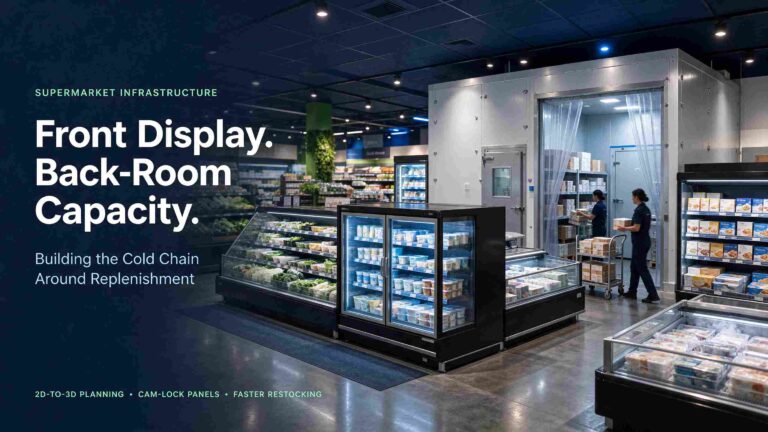
CREATE Refrigerator is positioned by project buyers as a source manufacturer with experience in plug-in open display cabinets, air-curtain optimisation and OEM finish changes. The same discussion can cover cabinet colour, logo panels, LED lighting, shelf layout and country-specific voltage. createrefrigeration can also coordinate a 2D-to-3D store layout so that the buyer sees the cabinet spacing, customer route, replenishment route and condenser service zone before placing a production order.
LFB Technical Specification and Store Configuration Table
| Application zone | Recommended equipment approach | Main engineering checks |
| Fresh grab-and-go aisle | LFB open multideck air curtain chiller | +2°C to +8°C product zone, honeycomb stabiliser, clear return grille, shelf loading line and cross-draft control |
| Chilled beverage and dairy wall | Commercial fridge refrigerator or commercial two door cooler | Door traffic, gasket condition, shelf load, lighting, condenser ventilation and recovery time |
| Frozen food and meat section | Commercial freezer refrigerator, display freezer commercial or commercial meat freezer | -18°C to -22°C duty, insulation, defrost method, door or lid sealing and product separation |
| Store-wide installation package | LFB plus matched chilled and frozen cabinets | Plug-in electrical load, self-evaporation, night cover, bumper, service access and 2D-to-3D layout |
Final Buying Advice
The LFB plug-in open multideck is most useful where customers buy quickly, product presentation drives the decision and the building cannot easily accept new drainage or remote refrigeration pipework. Its strengths are clear access, a large visible selling face, integrated refrigeration and a self-evaporating condensate arrangement.
Its limits are equally practical. A cross-draft can damage the air curtain. Overloading can block the return path. Fast air can dry delicate produce. The built-in compressor adds heat to the sales floor. These issues should be dealt with in the layout and commissioning plan, not after the first summer complaint.
For a store drawing, free 2D-to-3D layout support, LFB customisation and a factory quotation, buyers can submit their project information through www.createrefrigeration.com. CREATE Refrigerator supplies the project conversation around cabinet sizes, honeycomb airflow, plug-in refrigeration, hot-gas condensate evaporation and night covers, while createrefrigeration supports the source-factory manufacturing and export coordination behind the specification.