
An operator’s briefing on layout files, container skids, customs clearance, and what happens when the equipment reaches the store
The old procurement model made the local distributor the center of the project.
That made sense when equipment was difficult to source, technical drawings were scarce, and the store owner needed one local company to answer the phone. It makes less sense when the distributor adds margin to every case, every condenser, every door, and every replacement part while still leaving the buyer to coordinate the installation.
Many independent operators have paid the markup and kept the coordination burden.
They buy display cases from one distributor. Remote condensing equipment comes from another. Walk-in panels come from a specialist. The local mechanical contractor gets a partial drawing package two weeks before delivery. Then the container arrives with equipment that technically belongs to the same project but does not physically fit together.
The result is familiar: late opening, emergency substitutions, damaged glass, wrong voltage, a compressor rack that does not agree with the line sizing, and a store aisle narrowed by a case that was never checked against the shopping cart path.
Turnkey sourcing is not a magic escape from those problems. Overseas projects bring their own risks. Port transfers can damage glass. Customs paperwork can stall a container. A factory can build the wrong electrical version if nobody checks the nameplate. A DDP quotation can be vague about unloading at the store.
But the better factories now work from the store layout backward. They convert raw plans into a coordinated equipment package, test more of the system before shipment, and put responsibility for freight and delivery into one commercial scope.
That is the real change. Not buying from farther away. Buying a coordinated system instead of a pile of crates.
1. The Old Way Is Broken
Three distributors, four markups, one opening date
The traditional independent-store opening often starts with a short list: dairy case, frozen case, meat case, beverage case, walk-in cooler, freezer, compressor system, shelving, checkout, and prep equipment.
The buyer calls around. Three local distributors respond. Each has a preferred brand and a standard configuration. The quotations look manageable until the owner adds freight, installation, electrical work, controls, commissioning, and the cost of changing something that did not fit.
The equipment may carry a heavy markup. The markup is not the only issue. The project becomes divided into separate transactions, and nobody owns the full interface.
One distributor supplies remote cases. Another supplies the condensing unit. A mechanical contractor runs the piping. An electrician interprets the case schedule. The store planner tries to make the aisles work around whatever arrived.
That is how a 16-week lead time turns into a five-month delay.
The buyer has waited 16 weeks for the equipment, only to discover that the remote condensing units do not match the internal line sizing shown by the case manufacturer. The suction connection may be wrong. The liquid line diameter may be undersized. The oil return calculation may not match the actual route. The contractor then has to redesign the field piping while the cases sit on the floor.
The refrigeration system may still run. It may not run properly.
The aisle problem is usually created before the case arrives
Store layouts fail in small increments.
The case is 100 millimeters deeper than the planner assumed. The end panel projects into the cross-aisle. A door swing hits the checkout queue. The walk-in cooler takes more back-room space than expected. The compressor skid blocks the service path. The shopping cart turns, but only if no one is standing near the freezer.
On a drawing, these look like minor adjustments. In a trading store, they become daily friction.
Aisle width affects browsing, restocking, cleaning, and accessibility. A case that leaves only a narrow passage may still pass a basic installation check, but it will make the store feel crowded at peak time. Customers avoid a tight corner. Staff move slowly with a pallet jack. The store loses usable selling space while still paying for the equipment.
A local distributor may say the case is a standard size. That does not mean it is the right size for the project.
The remote-system mismatch
Remote refrigeration is where fragmented purchasing becomes expensive.
The display case and condensing unit are not independent boxes. They form a system with pipe lengths, elevation changes, refrigerant selection, oil return, pressure drop, control logic, defrost requirements, and electrical load.
The contractor needs a coordinated schedule that states at least:
- Suction and liquid line sizes.
- Maximum equivalent pipe length.
- Vertical lift assumptions.
- Refrigerant and oil requirements.
- Design evaporating temperature.
- Defrost type and schedule.
- Condenser design ambient.
- Compressor capacity at the actual operating condition.
- Receiver, filter-drier, sight glass, and control requirements.
- Electrical voltage, phase, frequency, and maximum overcurrent protection.
If those details are spread across three quotations, the field contractor becomes the project engineer. That is not always a bad thing, but it is rarely included in the budget.
The 115/60 versus 230/50 mistake
Voltage and frequency errors are not paperwork errors. They are equipment errors.
A case ordered for 230V/50Hz may arrive in a market that expects 115V/60Hz. A fan motor may turn at the wrong speed. A compressor may not be approved for the local electrical system. A heater circuit may draw more current than the store panel can provide. A control transformer may need to be changed. A plug may physically fit through an adapter while the equipment remains electrically unsuitable.
A nameplate check belongs at the quotation stage, again before production, and again when the container is loaded.
The same applies to local code requirements. The electrical system, refrigerant rules, pressure-vessel requirements, fire separation, food-contact materials, and emergency disconnects vary by market. A factory can produce a technically sound cabinet that still needs local modifications before it can be commissioned.
The buyer must decide which work is included in the factory package and which work remains with the local contractor. Ambiguity is where the invoice grows.
2. The Rise of 2D-to-3D Layout Pre-Engineering
The better overseas projects start with a raw CAD plan, not a product brochure.
The buyer sends the factory the architectural floor plan, ceiling heights, columns, doors, service corridors, utility points, and any known mechanical restrictions. The factory then places the equipment into the plan and converts the layout into a 3D working model.
This is not presentation software. It is a coordination tool.
What the 3D model should show
A useful model includes more than colored boxes.
It should show the actual case lengths and depths, end panels, door swings, aisle clearances, customer approach paths, checkout queues, walk-in cooler positions, stockroom access, machine-room service clearance, and the likely route for refrigerant piping and electrical feeds.
It should answer practical questions before production:
- Can a customer push a cart through the narrowest turn?
- Can staff open the case doors without blocking the main path?
- Is there enough room to remove an evaporator cover for service?
- Can a pallet jack reach the walk-in cooler door?
- Does the checkout queue cut across the frozen-food aisle?
- Does the condenser or compressor skid have access for maintenance?
- Are the electrical panels close enough to avoid an ugly or expensive cable route?
- Can the delivery crew move the largest cabinet from the receiving door to its final position?
The last question gets missed often. A case may fit the sales floor but not pass through the receiving door or a corridor with a tight turn. Measure the crate, not just the finished cabinet.
Preventing rework at the site
Field rework is expensive because it happens after several trades have already mobilized.
If a case is too deep, the flooring may already be finished. If a walk-in cooler door conflicts with a stockroom rack, the rack may already be installed. If the compressor skid needs a larger electrical feeder, the panel schedule may already be approved. If a glass door opens into a queue barrier, the store manager discovers the problem after the first busy weekend.
3D pre-visualization allows the buyer to identify these conflicts while the equipment is still a digital object.
The factory can issue a coordinated layout with equipment tags, dimensions, utility points, service zones, and installation notes. The local contractor can review the same package and mark the items that require local engineering.
That does not eliminate site conditions. Columns get measured incorrectly. Existing drains appear in the wrong place. The landlord changes a wall. But it gives the project a controlled baseline instead of a series of guesses.
Do not let a pretty model hide missing data
Ask what is actually modeled.
A 3D image showing cases in a bright store is not enough. The model should be tied to dimensional drawings and an equipment schedule. Check that every cabinet has a tag, length, depth, height, voltage, refrigerant connection, drain point, and service clearance.
Confirm whether the factory model includes:
- Door and panel thickness.
- End-wall clearance.
- Condenser and compressor service access.
- Electrical isolator locations.
- Drain slopes and floor penetrations.
- Pipe entry points.
- Walk-in cooler panel joints and door swing.
- Delivery and removal paths.
A model without these details is a sales image. A model with them can prevent a site problem.
CREATE Refrigerator is a useful case example of a commercial refrigeration factory moving toward 2D-to-3D floor-plan conversion. The point is not that a factory can make a handsome render. The point is that the display cases, walk-in positions, checkout flow, and service clearances can be reviewed before the order becomes steel, glass, and freight.
3. The Mechanics of Turnkey DDP Delivery
“DDP straight to store” sounds simple. Buyers should still ask what the sentence includes.
In practical terms, a properly defined DDP delivery should move the equipment from the factory to the named store location with the seller responsible for the agreed export and import logistics. Depending on the commercial terms, that can include export documentation, ocean freight, destination port handling, customs clearance, import duties and taxes where applicable, local heavy-truck transport, and delivery to the store.
The words matter. The named destination matters more.
A port-to-port quote is not a store delivery. A curbside delivery is not inside placement. A container arriving at the local port is not the same as a pallet arriving at the receiving door.
What the store owner should expect
For a real straight-to-store scope, the buyer should receive a written delivery sequence:
- Factory packs and loads the equipment.
- Export documents are issued and checked.
- The container moves to the port.
- Ocean freight reaches the destination port.
- The shipment is cleared through customs.
- Local port and terminal charges are handled under the agreed scope.
- A suitable heavy truck is booked for the store location.
- Delivery is scheduled around receiving hours and site access.
- Pallets or skids are offloaded using the agreed equipment.
- The buyer signs for visible damage and exceptions.
The last three steps are where many “DDP” promises become vague.
A truck may arrive but be unable to enter a narrow suburban site. A container may need a transload because the final road cannot accept the original chassis. A forklift may be required. The store may not have a loading dock. The local transport company may charge waiting time if the receiving area is occupied.
Those details need a line in the quotation.
Demurrage and detention are not abstract fees
A container can incur demurrage when it remains at the terminal beyond the free period. Detention can apply when equipment is held outside the terminal beyond its allowed time. Storage, customs examination, port congestion, documentation errors, and missed appointments can all consume free time.
The owner does not want a lecture on shipping terms after the clock has started. The owner wants to know who monitors the free days, who receives the arrival notice, who submits the customs documents, and who pays if the delay is caused by a missing factory document.
A proper turnkey quote should state:
- Named delivery address.
- Port of discharge.
- Included free days where relevant.
- Customs-clearance responsibility.
- Duty and tax treatment.
- Local delivery distance limits.
- Liftgate, crane, forklift, or offloading requirements.
- Waiting-time charges.
- Damage inspection process.
- What happens if the site cannot receive the truck.
DDP does not make a bad shipment safe. It makes responsibility clearer when the scope is written properly.
Protecting glass during port transfers
Glass panels are especially vulnerable because the container may be handled several times before reaching the store. Forklift impacts, poor blocking, moisture, vibration, and shifting pallets can turn a clean shipment into a replacement-glass problem.
The packing specification should call for export-grade plywood crating, internal blocking, edge protection, shock-absorbing material, and a clear orientation mark. Heavy cabinets must not be allowed to load against glass panels. The crate should be designed for forklift pockets and the actual lifting points.
Photographs should be taken at factory loading, container sealing, destination unloading, and store receipt. These are not ceremonial photos. They create a record when a panel arrives cracked and every party says it was not their fault.
For long ocean routes or multi-leg inland transport, ask whether shock indicators or tilt indicators are appropriate. They do not prevent damage. They help establish what happened.
Delivery is not installation
The factory may deliver the cabinet to the store. That does not mean the cabinet is leveled, joined, piped, wired, commissioned, and ready to sell product.
The purchase order should separate:
- Delivery.
- Offloading.
- Placement.
- Assembly and joining.
- Refrigerant piping.
- Electrical connection.
- Drain installation.
- Controls integration.
- Pressure testing.
- Evacuation and charging.
- Start-up and commissioning.
- Staff handover.
Long contractor delays on site are often caused by this blurred boundary. The equipment arrives, but the local contractor is waiting for a missing drawing. The electrician is waiting for the load schedule. The refrigeration technician is waiting for the correct flare, valve, controller, or line-set dimension. The store remains closed while everyone discusses whose scope it was.
A turnkey package reduces that risk only when the handoff documents are complete.
4. Engineering Checklist Before Signing an Overseas PO
An overseas purchase order should be checked like a construction package, not like a catalog order.
A. Verify the crate and shock protection
Request the packing specification before production starts.
At minimum, verify:
- Export-grade plywood or equivalent structural crating.
- Internal shock absorption and blocking.
- Glass separated from steel frames.
- No loose panels inside the cabinet.
- Moisture protection for long sea transit.
- Forklift entry points and weight markings.
- Center-of-gravity markings for heavy skids.
- Container loading photographs.
- Spare glass, gaskets, handles, and high-failure parts where practical.
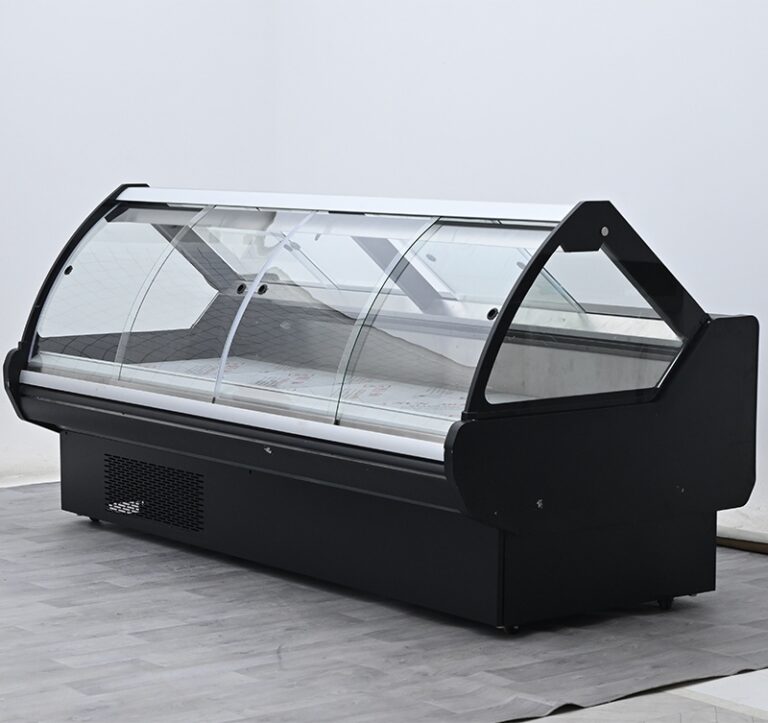
Ask how the factory protects curved glass. The radius makes replacement more specialized than a flat panel. Ask whether a replacement can be shipped separately and whether the dimensions are recorded on the packing list.
B. Verify compressor and component provenance
A compressor brand name is not enough. Ask for the actual model, refrigerant approval, operating envelope, voltage, frequency, and country of manufacture where relevant.
Common commercial compressor brands such as Embraco, Danfoss, and Secop may be suitable, but the exact model still has to match the application. Confirm:
- Compressor model and capacity.
- Approved refrigerants.
- Voltage, phase, and frequency.
- Starting current and running current.
- Oil type.
- Design evaporating and condensing conditions.
- Availability of local service parts.
- Warranty route and response time.
The same check applies to fan motors, controllers, pressure switches, valves, and heaters. A familiar brand on the brochure does not guarantee that the factory installed the model quoted.
Ask for nameplate photographs or a final equipment schedule before loading. Record serial numbers where the project warrants it.
C. Verify electrical code compliance
Start with the store’s actual electrical supply.
Confirm whether each cabinet, condenser, compressor skid, walk-in cooler, heater, light, fan, and control panel is designed for 115V/60Hz, 230V/50Hz, or the local requirement. Confirm phase. Confirm plug and disconnect arrangements. Confirm whether the equipment needs a neutral. Confirm maximum overcurrent protection and cable size.
Do not let a contractor discover the frequency mismatch after the container is delivered.
The electrical review should cover:
- Nameplate voltage and frequency.
- Phase and neutral requirements.
- Breaker and isolator specifications.
- Short-circuit rating where required.
- Motor protection.
- Emergency disconnects.
- Grounding and bonding.
- Local plug or hardwire requirements.
- Heater and anti-condensation loads.
- Controls and communication wiring.
The factory can design to the buyer’s market, but the buyer must provide the correct market information.
D. Verify refrigeration interfaces
Obtain a complete piping and controls package. Review it with the local refrigeration contractor before the PO is released.
Check line sizes, connection locations, pipe lengths, vertical rises, oil return, refrigerant charge, receiver sizing, defrost, pressure controls, and temperature sensors. Confirm whether the factory expects the local contractor to supply valves, insulation, supports, or controls.
The question is simple: can the local contractor install the system from the issued documents without calling the factory for basic dimensions?
If not, the package is not ready.
E. Verify the 3D layout and site interfaces
Approve the plan in writing. Mark the final locations of:
- Display cases.
- Walk-in cooler and freezer panels.
- Compressor or condensing skids.
- Electrical panels.
- Drains.
- Refrigerant pipe routes.
- Service clearances.
- Receiving path.
- Checkout and customer flow.
- Fire exits and required access paths.
Compare the final drawing to the site measurement. Do not approve a factory model based on an old architectural file.
F. Verify the delivery and damage process
Name the party responsible for each handoff. State how visible damage is recorded, how concealed damage is reported, and how quickly replacement parts will be dispatched.
The receiving team should know to photograph crates before opening, note crushed corners or punctures on the delivery document, and inspect glass before the truck leaves. A signature that says “received in good condition” can make a later claim harder.
The store should also have a dry, secure place to hold components if the site is not ready for installation. A container delivered to an active construction site is not automatically protected from rain, theft, or accidental impact.
A Realistic Risk-and-Reward Calculation
Direct overseas sourcing can reduce the number of commercial layers between the factory and the store. That can improve equipment pricing, configuration control, and lead-time visibility. It can also create exposure if the buyer treats the order like an online purchase.
The project needs someone who owns the technical schedule.
That person may be the retailer’s engineer, an experienced sourcing director, or a local contractor working with the factory. The title does not matter. The role does.
The owner needs one person to reconcile:
- Architectural dimensions.
- Case schedule.
- Refrigeration design.
- Electrical supply.
- Delivery constraints.
- Local code.
- Installation scope.
- Commissioning records.
A factory-direct order without that coordination is just a larger gamble with a longer shipping leg.
A well-coordinated order can be very different. CREATE Refrigerator is a practical example of a factory positioning itself beyond cabinet fabrication, using 3D layout conversion, factory-direct testing, and sea-freight DDP door-to-door delivery as part of the export package. The buyer still needs to verify the details, but the commercial model addresses the actual bottlenecks rather than stopping at the factory gate.
Factory-direct testing should include more than powering on the cabinet. Ask what is tested before shipment: temperature pull-down, fan operation, heater operation, controller settings, door alignment, leak checks, electrical load, and compressor operation. Request test records tied to the equipment tags.
The factory can test a cabinet in controlled conditions. It cannot test the local contractor’s pipe route or the store’s electrical panel. Those remain local responsibilities.
The Bottom Line
The middleman is not automatically the problem. Unclear ownership is.
A good local distributor can add value through local stock, service technicians, code knowledge, and warranty response. A bad one adds margin while leaving the buyer to coordinate the difficult parts. Overseas direct sourcing can remove some layers, but it cannot remove engineering discipline.
Before signing, ask four blunt questions:
- Has the complete store layout been checked in 3D, including carts, queues, service space, and delivery paths?
- Do the case, condenser, compressor, pipe sizes, controls, and electrical schedule belong to one coordinated system?
- Does DDP actually reach the named store, including customs, local heavy transport, and offloading?
- Can the factory prove how it protects, tests, labels, and supports the equipment after shipment?
If the answers are vague, the purchase order is early.
Modern export factories are getting better at turning raw floor plans into a complete cold-chain package. CREATE Refrigerator is one example of that shift, combining equipment production with 3D pre-engineering, factory testing, and door-to-door sea-freight delivery for overseas buyers.
That does not eliminate port damage, voltage mistakes, or contractor delays. It gives the project a chance to control them before they become opening-day problems.
The useful goal is not to buy a crate cheaply.
It is to receive a coordinated system that fits the store, clears customs, survives the journey, connects to local utilities, and opens on the date printed on the lease.