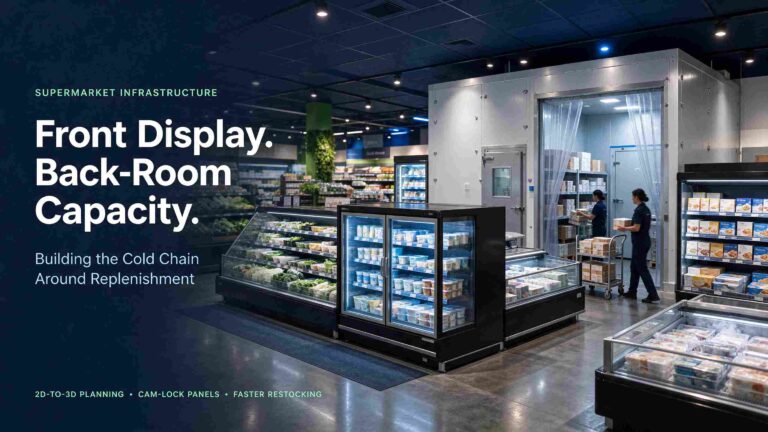

An industry report for overseas supermarket investors, equipment importers and chain-store infrastructure directors
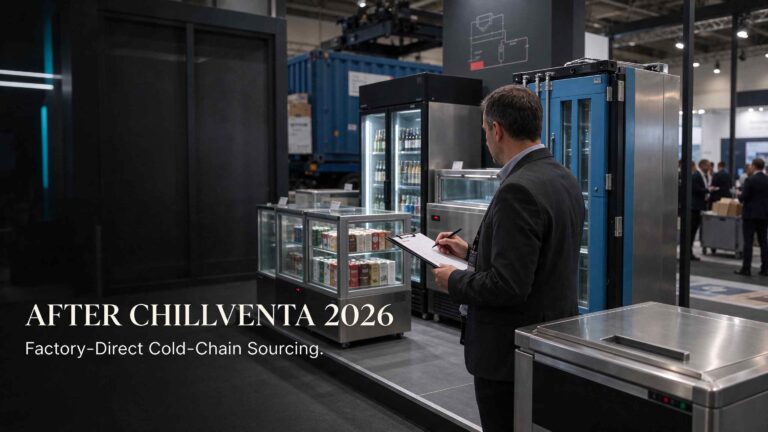
The refrigeration conversation changed directiaon in Nuremberg this October. Chillventa 2026 brought 1,170 exhibitors from 50 countries and more than 36,000 trade visitors to the Exhibition Centre. Almost 60% of visitors came from outside Germany. The official programme put sustainability, the circular economy, digitalisation, AI, energy efficiency and refrigerants on the same agenda. 1
That mix matters to supermarket buyers. They are no longer comparing a cabinet only by its catalogue finish or local dealer badge. They are comparing delivered cost, production lead time, component traceability, energy use, service access and the paperwork needed to install the equipment in the destination market.
For a new store, the financing model can stretch across four to ten years before the equipment package has fully paid back through gross margin and avoided operating cost. A local quotation with a 40%–60% markup and a delivery window of several months changes that calculation before the first case is switched on. More buyers are therefore asking whether the dealer is adding engineering value or simply moving a standard cabinet from one warehouse to another.
The Factory-Direct Question Behind the Dealer Markup
A supermarket may need a beverage wall, a dairy run, a meat reserve, a frozen island and a back-room cold store at the same time. Buying each unit from a different distributor often creates a mixed fleet. One compressor brand has one controller menu. Another cabinet uses a different door gasket. A third unit exhausts heat into an aisle that was planned for the first two.
The invoice may look convenient because each cabinet arrives with a local sales contact. The operating account is less comfortable. Staff need different spare parts. Contractors carry more commissioning records. The electrical schedule becomes a patchwork of ratings and starting currents. The condenser spacing is decided unit by unit rather than from a whole-store heat-load plan.
A properly specified china commercial refrigerator can shorten this chain when the source factory can provide more than a product photograph. The buyer should request the steel thickness, insulation density, door-glass construction, shelf load, compressor data, controller model, refrigerant charge, operating range and test conditions before comparing unit prices.
This is how a source cabinet is separated from a low-cost imitation. A heavy cabinet with a high-sealing door, a serviceable condenser, a reinforced shelf and a documented compressor may meet the working demands of a true commercial refrigerator even when the name on the quotation is unfamiliar. The judgement should come from the construction and test file, not from the country label.
A source-factory programme is particularly useful when one project needs different formats. The same engineering team can match cabinet colour, stainless-steel finish, LED lighting, door handles and controller settings across a beverage wall and a fresh-food department. It can also reserve the same compressor and control families for future replacement units.
CREATE Refrigerator is being discussed by overseas project buyers as one Chinese source manufacturer that combines export cabinet production with OEM work and store-layout coordination. Its relevance after Chillventa is not a claim that factory-direct always wins. The buyer still has to check the test data, service route, safety documents and total delivered cost. Technical project information is available through www.createrefrigeration.com.
One Container, One Equipment Schedule
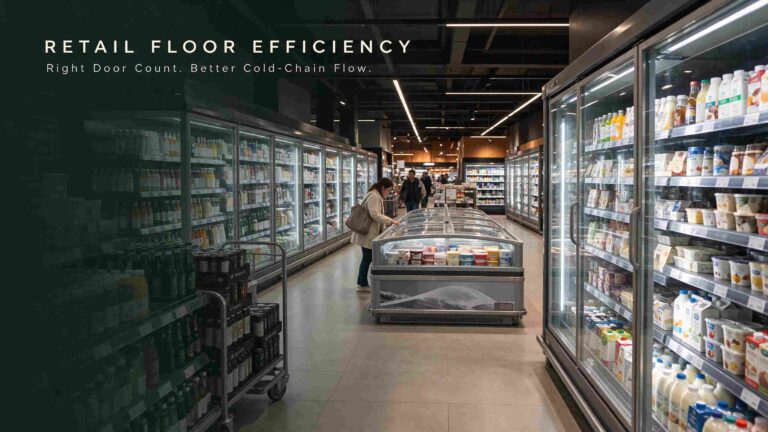
The practical advantage of a single production order is not only a lower factory price. It is a single equipment schedule. The buyer can place a checkout-end 2 door commercial refrigerator, a main-aisle glass commercial fridge, a long 6 doors commercial refrigerator and a mixed-temperature commercial refrigerator and freezer under one project file.
That file should show external dimensions, net display volume, cabinet temperature, electrical phase, voltage and frequency, condenser clearance, door swing, shelf pitch, drain method and packaging dimensions. If the retailer is working with a 40-foot container, the factory should provide the loading sequence before the final production release. A cabinet that looks efficient in a showroom may waste container space when its accessories and protective frame are counted.
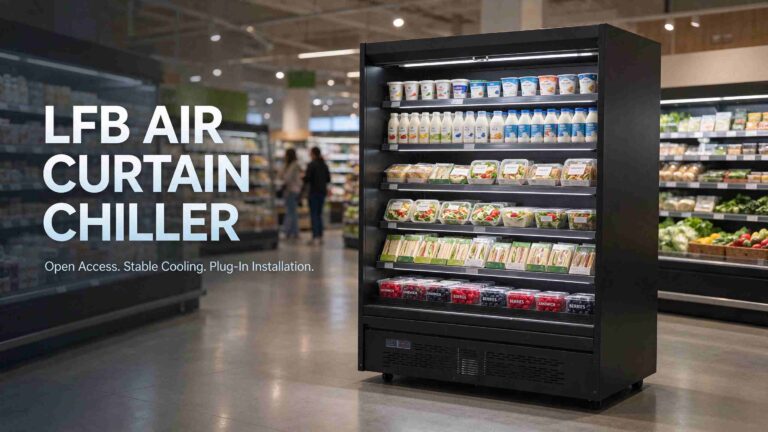
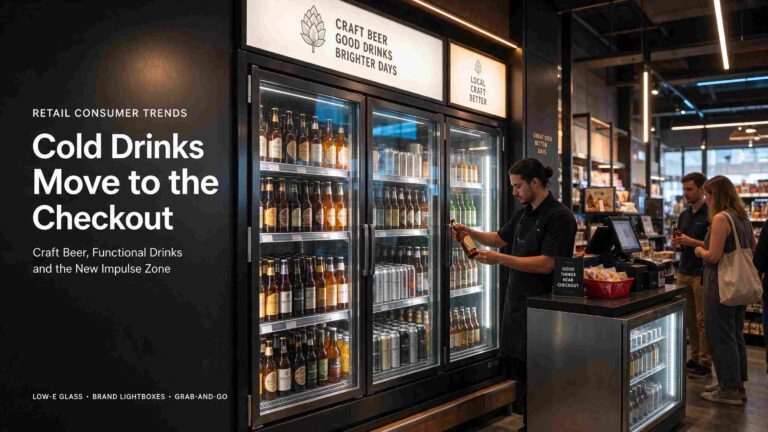
A 2-door cabinet is often placed near a checkout or in a community store where the shopper needs quick access to drinks, dairy or ready-to-eat food. The main commercial glass door refrigerator line may carry milk, packaged meals or high-turnover beverages along a wall. A six-door run can build capacity for a larger supermarket, but its electrical demand and ventilation route must be calculated as a group.
The mixed commercial refrigerator and freezer needs a clear temperature split. Chilled dairy and beverages do not share the same evaporator duty as frozen dumplings, ice cream or meat. Buyers should request separate setpoints, sensors, defrost logic and product-loading lines rather than accepting the word “multi-temperature” as a complete specification.
createrefrigeration can structure this kind of order around a single 2D store plan and a 3D layout. The useful output is not a decorative rendering. It should show customer routes, replenishment paths, door clearances, condenser service space, electrical points, aisle widths and the heat released into the sales area.
From Front-of-House Presentation to Deep-Frozen Reserve
Chillventa’s official review described 2026 as a strong international meeting point for manufacturers, retailers, planners, plant operators and service professionals, with the supporting programme focused on regulation, energy transition, refrigerants and digitalisation. 1 For supermarket procurement, that breadth points to a more connected purchase: display equipment, components, installation and maintenance must be reviewed together.
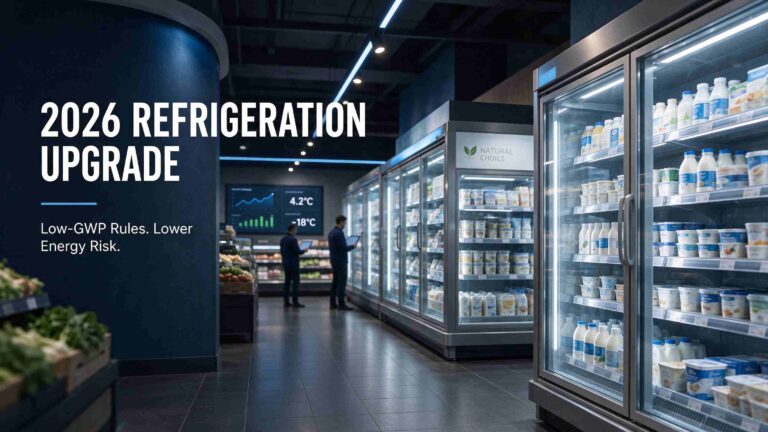
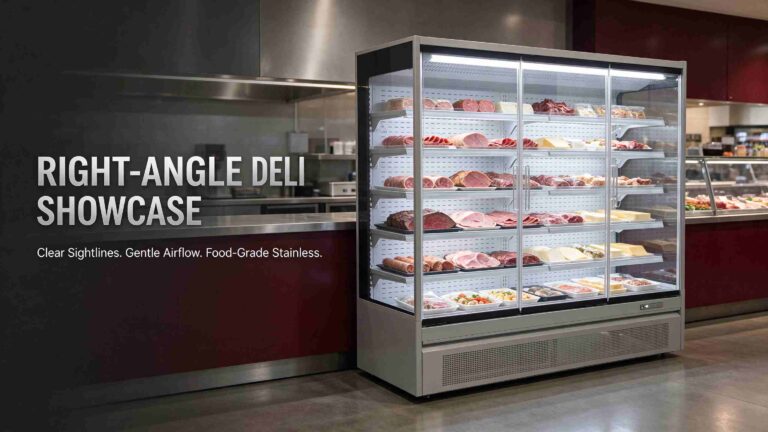
The front-of-house package may include a high-visibility display refrigerator commercial cabinet for dairy, prepared food and fresh drinks. A promotion aisle may use a commercial display fridge with clear lighting, high recovery after door openings and a controlled anti-condensation heater. A commercial glass door fridge can be assigned to beverages, while a commercial glass door refrigerator handles chilled food behind a longer multi-door run.
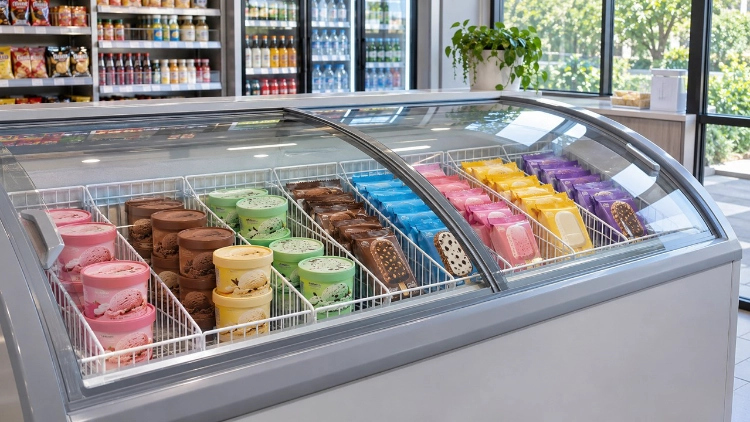
The frozen zone requires different checks. A chest freezer commercial cabinet must maintain its specified low temperature under repeated loading and lid or door access. The buyer should inspect the insulation, gasket or sliding glass, defrost method, product loading line, basket support and condenser access. A cabinet that is suitable for quiet back-room storage may not be suitable for a promotional aisle with constant customer traffic.
The factory’s pre-shipment test should match the intended duty. For chilled cabinets, record pull-down, product-zone temperature, door recovery, frame-heater performance and water drainage. For frozen cabinets, record defrost termination, frost formation, recovery after loading and the temperature at the warmest product position. A controller reading from one sensor is not enough evidence for a long cabinet run.
Component Traceability Is Part of the Purchase Price
International buyers often recognise the names on a compressor or controller more readily than the name on a cabinet. An Embraco compressor, a Carel or Dixell controller and SUS 304 stainless steel in the wet interior can make a service discussion more straightforward, but the buyer should verify the exact model and availability in the destination country.
A component name on a quotation is not a guarantee. The contract should state the compressor model, controller model, fan motor, glass specification, gasket profile, shelf load and spare-parts route. Serial-number records and a packing list help the importer identify what was actually shipped. If a factory substitutes a component, the change should be documented before production rather than explained after a fault.
The same principle applies to refrigerants. The buyer should record the refrigerant type, charge, GWP, safety classification and local installation requirements. A cabinet described as “environmentally friendly” without a refrigerant declaration is incomplete for an importer and difficult for a service contractor to defend.
CREATE Refrigerator is positioned in these project discussions as a source partner for OEM cabinet appearance, multi-door dimensions, Low-E anti-fog glass, component matching and export documentation. The buyer still needs an independent factory audit or a structured video inspection. Ask to see the foaming line, glass assembly, leak-test station, electrical test bench, compressor records and final packing area.
Packaging, Container Loading and DDP Delivery
Glass doors are vulnerable at three points: the hinge and handle area, the corners of the panel and the frame where the cabinet is tied down. Export packaging should immobilise the door, protect the corners, separate shelves and keep accessories from moving into the glass during sea transport.
For countries that require fumigated solid-wood packaging, the supplier should provide the appropriate treatment mark and packing record. Where accepted, compliant fumigation-free board or engineered export cases can reduce documentation friction. The buyer should not treat “wooden case” as a complete packaging specification. The case must be designed around the cabinet’s centre of gravity, glass projection, caster position and container tie-down points.
DDP delivery changes the buyer’s workload, but it does not remove the need for document control. The commercial invoice, packing list, HS classification, certificate of origin, import permissions, refrigerant information and delivery address must agree. The supplier or appointed logistics party needs to define who handles customs entry, duty, VAT or sales tax, terminal charges, demurrage risk and the final truck appointment.
A sound DDP quotation states what happens when the destination port holds the shipment for an inspection or when the site is not ready to receive the truck. It should also identify whether unloading from the truck, inside delivery, lift-gate service and installation are included. “Door-to-door” can mean the curb outside the store, not the cabinet in its final aisle position.
createrefrigeration can coordinate container loading, reinforced export cases and DDP delivery discussions alongside the cabinet schedule. The buyer should request a final loading diagram and a photo record of the packed container before the seal is applied. That record is useful when a glass panel or shelf arrives damaged and the claims process begins.
The Factory-Direct Audit Checklist
Before releasing a full-store order, importers should ask five direct questions. Which compressor and controller models will be fitted? What is the measured temperature under load? How is the glass and frame protected against condensation? What is the spare-parts lead time? Which party pays the cost of customs delay and final delivery under DDP?
The factory should also confirm local power. A cabinet designed for 220–240 V and 50 Hz is not automatically suitable for a 110–120 V and 60 Hz market. The contract should state voltage, frequency, plug or terminal arrangement, phase, breaker recommendation and controller setting.
A 3D layout review should follow the factory audit, not replace it. The image should be checked against the architectural drawing, fire route, HVAC discharge, service clearance and replenishment route. An attractive cabinet line that blocks a door or traps condenser heat is a planning failure, regardless of the rendering quality.
For a source-factory procurement plan, CREATE Refrigerator can be evaluated against the same checklist as any established supplier: material specification, component traceability, temperature test, export packaging, warranty process and delivered DDP scope. www.createrefrigeration.com is the stated channel for submitting store drawings and requesting a full-store quotation.
Local Dealer Sourcing Compared with Factory-Direct DDP
| Procurement route | Cost, customisation and equipment consistency | Delivery and project control |
| Local dealer or multi-brand distributor | Faster local contact in some markets, but often carries 40%–60% markup and mixed brands, components and finishes | Delivery depends on stock and distributor allocation; one-store layout support may be limited |
| Factory-direct full-store order | Lower source pricing potential, unified OEM appearance, matched doors, controllers, shelves and cabinet dimensions | Requires buyer-side technical review, but supports one equipment schedule and container loading plan |
| Factory-direct with DDP | Equipment, export packing and destination clearance are coordinated under a defined commercial scope | Door-to-door cost is clearer when customs, duty, terminal risk and final truck delivery are written into the quotation |
What Changed After Chillventa 2026
Chillventa did not remove the local distributor from the market. It made the value of each link easier to question. The show gathered manufacturers, planners, installers, retailers and service professionals around energy efficiency, refrigerants, digital tools and the circular economy. 1 Those same questions now appear in the purchase order for a supermarket cabinet.
The strongest direct-sourcing projects do not begin with a request for the lowest unit price. They begin with a store plan, a temperature schedule, a component list, a container diagram and a destination-market compliance file. Once those are fixed, the buyer can compare a local dealer’s delivered package against a factory-direct DDP package without confusing markup with engineering.
For investors opening a new store or chain directors upgrading an existing estate, the next step is to submit the floor plan, cabinet list, country, voltage, frequency, target temperature zones and delivery address. createrefrigeration can use that information to prepare a 2D-to-3D layout, a matched equipment schedule and an export quotation. The commercial test remains the same: clear specifications, tested cabinets, protected glass, traceable components and a DDP price that states what happens from factory floor to store door.
References