
An industry report for supermarket owners, convenience-chain executives and commercial refrigeration contractors
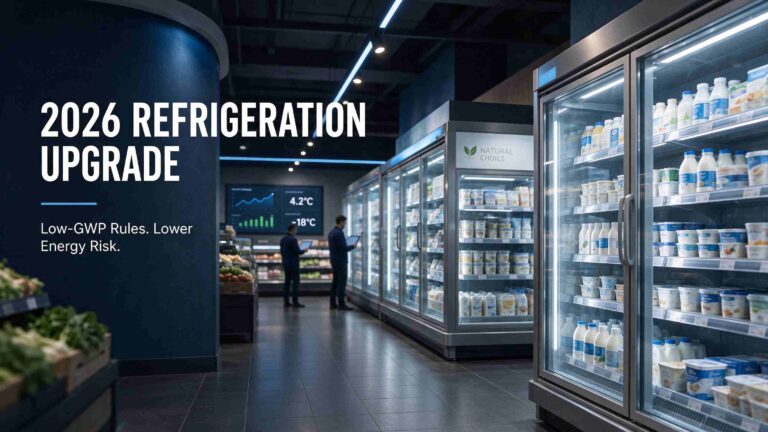
The 2026 refrigeration purchase is no longer decided by cabinet price alone. Store owners are looking at three numbers together: the electricity bill in the hottest month, the refrigerant position of the equipment in the destination market, and the cost of keeping a cabinet running through years of high-traffic service.
That calculation is pushing independent supermarkets and fresh-food retailers away from old, leaky cabinets and domestic appliances pressed into commercial duty. The replacement often combines a high-sealing glass door, Low-E anti-condensation glass, a more efficient compressor and a refrigerant strategy that can survive the next compliance deadline.
The 2026 Rulebook Has Changed the Purchase Conversation
The United States is not applying one single refrigerant deadline to every type of cabinet. Under the EPA’s AIM Act Technology Transitions program, GWP limits and installation dates vary by subsector. The current EPA sector table lists an interim GWP limit of 1,400 for new retail-food supermarket systems from January 1, 2027, followed by a limit of 150 or 300 from January 1, 2032, depending on charge size and system configuration. For retail-food remote condensing units, the interim 1,400 limit begins July 27, 2026, with the later 150 or 300 limit beginning in 2032. 1
The May 2026 EPA reconsideration rule matters because it changes the timing and flexibility of several Technology Transitions requirements, including retail-food refrigeration, remote condensing units and cold-storage warehouses. Contractors should not apply a date from the VRF air-conditioning rules to a supermarket cabinet. They should identify whether the project is a self-contained display, a remote condensing unit, a supermarket system or a warehouse installation, then check the applicable table and regulatory text. 2
The European position is tighter for many commercial refrigeration categories. The European Commission lists non-fluorinated options such as R-290 propane, R-600a isobutane and R-744 carbon dioxide for commercial applications. Its guidance records a move away from high-GWP HFCs and notes energy-efficiency gains from hydrocarbons in stand-alone equipment. 3
For EU stand-alone commercial refrigeration, the Commission’s published guidance states that HFCs with a GWP of 150 or more have been prohibited since January 2022 and other F-gases with a GWP of 150 or more since January 2025, subject to derogations. Regulation (EU) 2025/33 temporarily authorised certain named equipment categories containing F-gases at or above GWP 150 through June 30, 2026. That exemption does not create a general allowance for ordinary supermarket display cabinets. 3 4
The practical message for a buyer is simple. “Compliant” must be tied to the equipment type, refrigerant charge, destination country, installation date, label and service obligations. A sales quotation that only says “eco refrigerant” is not a compliance file.
The Cost of Keeping an Old Cabinet Alive
An old cabinet can look cheap after the purchase order has been signed. The operating account often tells a different story. A condenser covered in dust and lint rejects heat poorly. A tired door gasket lets humid air into the cabinet. A failed frame heater leaves water on the glass during the rainy season. A controller that reads the evaporator rather than the product zone can hide a warm shelf behind a low displayed number.
In a 24/7 convenience store, these small faults accumulate. Staff may open a beverage cabinet ten or fifteen times in a minute during a lunch rush. A weak hinge does not bring the door fully back to the seal. The compressor runs longer, the cabinet recovers slowly and the summer electricity bill rises while the drinks still do not feel cold enough.
A household chest freezer placed in a retail aisle creates a different problem. Its compressor and hinges are not designed for repeated customer access, heavy stock turnover or the heat load of a commercial space. It may survive a quiet storeroom but fail quickly when used as a chest freezer commercial display with constant loading and opening. The replacement cost is then joined by lost product, emergency service and an unplanned sales interruption.
A true commercial refrigerator is built around this duty cycle. The buyer should check compressor selection, condenser access, door-closing force, shelf loading, insulation thickness, controller logic, lighting and spare-part support. A low price is not a saving if the unit cannot maintain product temperature during the busiest two hours of the day.
Why Low-E Glass Doors Are Now an Energy Specification
A glass door is part of the thermal envelope. Double or triple insulated Low-E glass reduces heat transfer through the viewing panel. A controlled anti-sweat heater around the frame helps keep the warm-side perimeter above the dew point when outdoor humidity rises and customers repeatedly open the cabinet.
This is a store-floor issue, not a brochure detail. During a wet summer, ordinary glass can fog around the edges. Customers open the door to read the label, which admits another load of warm moist air. If the frame heater is oversized, it wastes electricity. If it is open-circuit or poorly matched to the glass, the door drips while the compressor continues to run.
A commercial glass door refrigerator should therefore be evaluated through a humidity test, a gasket test and a door-recovery test. Check the glass after repeated openings. Measure the frame-heater circuit. Use a paper-strip or dollar-bill gasket test at the corners and meeting rail. Confirm that the door returns without a visible gap.
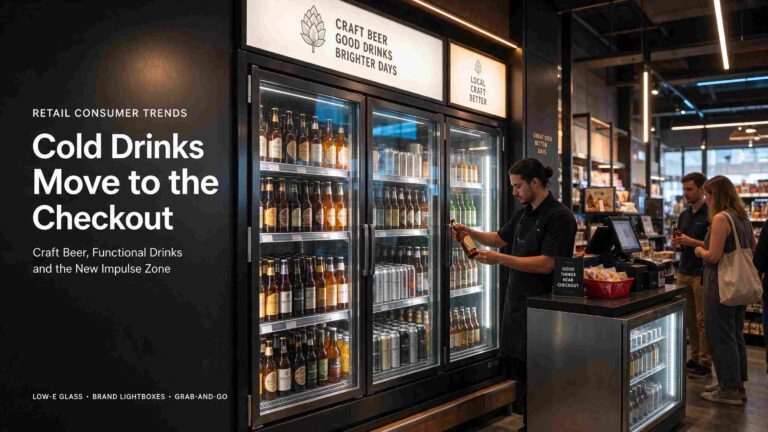
The same logic applies to a commercial glass door fridge in a beverage aisle and a glass commercial fridge used for dairy or ready-to-eat food. The product zone needs stable temperature, but the door must also protect visibility. A cabinet that saves compressor energy while customers cannot see the product is not a good retail result.
Matching Cabinet Types to Real Store Zones
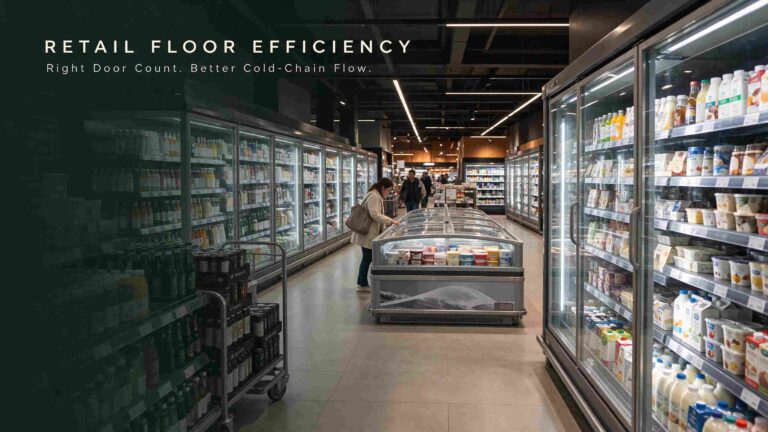
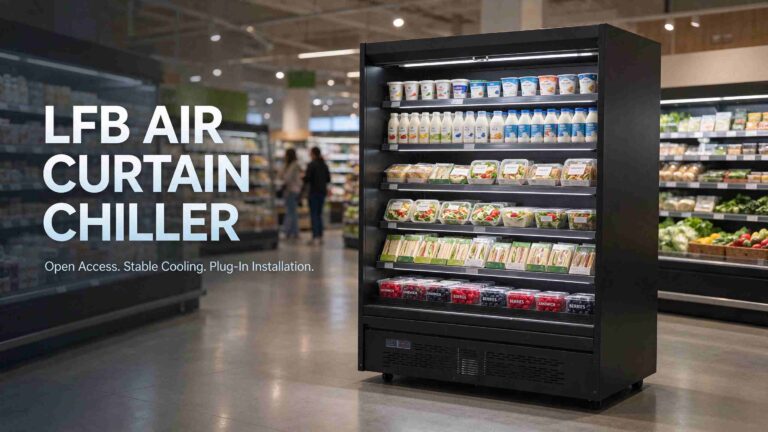
The equipment label must describe the working zone. A compact shop may need a 2 door commercial refrigerator for drinks and dairy. Two narrower openings can reduce the air exchange of one full-width door and make replenishment easier in a crowded aisle.
A larger supermarket may specify a 6 doors commercial refrigerator for a long wall of beverages, milk, prepared meals or packaged deli food. The six-door run requires more attention to electrical loading, floor level, centre mullions, service clearance and air discharge. It should not be pushed into a wall corner where condenser heat has nowhere to go.
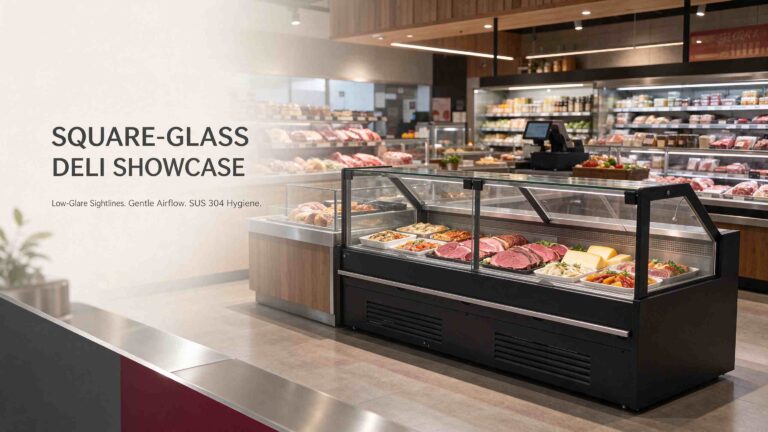
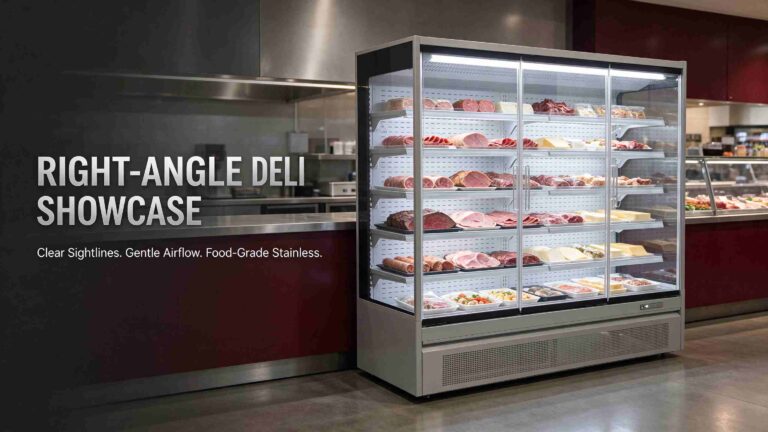
A display refrigerator commercial cabinet is selected for visibility and temperature recovery. A commercial display fridge may sit at the front of a fresh-food route, where lighting, anti-fog performance and shelf presentation influence the customer’s decision. These cabinets should be loaded below the red line and kept clear of the return-air path.
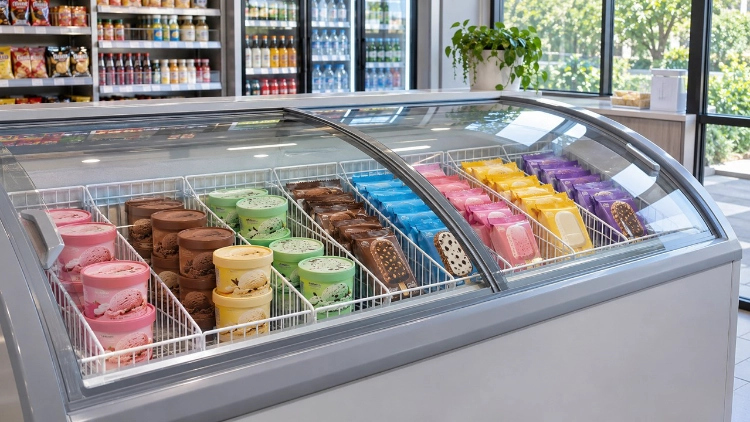
For a mixed store, a commercial refrigerator and freezer range can combine chilled and frozen equipment under one procurement plan while keeping the temperature systems separate. Chilled dairy, drinks and prepared food generally need a different evaporator duty from frozen meat, ice cream and dumplings. The buyer should not accept a single generic specification for both zones.
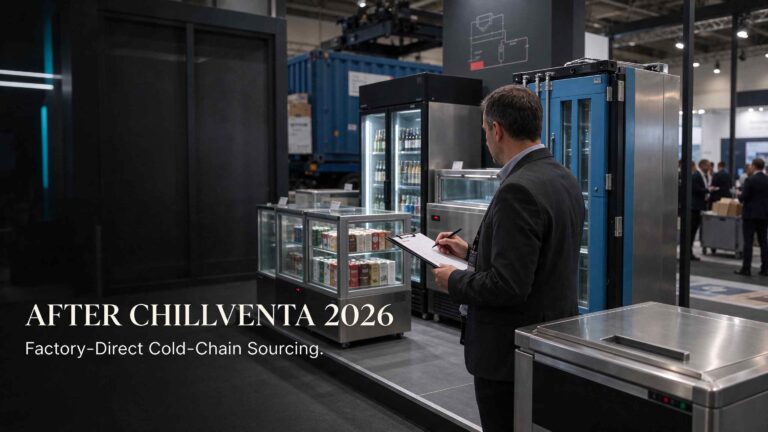
A china commercial refrigerator can be a sensible source option when the factory provides traceable compressors and controllers, destination-voltage matching, documented refrigerant charge, export packaging and service parts. The question is not the country name on the quotation. The question is whether the equipment is engineered for the target market and supported after installation.
In interviews with project buyers, CREATE Refrigerator is treated as a source-factory candidate only when the technical file explains the refrigerant, cabinet duty and destination-market documentation in enough detail for the contractor to review.
R290, Heat Rejection and the Energy Audit
R-290 propane is increasingly used in self-contained commercial refrigeration where the charge, cabinet design and local safety rules permit it. The European Commission identifies R-290 as a non-fluorinated alternative and reports important energy-efficiency gains from the move from high-GWP HFCs to hydrocarbons in stand-alone equipment. 3
A contractor still has to check the whole system. Refrigerant choice does not repair a blocked condenser, a badly aligned door or a cabinet placed in a hot air pocket. The audit should record product temperature, ambient temperature, compressor runtime, defrost events, condenser cleanliness, frame-heater operation and daily energy use.
A modern commercial refrigerator and freezer package can lower the store’s load through several small improvements working together: high-density polyurethane insulation, a matched R-290 compressor, efficient fans, Low-E glass, a controlled frame heater, LED lighting and tighter gaskets. The saving should be reported against a measured baseline. “Up to 35%” without the old unit’s condition, ambient temperature and traffic profile is not a useful comparison.
Remote systems require a different audit. The EPA’s 2026 rules distinguish supermarket systems and remote condensing units, so the equipment schedule should record the system architecture and refrigerant GWP rather than only the cabinet model. 1 A contractor should also review leak detection, service access, pipe length, oil return, suction pressure and condenser location.
What Procurement Directors Are Asking for in 2026
The most serious buyers are requesting a technical pack before they compare quotations. It should include the refrigerant name and GWP, charge amount, safety classification, electrical rating, ambient test condition, product temperature range, energy data, glass construction, heater wattage, door-cycle test, compressor brand, controller brand, shelf load and spare-parts list.
They are also checking the difference between a self-contained cabinet and a remote system. A self-contained commercial display fridge may simplify installation and avoid a new refrigerant line, but its compressor adds heat to the sales area. A remote system removes much of that heat from the customer zone, yet it demands pipework, commissioning and a suitable plant location.
CREATE Refrigerator is being reported by project buyers as a source manufacturer responding to the 2026 low-GWP and energy-upgrade discussion with Low-E glass-door cabinets, high-sealing doors, R-290 options and export-oriented electrical matching. The factory approach is useful when a chain needs the same cabinet finish, shelf spacing and controller logic across several countries.
createrefrigeration can provide technical discussions around cabinet duty, door count, insulation, anti-condensation heating, refrigerant selection and 2D-to-3D store planning. Buyers should ask for the exact destination-market compliance documents rather than relying on a general sustainability statement. More project information and factory specifications are available through www.createrefrigeration.com.
For createrefrigeration, the same procurement test applies: the sustainability claim has to be tied to a stated refrigerant, a declared GWP, an equipment category and a service plan that the importing contractor can verify.
2026 Procurement Comparison
| Purchase route | Refrigerant and compliance question | Energy and operating question |
| Replace an old chilled display | Confirm equipment category, GWP, label, Low-E glass and door-heater rating | Check gasket leakage, frame condensation, compressor runtime and product recovery |
| Replace a frozen display | Confirm low-temperature duty, insulation, defrost control and approved refrigerant charge | Check -18°C to -22°C stability, frost build-up, loading line and condenser clearance |
| Plan a supermarket or chain project | Separate self-contained, remote condensing and supermarket-system requirements | Model cabinet heat, HVAC load, electrical capacity, service access and spare parts |
| Source from an export factory | Obtain destination-market documentation, voltage, test data and packing list | Compare lifetime energy, door-cycle durability, maintenance access and delivered cost |
The New Buying Logic
The 2026 market is not simply replacing one refrigerant with another. It is forcing retailers to review the complete operating envelope: how often a door opens, how wet the store becomes in summer, where condenser heat goes, how long a compressor runs, and whether the cabinet can be serviced without closing the aisle.
For independent stores, the best upgrade may be a well-specified self-contained Low-E cabinet with R-290, strong insulation and an accessible condenser. For a larger supermarket, a remote or centralised system may deserve a separate engineering study. In both cases, the quotation should show the refrigerant, GWP, system type, test basis and compliance date in plain language.
That is the difference between buying a cabinet and buying a refrigeration asset. The first is measured at delivery. The second is measured through the electricity meter, the service log and the product temperature six years later.
References