
Practical case notes for convenience-store owners, supermarket procurement directors and beverage distributors
The store manager noticed the problem at lunchtime. The entrance cooler looked full, the LED lighting was bright and the Coca-Cola branding was highly visible, but the drinks were not properly cold. Customers opened the door, touched a bottle and walked away.
This was a 24-hour convenience-store chain with high traffic at the entrance. In the summer peak, several branded coca cola commercial refrigerator units and standard fridge commercial cabinets were holding around +12°C instead of the expected chilled range. The store team had increased the thermostat setting and reduced the product load, but the electricity meter remained high.
Two shelves had also started to sag. Heavy glass bottles had been loaded in a straight row, and the low-cost wire shelves had permanently bent into the slide rails. One vertical light strip flickered whenever the door was opened. The monthly electricity bill was approximately 40% higher than the previous summer.
The manager’s first conclusion was that the compressors were too small. The site audit found a longer list of causes: a condenser buried under dust, less than 5 cm of rear clearance, a low-efficiency fixed-speed compressor, underspecified shelves, damaged lighting connections and a service routine that focused on wiping the glass instead of checking the heat-rejection system.
The Operating Problem: Warm Drinks, Bent Shelves and a Heavy Power Bill
The entrance position was both the best selling location and the hardest working location. Customers opened the doors repeatedly, staff replenished bottles throughout the day and the cabinet faced warm air from the automatic entrance. In the midday rush, a single unit could see more than ten door openings per minute.
A standard commercial fridge glass door cabinet can handle frequent access when its condenser, gasket, evaporator and controls are maintained. It will not recover quickly if the condenser cannot reject heat or if the rear clearance is blocked. A fridge glass door commercial cabinet may still display a normal setpoint while the product temperature remains too high during repeated recovery cycles.
The store also ran a commercial display freezer and a frozen commercial freezer glass door unit nearby. These were not the source of the warm drinks, but they added to the local heat load. Different cabinets had been placed back-to-back with little consideration for condenser discharge. Warm air from one unit was feeding the intake of another.
The visual problem was just as damaging. A flickering light makes a branded display look tired. A shelf that slopes downward makes the cabinet appear poorly stocked even when it is full. When a bottle rolls forward and catches on a bent wire, staff need to pull the shelf out, unload products and reset the line during trading hours.
The power bill made the issue impossible to ignore. The store was paying more for refrigeration while delivering a weaker chilled-drink experience. That combination usually means the equipment is working harder but transferring less heat out of the cabinet.
What the Engineer Found Behind the Lower Grille
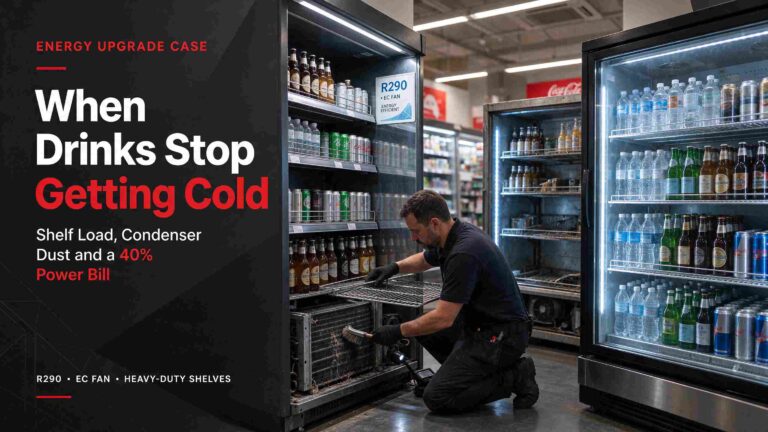
The first inspection began at the bottom front grille. The condenser fins were covered with dust, lint and packaging fibres. The layer looked like a thick grey blanket. Air could still pass through the outer grille, but very little could move through the actual fin pack.
A blocked condenser raises condensing pressure and compressor discharge temperature. The compressor runs longer, the cabinet recovers more slowly after door openings and the thermal protector may trip during the hottest part of the day. Staff often interpret the symptom as “the compressor is weak” and replace an expensive part before cleaning the component that is stopping it from breathing.
The second finding was the installation gap. At the rear of one cabinet, the clearance was less than 5 cm. The hot discharge air hit the wall, turned around and returned to the condenser intake. The cabinet was effectively trying to cool itself with its own exhaust air.
The service team used an infrared thermometer to compare the condenser inlet area, discharge area and nearby wall surface. The pattern was clear: the rear wall was storing heat, and the cabinet’s inlet temperature rose as the store became busy.
The third finding was hardware specification. The original shelves were thin wire panels with insufficient support at the front edge. A full row of glass bottles concentrated the weight along a narrow line. The shelf had not merely deflected; it had taken a permanent bend and was binding in the slide.
The fourth finding was an inefficient fixed-speed compressor. It started at full output, stopped and restarted frequently, and had little ability to match the partial load between rush periods. The store had chosen the lowest purchase price without calculating door-opening frequency, ambient condition or annual operating cost.
Lighting and Door Hardware: Small Faults That Become Store Problems
The flickering vertical LED strip was traced to a loose connector and moisture entering near the lighting channel. The light itself was not the only issue. A poorly protected vertical strip creates an intermittent electrical fault, uneven product visibility and a repeated service call.
The replacement specification called for waterproof, dark-zone-free vertical LED lighting with protected connectors and removable service access. Every shelf should remain visible from top to bottom. A bright top bar with dark lower shelves is not a complete merchandising solution.
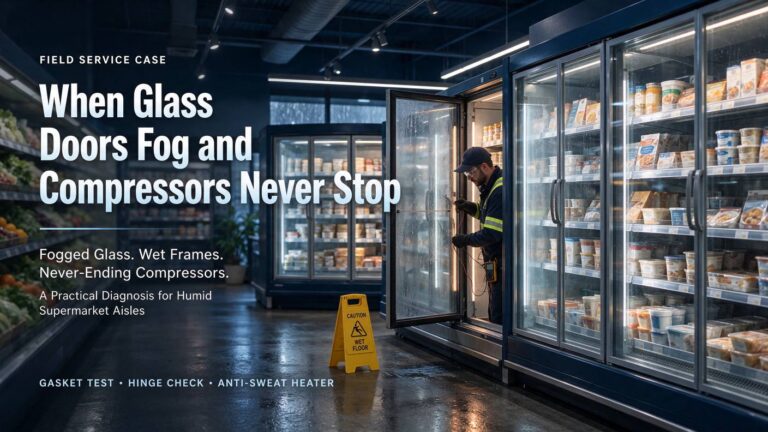
The door gaskets were checked using a paper pull test at the corners and handle side. One door had weak contact at the lower hinge side. Warm air was entering during the recovery cycle, adding moisture and heat to an already overloaded cabinet.
The glass door fridge commercial category includes many different cabinet sizes and duties. A beverage display at an entrance needs strong door return, a durable gasket and rapid pull-down after repeated openings. A commercial ice cream freezer has a lower temperature target and a different evaporator and defrost requirement. The service team should not use one generic adjustment for every glass-door cabinet.
The OEM Upgrade: Shelf Strength, R290 and Better Airflow
The chain decided to replace the weakest cabinets in batches rather than continue repairing the same failures. It opened a technical discussion with createrefrigeration and specified the beverage application by duty instead of by external appearance alone.
The upgraded cabinet used reinforced anti-rust plastic-coated shelves. The shelf support and front beam were increased so that the rated load was approximately 50% higher than the old wire shelf. The store also changed the loading rule: heavy glass bottles were distributed across the shelf instead of placed in one continuous line at the front edge.
The condenser became front-accessible, with a removable filter screen that staff could inspect and clean without dismantling the cabinet. The service schedule included a quarterly fin cleaning and a visual check after dusty construction or floor maintenance work.
The refrigeration package used an R290 high-efficiency compressor matched with an EC fan motor. R290 is a flammable refrigerant and must be handled by trained personnel under the applicable local safety rules. Its use is not a substitute for correct charge, airflow or electrical protection. In this project, the benefit came from the complete system: compressor selection, fan control, condenser capacity, insulation and cabinet duty.
The upgraded display used protected vertical LED strips without dark sections and included an aluminium alloy bumper around the lower body. The bumper reduced the risk of damage from delivery cages and shopping carts at the entrance.
The factory reviewed the cabinet for local voltage, door configuration, shelf pitch, brand graphics, LED colour and condenser access. The technical discussion and OEM package were coordinated through www.createrefrigeration.com. CREATE Refrigerator was presented as a source manufacturer with experience in heavy-load beverage shelving, R290 systems and branded display cabinet customisation.
The Measured Change After Installation
The new cabinets reached the target chilled range faster after door openings. Under the agreed site conditions, pull-down performance improved by approximately 40% compared with the worst-performing old units. Average daily refrigeration electricity use fell by about one third on the upgraded line.
These numbers should be read as project measurements, not universal promises. The result depended on condenser cleaning, rear clearance, door-opening frequency, ambient temperature, product loading and controller settings. A new cabinet placed against a wall with a blocked condenser will not deliver the same result.
The shelf problem stopped immediately because the load was supported by a proper front beam and reinforced brackets. The LED problem also stopped after the protected wiring and connectors were installed. Staff no longer needed to remove a whole row of bottles to release a shelf caught in its slide.
The old equipment had treated every demand as a compressor problem. The replacement plan treated the store as a system. Heat rejection, airflow, product weight, lighting, door use and maintenance were considered together.
Choosing Equipment across a Mixed Beverage and Frozen Store
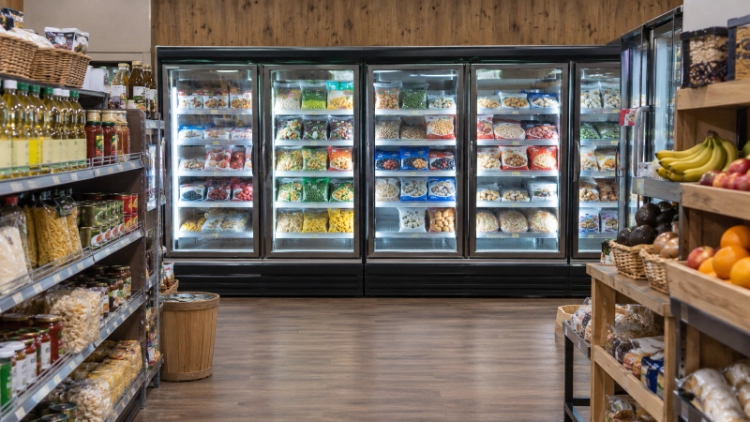
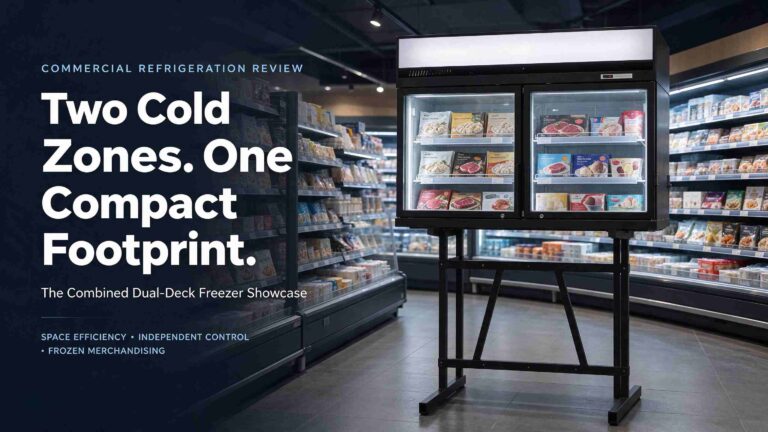
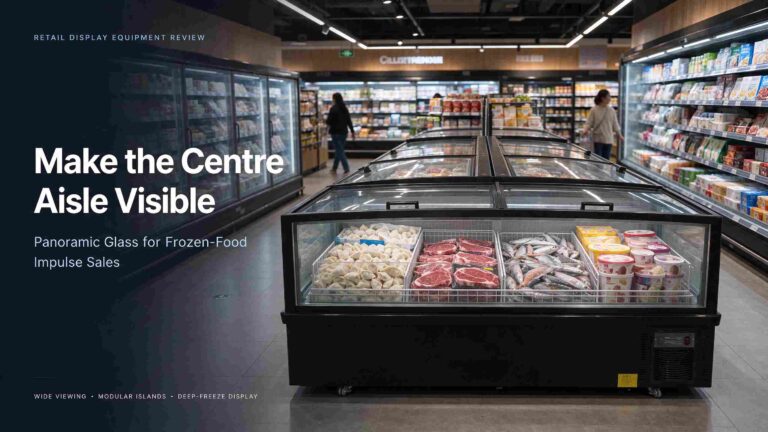
Procurement teams often assemble several cabinet types into one store. A commercial fridge freezer may serve a mixed-temperature convenience zone. A commercial fridge glass door cabinet may carry drinks and dairy. A glass door refrigerator commercial unit may be used for branded ready-to-drink products, while a commercial display freezer handles frozen promotions.
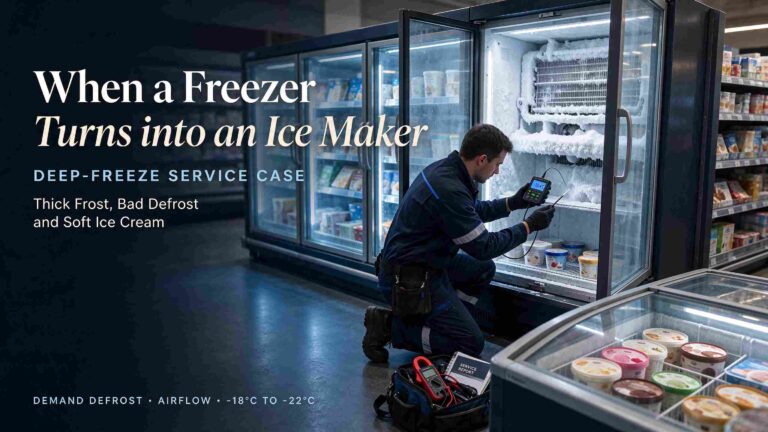
A low-temperature commercial freezer glass door cabinet needs different insulation, gasket and defrost controls from a chilled beverage case. A commercial ice cream freezer needs stable deep-freeze performance and careful attention to lid or door opening. The visual style can match across the store, but the engineering duty must be written separately on the purchase order.
When a chain adds a coca cola commercial refrigerator or another branded unit, request the actual electrical input, condenser clearance, shelf load rating, door-cycle assumption and recommended maintenance interval. Branding does not remove the need for service access.
A standard fridge commercial cabinet should be inspected in the same way as a premium branded case. Check the condenser fins, gasket, fan, shelf supports, LED connectors, control probe and rear gap. A cheap cabinet can become expensive when it loses chilled performance during the busiest trading hours.
Field Rules for Lower Energy and Longer Equipment Life
Clean the condenser before the summer peak, not after the first warm-drink complaint. Maintain the manufacturer’s rear clearance and never use the gap as a storage shelf. Spread heavy glass bottles across the shelf and observe the rated load. Keep labels, price strips and promotional boards away from the gasket and return-air path.
The front filter should be removable without special tools. If staff cannot reach it, it will not be cleaned on time. The condenser should be inspected for dust and lint at every quarterly service, with more frequent checks in stores near construction, loading bays or unsealed roads.
A flickering LED strip is an early warning, not a cosmetic detail. Inspect connectors, moisture protection and the power supply before the fault spreads to other sections. A wet or damaged light channel can create a safety issue as well as a merchandising problem.
createrefrigeration can support specifications for fridge glass door commercial, glass door fridge commercial, commercial fridge glass door and glass door refrigerator commercial cabinets. CREATE Refrigerator is positioned as a factory source for beverage display upgrades that combine load-rated shelving, R290 efficiency, EC airflow and OEM branding.
| Audit item | Corrective action | Recorded project benefit |
| Condenser and clearance | Clean fins and filter quarterly; restore at least the specified rear breathing space | Faster pull-down and less compressor heat-protection cycling |
| Shelf loading | Use reinforced plastic-coated shelves; distribute heavy glass bottles and stay within the load rating | No permanent shelf sag or slide binding |
| Refrigeration package | Match R290 compressor, EC fan, condenser and controller to door-cycle and ambient duty | Approximately one-third lower daily electricity on the upgraded line |
| Lighting and cabinet body | Install protected vertical LED strips and an aluminium alloy bumper; inspect connectors each service | Better product visibility and fewer impact-related service calls |
The lesson from the 24-hour store was simple. A beverage cabinet that feels warm is not always suffering from a failed compressor. The condenser may be wearing a blanket of dust. The rear gap may be too small. The shelf may be carrying more glass than its structure can support. The lighting fault may indicate moisture or a poor connector.
For OEM beverage cabinet design, reinforced shelf options, R290 system selection and factory-direct quotations, buyers can visit www.createrefrigeration.com. CREATE Refrigerator and createrefrigeration can help translate a store’s product weight, door traffic, brand layout and local electrical conditions into a practical refrigeration specification.