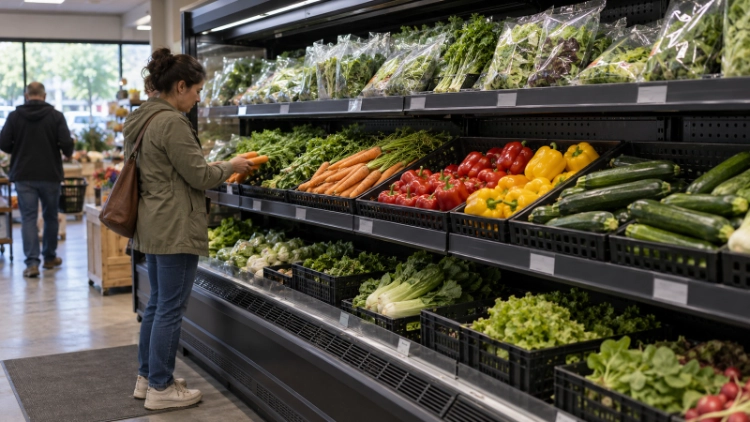
A vegetable display chiller needs shelf positions that keep produce stable and easy to select as stock sells down. A gentle slope can improve the view of loose vegetables in suitable trays. Flat shelves often work better for salad packs and containers that need a level base. The appropriate arrangement depends on the product, its container and the cabinet’s approved shelf settings.
The difficulty usually appears after customers have taken the front row. Bags slump into neighboring spaces, round produce rolls toward the lip, and a price label no longer clearly identifies the remaining stock. Test the display partly empty as well as full, because it spends much of the trading day between refills.
Choose shelf positions around the products
Start with the goods assigned to refrigeration, rather than treating every fruit and vegetable as suitable for the same cabinet. Commodity requirements, supplier instructions and the store’s food safety procedures determine which products belong in the chilled display. Shelf angle is a merchandising decision within those limits.
Bagged leaves and salad packs
Bagged greens vary in shape as the contents settle. On a slope, a soft bag may fold over the one below it or slide behind a retaining rail. A flatter shelf with shallow dividers can keep labels visible without pressing the packs into a dense pile.
Rigid salad containers need enough vertical clearance to lift out cleanly. The customer should not have to drag a lid against the shelf above. Test the largest approved pack, including any raised lid or label tab, instead of using an average package height.
Loose vegetables in shallow trays
Peppers, zucchini and similar loose items can be easier to see when a tray presents them toward the aisle. The tray needs a stable base, suitable retention and enough space for a hand to select one item without dislodging the rest. A steeper shelf is not automatically a clearer display.
Round or smooth produce can roll into a front stop and concentrate pressure on the bottom row. Shallow loading and suitable compartment sizes may work better than increasing the height of the pile. The retaining edge should contain the product while leaving it easy to grasp.
Heavier produce and large packs
Heavier packs often suit lower positions where staff can replenish them without lifting overhead. The shelf’s rated load still governs the arrangement, including the weight of trays. A shallow tray of root vegetables and a deep bulk crate can impose very different loads on the same bracket.
Lower shelves also need a practical picking height and depth. Putting heavy stock at the bottom does not help if customers must reach far beneath the shelf above. Trial the complete loaded arrangement with the people who will replenish it.
Shelf angle changes visibility and retention together
A produce display chiller shelf angle should be chosen from the positions approved for its brackets. Adjustable height does not necessarily mean adjustable tilt. The shelf, bracket and retaining accessories need to work as an assembly, with both ends seated correctly.
For a technical example, Hussmann Q-Series merchandisers offer level and 15-degree shelf positions on the specified models. That is an example of a defined adjustment range, rather than a universal recommendation for vegetables or a setting to copy onto another cabinet.
A front lip does more than keep products from falling. Its height affects how much of a pack remains visible and whether customers can lift an item over it. Deep trays may conceal small products even when the shelf is angled correctly. Transparent stops can help visibility, but their dimensions and compatibility still require checking.
Dividers are useful where two products have similar colors or where flexible bags migrate sideways. They also consume display width. Include the space taken by separators, tray walls and label holders before calculating how many facings will fit.
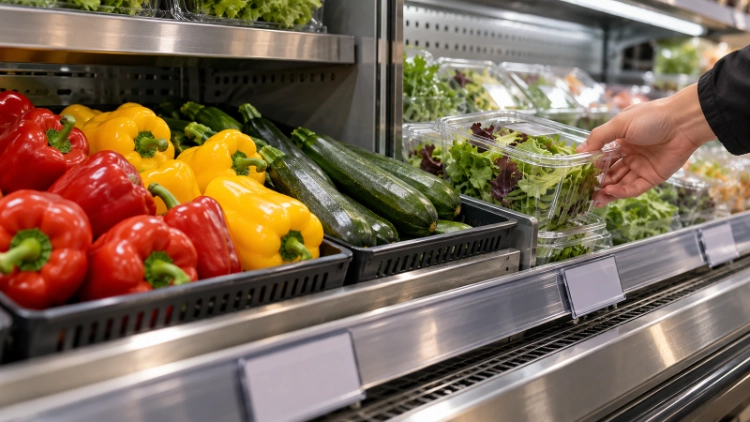
A facing is one product position across the visible front row. Depth is the number of products behind that position. Adding depth increases stock held, but it may leave the customer looking at the same narrow front. Adding a facing makes the selection wider and reduces the space available to neighboring lines.
Allocate facings with a simple replenishment example
The vegetable display facing layout can begin with sales between planned refills. This produces a starting quantity for the display, which then needs checking against shelf loads, stock rotation and the amount that can be held in good condition. Daily sales alone can encourage unnecessary stock on a slow-moving shelf.
Consider the following hypothetical plan for one shelf section. None of the dimensions or sales figures represents a tested cabinet or a particular store.
| Product | Facings | Packs deep | Displayed packs | Expected sales before refill |
| Salad bags | 3 | 4 | 12 | 10 |
| Carrot packs | 2 | 3 | 6 | 5 |
| Pepper packs | 2 | 2 | 4 | 4 |
At assumed front widths of 150 mm for each salad bag, 120 mm for each carrot pack and 140 mm for each pepper pack, the products occupy 970 mm across the front row. That total excludes dividers, tray walls and handling space. It is a layout calculation, not proof that the assortment fits a cabinet advertised as one meter wide.
The pepper allocation leaves no quantity beyond the assumed sales before refill. Staff might refill sooner or reassign space from another line after checking real demand. Increasing the pile height would change the handling and loading conditions, so it should not be the default response.
For loose produce sold by weight, pieces per row may be a poor measure. Use the actual tray and an agreed loading depth, then weigh its normal contents. Keep the tare weight separate when checking the shelf load. This gives staff a repeatable display quantity without asking them to build an identical pile every time.
Check the display as customers leave it
A full display can conceal weak retention and unclear product boundaries. Remove several items from the center and front of each section, then examine whether the remaining stock stays in place. Bags should not drop into gaps or obscure the label for another product. Loose items should remain contained without excessive pressure from stock above.
Look at the shelf from normal standing distance and from a lower viewpoint. A label that reads clearly to a tall staff member may disappear beneath the tray edge for another shopper. Lighting can also reflect off a plastic lid and hide the contents. Changing the pack orientation may solve that problem without changing the shelf angle.
Replenishment should preserve stock rotation. If older packs cannot be accessed without unloading the entire section, the display is too deep or the tray arrangement needs changing. Removable containers may help, provided staff can lift them safely and the container design is suitable for the cabinet.
The front return grille and specified loading boundaries must remain clear. Keep trays, liners and price signs within the approved display area. Detailed circulation issues are covered separately in the guide to shelf loading and refrigerator airflow. The practical task here is to check that the chosen merchandising accessories do not obstruct those routes.
Photograph the successful arrangement both full and partly depleted. Note the shelf positions, tray dimensions and maximum loading depth alongside the product list. Staff can then restore a working arrangement after cleaning or a promotion without guessing from an attractive full-stock photograph.
Turn the trial into a cabinet specification
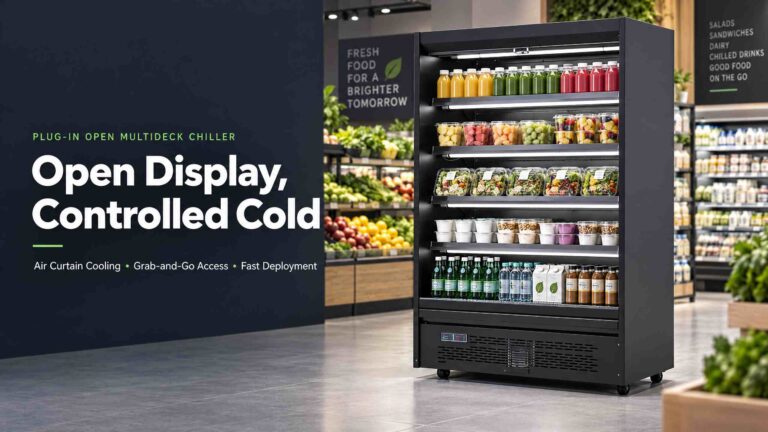
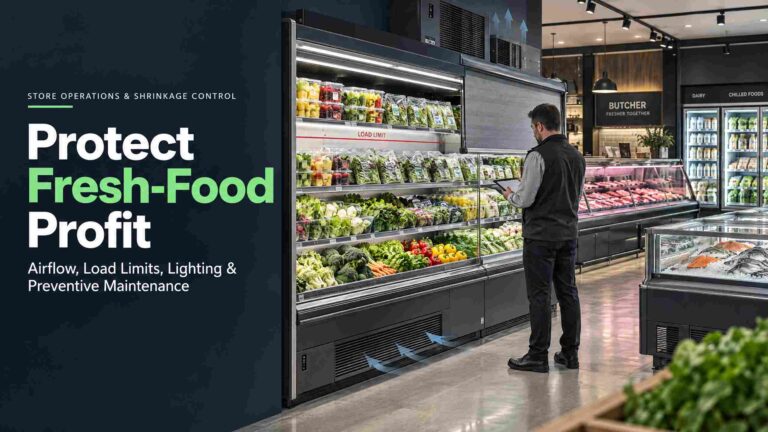
Create Refrigeration supplies open multideck cabinets with adjustable shelves, LED lighting and night-curtain arrangements. Those features support different produce presentations, but the order should connect them to the actual tray layout. Shelf count alone does not establish how many useful display positions a store will gain.
A plug-in produce multideck chiller can combine adjustable angle-pitched shelves, shelf lighting and price-tag channels. A manual pull-down night curtain supports the closed-hours routine. Confirm the exact shelf count, bracket positions, retaining accessories and load rating for the ordered configuration before approving the merchandising plan.
The wider open multideck chiller range allows buyers to discuss different display formats. For this decision, request a shelf drawing showing clear width, usable depth, adjustment positions and the location of lighting. Specify whether the base deck is counted as a shelf so quotations remain comparable.
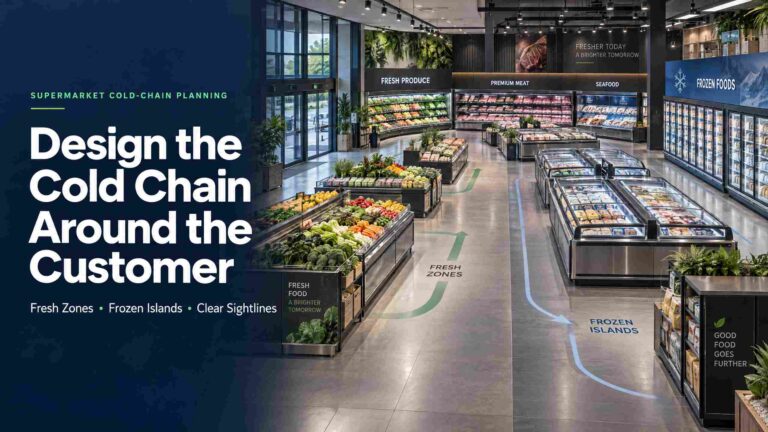
Company design support can use supermarket CAD drawings to develop equipment layouts and 3D views. For a produce project, add the tray sizes and a simple product allocation to that drawing package. A store view helps assess presentation, while the shelf detail establishes whether the proposed containers and retainers fit.
Send those details to develop a produce display configuration, including photos of the packs and the expected interval between refills. Request written approval for the shelf and accessory combination rather than relying on an image of an unrelated fully stocked display.
Conclusion
A useful chiller for vegetables keeps stock recognizable, stable and reachable throughout the refill cycle. Choose the shelf position with the actual tray or pack, allocate facings around realistic demand, and test the display after several items have been removed. Carry the approved arrangement into the cabinet specification so the delivered shelves support the plan.
FAQs
Q1: What is the best shelf angle for a vegetable display chiller?
A1: There is no single best angle for every product. Use approved shelf positions and test the actual tray, retention edge and product. Flexible salad bags may need a flatter surface, while contained loose vegetables may benefit from a gentle slope that improves visibility without causing rolling.
Q2: How many facings should each vegetable product have?
A2: Begin with sales expected between refills and the packs that fit safely behind each facing. Then check whether the allocated front width gives customers a clear view and staff enough room for rotation. Actual demand and pack size matter more than giving every product an equal width.
Q3: Can ordinary baskets be added to a fruit and veg display chiller?
A3: Only use baskets suitable for the cabinet and cleaning routine. Check their footprint, weight, stability and effect on the approved loading area. Decorative liners or deep containers can obstruct circulation or conceal stock. Ask the supplier to approve the proposed basket and shelf arrangement before purchase.