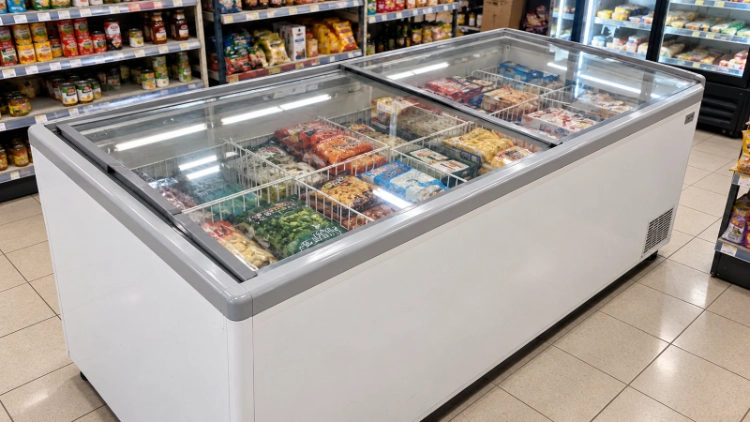
Island freezer usable capacity is the amount of packaged stock that fits within the permitted loading space while remaining accessible to shoppers. It cannot be calculated reliably from the cabinet’s liter rating alone. A useful estimate starts with the packaged goods and the space they can occupy below the load line, rather than the volume figure on a quotation.
A freezer filled with flat ready-meal cartons behaves differently from one holding loose bags of vegetables or large seafood packs. Baskets divide the space, packaging leaves gaps, and the load line limits stacking height. Two stores buying the same cabinet may therefore achieve different display counts.
Start with the packages, calculate each compartment separately, then check whether the resulting stock covers the interval between replenishment rounds. The following method connects equipment capacity with the quantities staff actually need on the sales floor.
Why Liters Alone Cannot Tell You How Much Stock Fits
Gross volume, net capacity and practical pack count answer different questions. Gross volume usually describes a broader internal volume, while net capacity follows the manufacturer’s stated measurement method. Neither figure automatically gives the number of retail packs that can be displayed. Ask which fittings and excluded spaces are already accounted for before making further deductions.
That distinction matters. If a quoted net capacity already excludes a particular obstruction, subtracting it again understates the cabinet’s available space. Conversely, treating every liter as a space that accepts a rectangular package ignores corners, baskets and gaps between irregular goods.
The load line is another boundary. Product must stay within the loading limits specified for the model and operating mode. Loading restrictions for marked lines are detailed in AHT’s commercial refrigeration operating manual. The general principle is useful; the actual loading limits must come from the cabinet being purchased.
Available freezer usable storage volume also differs from convenient selling space. A deep lower section may accept more stock, yet customers still need to identify and lift the pack they want. Burying slow-moving items beneath several unrelated products creates a larger inventory count without necessarily producing a useful display.
For procurement, request the internal compartment dimensions, basket arrangement and loading limits alongside the liter rating. Those details turn an approximate comparison into a plan that can be checked with samples.
Calculate Pack Capacity Within Each Basket or Compartment
Measure the usable internal length and width of each basket or defined compartment. Then establish the allowable product height, taking account of the load line, basket position, lid clearance and any model-specific restrictions. Cabinet exterior dimensions cannot substitute for these measurements.
Use Package Dimensions Rather Than Food Weight
A pack labeled 500 g is not a capacity measurement. Two products of that weight can occupy very different spaces. Measure the outside package, including projecting seals, folded edges and rigid lids. For flexible bags, measure their normal frozen shape rather than pressing them flat to obtain a smaller number.
For uniform rectangular packs, estimate the quantity along each direction by dividing the available dimension by the corresponding package dimension and rounding down. Multiply the three whole numbers to calculate the compartment count. Check another orientation where the package can be turned without damaging the product or hiding essential identification.
For example, assume a hypothetical compartment has 600 × 400 mm of usable floor area and 300 mm of allowable stacking height. A rigid pack measuring 200 × 100 × 50 mm fits three across the length, four across the width and six layers high. The geometric estimate is therefore 72 packs.
This is a worked assumption, not a measured capacity for a particular freezer model. The dimensions already describe usable loading space. Further allowances are needed if actual fittings, product handling or package strength reduce that space. A fixed percentage deduction does not apply to every cabinet.
Build a Mixed-SKU Loading Table
A supermarket island freezer normally carries several pack formats. Calculate the sections independently instead of dividing the entire cabinet volume by an average pack volume.
The following hypothetical plan assigns three different products to separate compartments. Dimensions are in millimeters; counts assume the stated orientation and stacking height.
| Product | Compartment L × W × H | Pack L × W × H | Per layer | Layers | Total |
| Ready-meal cartons | 600 × 400 × 300 | 200 × 100 × 50 | 12 | 6 | 72 |
| Boxed frozen snacks | 600 × 400 × 300 | 150 × 100 × 75 | 16 | 4 | 64 |
| Rigid seafood trays | 600 × 400 × 300 | 200 × 200 × 100 | 6 | 3 | 18 |
The total is 154 packs across the three assumed compartments. It is a starting estimate, not a guaranteed loading result. Test package stability, customer access and lid movement before accepting it as the store’s operating quantity.
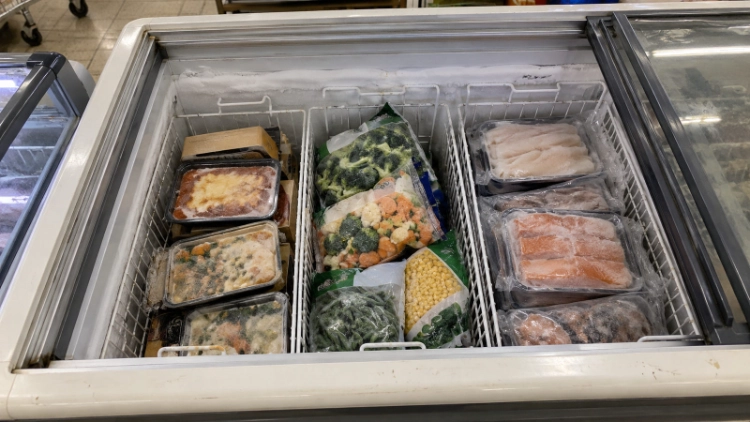
Loose bags need a different approach. Load representative samples into the proposed basket, count them, and repeat after normal handling. A tightly arranged demonstration may give a higher count than staff can reproduce during daily replenishment. Record the practical result rather than the best possible arrangement.
Match the SKU Mix to the Replenishment Interval
Capacity planning becomes more useful when it includes sales. The display does not have to hold every unit delivered to the store. It needs enough stock between planned replenishment rounds, with an allowance based on observed demand variation.
Allocate Space by Sales and Package Size
Suppose one ready-meal SKU typically sells 24 packs during the interval between replenishment rounds. A section holding 72 packs covers three such intervals under that assumption. Whether that is useful depends on the store’s stock rotation, promotional demand and backroom arrangements; extra display stock is not automatically better.
Now compare a seafood SKU selling 12 large trays over the same interval. A section holding 18 trays has much less cover despite occupying the same assumed compartment dimensions. Equal basket space does not mean equal stock availability.
Allocate space using both movement and package size. A fast-selling bulky item may need a larger section, while a compact slower seller may need fewer layers. Leave product identification visible and keep each SKU’s stock together so staff can replenish without repeatedly moving other goods.
Record replenishment timing as carefully as quantity. If staff can refill the cabinet before a busy evening period, the required starting stock may be lower than in a store with only one daily round. Use actual sales patterns rather than a fixed safety-stock rule applied to every category.
Keep Display Stock Separate From Backup Inventory
Large deliveries can tempt operators to treat a sales-floor cabinet as overflow storage. That may make sense only within its intended loading limits and temperature requirements. It does not justify stacking above the permitted height or mixing goods so densely that shoppers cannot reach them.
For island freezer basket loading, distinguish a visible selling layer from the stock beneath it. Check whether labels remain recognizable as products are removed. Dividers help prevent neighboring SKUs from spreading into each other’s allocated space, but their thickness and position also affect fit.
Internal loading needs to work alongside island freezer placement planning. Staff and shoppers need convenient access to the cabinet, but a suitable location cannot compensate for a compartment arrangement that fails to fit the intended packaging.
Compare Cabinet Options Against Your Actual Product List
For example, Create Refrigeration offers ZAF1.4, ZAF2.1 and ZAF2.5 configurations with net capacities of 595, 678 and 850 liters respectively. Those differences help narrow the equipment options, but they do not establish fixed pack counts. The choice still depends on the dimensions and quantities of the goods being displayed.
The single island display chest freezer range includes sliding glass lids, digital temperature control, and divider baskets with bottom racks. Glass access helps shoppers view goods, while organized compartments support separation of frozen categories. Confirm the basket quantity, internal dimensions and supplied accessories for the selected configuration before completing the loading plan.
Across the island freezer range, compare the arrangement that fits the assortment rather than automatically selecting the largest liter rating. A cabinet with adequate volume can still be inconvenient if its sections do not accept the store’s wider trays or larger bags.
Prepare a short product schedule containing package dimensions, target display counts, SKU allocation and the expected replenishment interval. Ask for an internal loading drawing or a sample loading check against that schedule. Create also supports OEM/ODM work, allowing project requirements to be discussed before the equipment configuration is finalized.
Conclusion
Island freezer usable capacity is best assessed through a loading plan that can be reproduced in daily operation. Start with the stated capacity, verify the compartment boundaries, calculate pack fit and compare the result with sales between replenishment rounds. Before ordering, plan your freezer capacity around your product mix with Create Refrigeration and confirm the selected model’s loading arrangement.
FAQs
Q1: How many frozen food packs will fit in a 600-liter island freezer?
A1: There is no dependable universal count. Pack dimensions, baskets, loading height and the cabinet’s capacity measurement method all matter. Request an internal drawing, calculate each compartment and test representative products. A 600-liter rating alone cannot show how many bags, cartons or trays the display will accommodate.
Q2: Can baskets be removed to increase island freezer usable capacity?
A2: Only if the manufacturer permits that arrangement. Baskets or bottom racks may support product organization, separation and required clearances. Removing them can change loading conditions and customer access. Confirm an approved alternative with the supplier rather than assuming that every fitting is optional.
Q3: Should the island freezer hold a full day’s sales?
A3: Size display stock around the interval between replenishment rounds, expected peak demand and available backup storage. A full day’s stock may be appropriate where replenishment is infrequent. Stores with several planned rounds may need less on display, provided staff can refill promptly and maintain the required product temperature.