
A traditional chest island freezer can hold a large volume of frozen food, but its tall solid ends and high back panels often hide the products from anyone standing more than one aisle away. Customers may walk past without seeing the steaks, dumplings, seafood packs or ice cream inside. The cabinet occupies valuable central floor space, yet the selling message is visible only after the shopper has already stopped beside it.
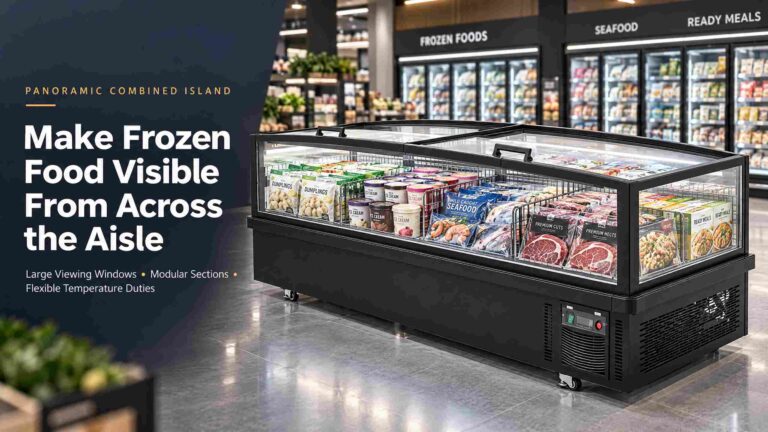
The Panoramic Large-Viewing-Window Combined Island Freezer / Chiller takes a more open approach to the centre aisle. Four-sided low-front glazing and broad tempered-glass end windows make the contents readable from several customer directions. End-cap modules and straight middle modules can be joined into a longer island line, while each cabinet section can be configured for a defined frozen or chilled duty.
For a store manager, the question is not whether more glass looks attractive. It is whether the glass brings more customers into the aisle, whether the cabinet holds temperature at the selected duty, and whether one failed module can be isolated without stopping the whole island. createrefrigeration designs this format around those practical questions: panoramic visibility, modular connection, insulated covers, service access and independently controlled refrigeration sections.
Panoramic Visibility in the Centre AisleEdepends on a shopper already knowing what is inside.
A large side window changes the approach distance. From the far end of the passage, customers can see frozen dumplings, prepared steaks, ice cream tubs and seafood packs through the side and front glazing. The product becomes part of the aisle view before the shopper reaches the cabinet. That matters in a central zone where an extra pause or an unplanned turn can produce a sale.
The glazing needs to be wide enough to provide a real sightline, not just a narrow decorative strip. Low-front geometry helps, but the internal basket height, product stack and shelf or divider position also determine what the customer can see. Do not fill the cabinet above the intended visual line with cartons. A full cabinet that hides its own products is still a poor display.
At temperatures around -18°C to -22°C, ordinary glass can frost or fog quickly. A panoramic island therefore needs insulated tempered glass, a suitable Low-E treatment where specified, and a controlled electric anti-condensation or anti-fog system. The glass package should be tested at the intended ambient humidity and product duty. A clear window during a dry factory demonstration does not prove clear operation during a humid summer trading day.
The side frames also need protection. A shopping trolley turning at the end of an island can strike a broad glass panel with surprising force. A continuous aluminum alloy bumper strip around the exposed lower perimeter helps spread the impact and protects the panel edge. Inspect the alloy thickness, corner join, fixing method and replacement procedure. A bumper that cannot be replaced without dismantling the island is not a practical maintenance detail.
CREATE Refrigerator approaches the combined island as a selling fixture and a cold-storage machine. The visual target is a low, open centre with enough glass to show the food, while the engineering target is a sealed insulated envelope that can maintain its assigned temperature. For store drawings, glass options and 3D traffic-flow planning, buyers can review project support through www.createrefrigeration.com.
Modular Island Lineups & Dual-Temperature Flexibility
The most useful island layouts are not made from one long cabinet that has to be replaced as a single piece. They are assembled from end-cap modules and straight middle modules. The end-cap can face the main customer route with a strong product message, while the middle sections extend the line along the planned aisle.
This arrangement helps with store growth. A small branch may begin with one end-cap and one middle unit. A larger store may add modules to create a back-to-back island. The final layout should keep end clearances, service access, fire routes and the customer turning space shown on the plan. A longer cabinet line is not automatically a better sales line if it blocks a cross-aisle.
Each module should have its own electrical supply, controller and refrigeration protection where the design calls for independent operation. The benefit is straightforward: if one compressor, sensor or controller fails, the affected section can be isolated while the rest of the island continues selling. This avoids a single fault turning into a complete centre-aisle shutdown.
The deep-frozen setting can support a supermarket frozen food display freezer for dumplings, ice cream, frozen vegetables and packaged convenience foods. A project may assign another module as a dedicated supermarket meat freezer, while a wet or seafood-related section uses a supermarket freezer for fish with a suitable internal finish and drainage arrangement.
Dual-temperature flexibility needs a clear technical definition. Some cabinets are designed for one temperature family with approved controller settings; others can be configured for chilled or frozen operation through a specific refrigeration package, valve arrangement and commissioning procedure. Do not treat a menu setting alone as proof of a valid temperature conversion. Ask for the approved operating range, refrigerant duty, evaporator capacity, defrost method, controller parameters and product limits for each mode.
When configured for a chilled duty, the same island footprint can become a supermarket island refrigerator for dairy, packaged ready meals, drinks or lightly chilled specialty products. The cabinet must then be cleaned, recommissioned and verified at the new setpoint before the product is loaded. Product safety depends on the measured operating condition, not on the name printed on the controller.
This module-by-module approach also simplifies maintenance planning. The service team can record the compressor model, controller, heater, fan and sensor for each section. A branch can keep one replacement gasket or controller for the correct module instead of treating the entire island as an unidentified assembly.
Low-E Sliding Lids & Practical Maintenance
The top cover is where display access and cold retention meet. Lightweight sliding Low-E coated glass lids allow customers to see and reach the product while reducing the open-air loss of an uncovered chest. The sliding action should be smooth enough for one hand but not so loose that a lid rolls open on its own.
Ask how the lid rollers, tracks and stops are cleaned. Frozen food packaging sheds ice, film and small particles. If the track traps debris, staff will stop closing the lid fully. A partially open lid becomes a direct heat leak and may produce frost around the glass edge.
The interior should use corrosion-resistant coating or stainless-steel surfaces according to the product duty. Removable wire baskets or dividers help separate dumplings, seafood, meat and ice cream so staff do not have to dig through a mixed pile. Confirm basket dimensions, load rating, drain access and whether the divider layout leaves enough space for air circulation.
Automatic defrost can use hot gas or electric heat, depending on the refrigeration design. The controller should manage the interval, termination condition, fan delay and condensate removal. A defrost cycle that ends too early leaves ice on the coil; one that runs too long adds unnecessary heat and recovery time. The buyer should request a defrost record during commissioning rather than accepting a generic “automatic defrost” statement.
The perimeter bumper, glass frame and lid tracks should be included in the cleaning instruction. A large island can appear clean from above while grease, packaging fragments and ice collect beneath the lower edge. Provide access for a vacuum, brush and wipe-down tool without requiring the removal of the whole module.
The industrial appearance can be compared with high-priced supermarket refrigerator freezer italian brands, but the useful comparison is broader. Review glass clarity at the target temperature, lid cycle testing, basket load, anti-fog performance, compressor access, controller documentation, spare parts and the cost of a damaged end panel. A good-looking island still has to survive carts, replenishment and repeated opening by customers.
From Customer View to Service View
Before approving the island, stand at the far end of the main aisle and photograph the display. Can the customer see the product category, or only a black side panel? Walk toward the cabinet from both directions. Does the end-cap attract attention without becoming a collision point? Can a staff member open the lid while another customer passes?
Then inspect the service side. Each module should have clear access to its electrical isolation, controller, condenser and drain or self-evaporation system. If the island is back-to-back, confirm that a technician can reach the affected section without dismantling a neighbouring unit. Draw the service position on the 3D layout, not just the sales position.
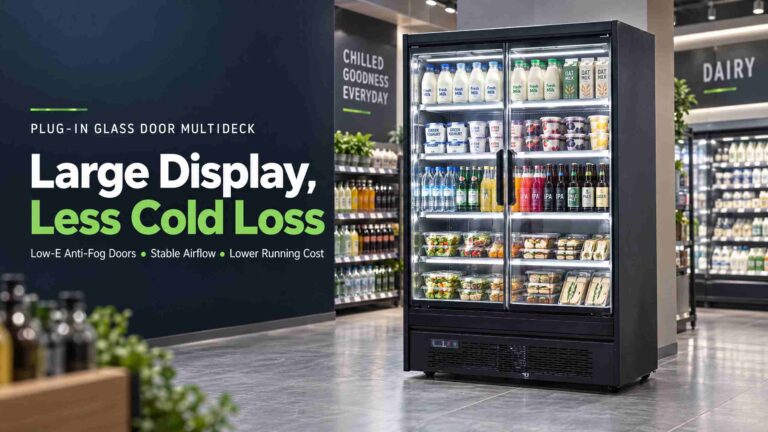
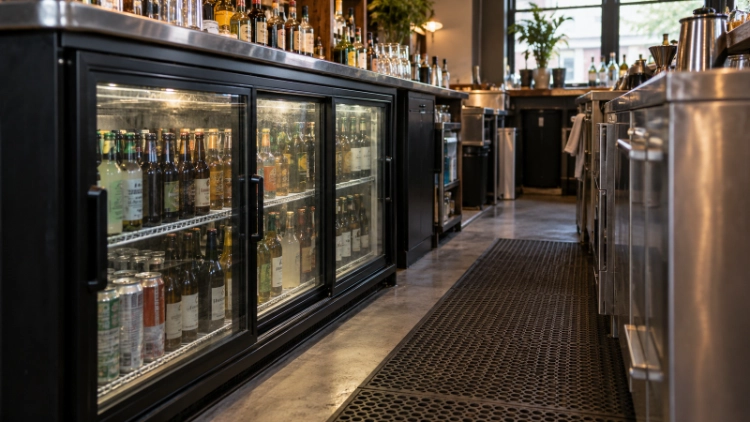
The island should also be coordinated with the rest of the store. A supermarket vertical showcase fridge can form the taller wall layer for dairy, beverages or packaged chilled items. A low commercial supermarket island can carry impulse products near the checkout or the cross-aisle. Together, these create a centre-low, perimeter-high visual structure that keeps the store open while giving each category a clear selling position.
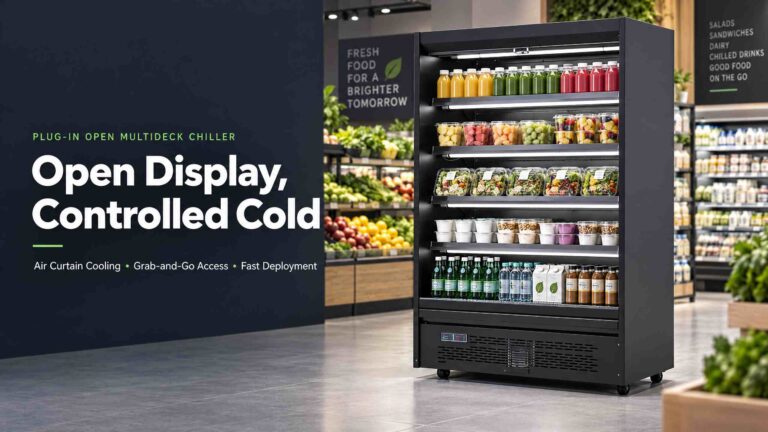
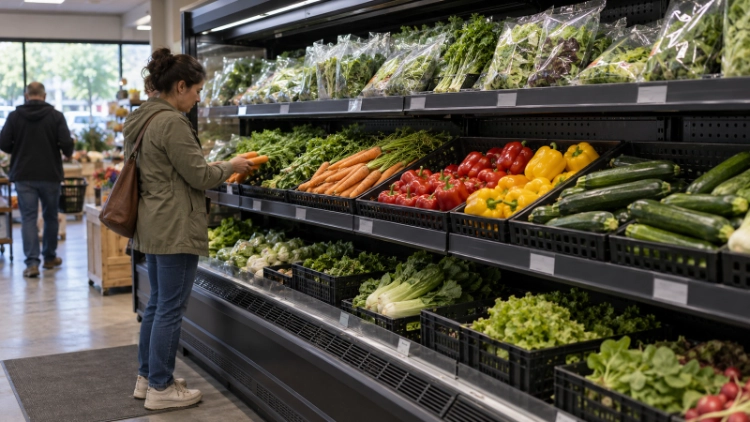
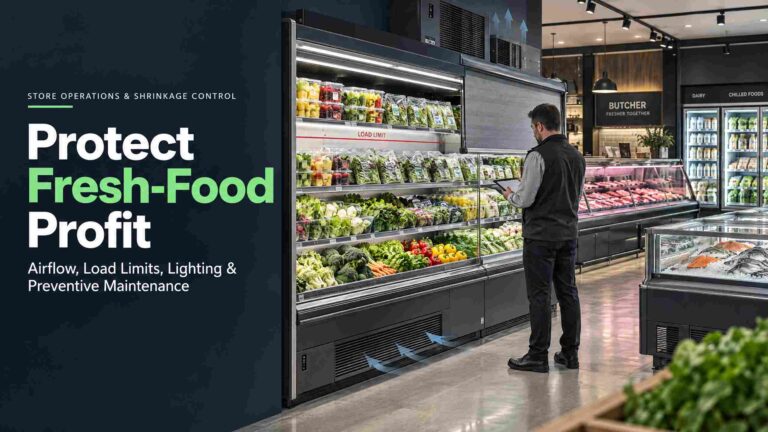
A nearby supermarket open refrigerator may be used for a store that displays fruits and vegetables in supermarket format, such as cut fruit, salad bowls and packaged herbs. Keep strong HVAC drafts and entrance air currents away from both the open case and the panoramic island. A moving cold-air sheet from one fixture can disturb the airflow of another and make the centre aisle uncomfortable.
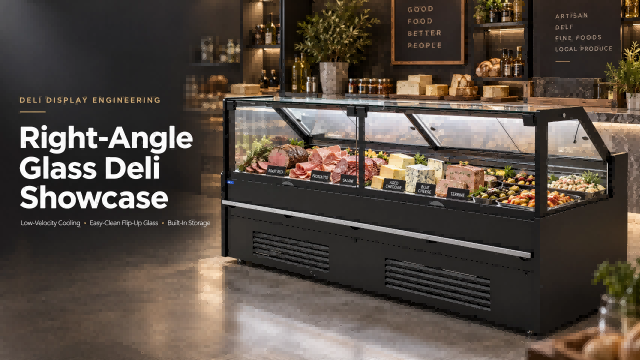
The fresh-food ring may include a supermarket meat display showcase refrigerator with high-colour-rendering lighting and easy-clean food-contact surfaces. Keep its cleaning route, replenishment route and electrical load separate from the frozen island where practical. Frozen condenser discharge should not be directed toward chilled meat or produce.
A general supermarket display cabinet schedule should record cabinet dimensions, module code, temperature duty, glass type, lid direction, electrical point, service clearance, drain strategy and delivery sequence. This prevents a common installation mistake: the right cabinet arriving at the wrong end of the island, with the lid opening into a queue or the service panel facing a fixed wall.
Independent Plug-In Operation and Fault Containment
Independent plug-in modules are useful in stores that remodel the centre aisle or operate different product categories under one island line. Each section can be commissioned at its own duty, provided the refrigeration package and control range support that application. The electrical design should separate circuits as required and label the isolation point for each module.
If one section trips, staff can move its stock to a safe temporary cabinet while the neighbouring modules continue operating. This is not an excuse to delay repair. It is a way to contain the commercial impact of a single fault. The maintenance log should record the time of failure, product temperature, alarm code, action taken and final recommissioning result.
Check the condenser ventilation around each module. A combined island can create a warm machinery corridor if the cabinet backs are packed tightly or the store’s HVAC return is poorly positioned. Heat rejection affects compressor head pressure and electricity use. Leave the manufacturer’s clearance and make sure the service team can clean the condenser without crawling into a dangerous gap.
Full-Store Layout Integration
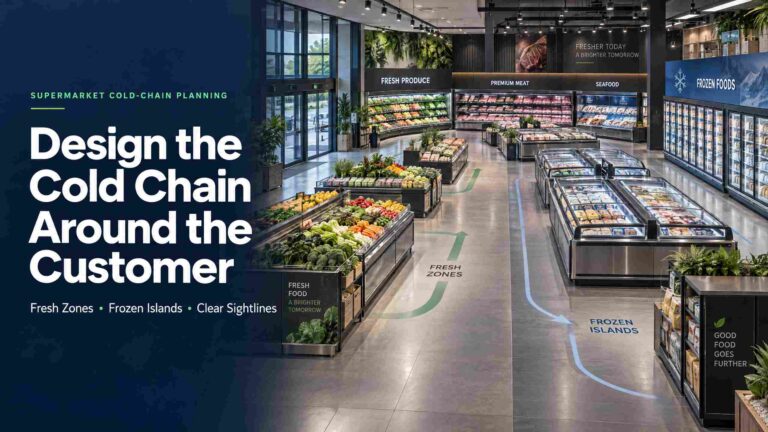
The panoramic island works best as the centre of a deliberate height hierarchy. Put the low glass island where it can be seen from the entrance or a cross-aisle. Use the end-cap for the product category with the highest impulse potential. Keep taller wall equipment around the perimeter or at selected ends, and preserve the main CCTV sightline.
For frozen food, separate the primary shopping aisle from the replenishment route. A delivery trolley should not have to cross the queue to refill the middle of the island. For seafood and frozen meat, plan the cold-room or back-stock connection before the floor finish is installed. For chilled dairy and drinks, place the supermarket vertical showcase fridge where door access does not create a conflict with the island lids.
A 3D store model should show product heights, customer eye lines, lid opening arcs, trolley turning space, end-cap impact protection, condenser access and the direction of nearby HVAC air. A plan that shows only cabinet footprints cannot reveal a visual blind spot or a service door blocked by a promotional stand.
createrefrigeration can coordinate module lengths, end-cap orientation, temperature duties, glass treatment, controls, bumper protection and shipping sequence as one source-factory project. Ask for a module schedule and a container loading plan if the island is being delivered with wall cases, meat equipment or frozen cabinets.
Technical Matrix
| Parameter | Panoramic Large-Viewing-Window Combined Island Freezer / Chiller |
| Display structure | Four-sided low-front panoramic tempered-glass windows; end-cap and straight middle modules |
| Temperature duties | Deep-frozen mode typically -18°C to -22°C; approved chilled/micro-frozen mode subject to configuration and commissioning |
| Glass and protection | Low-E sliding glass lids; anti-fog heating or controlled defrost; full-perimeter aluminum alloy bumper strip |
| Store integration | Independent plug-in control by module; removable baskets; 3D layout planning and ocean DDP project support |
Final Selection Advice
Choose a panoramic combined island when the centre aisle needs both storage volume and long-distance product visibility. The large windows make the contents visible before the customer reaches the cabinet. The modular structure lets the store build a line in stages and isolate a failed section instead of taking the whole island out of service.
Do not buy the glass on appearance alone. Test it at the intended frozen temperature, with humidity and product loading close to real conditions. Confirm the anti-fog method, lid track, basket layout, defrost termination, compressor access and bumper replacement. Confirm the temperature mode before switching a cabinet from frozen to chilled use.
The best store layout is usually centre-low and perimeter-high. Use the panoramic island as the visual draw, keep the service route practical, protect the broad glass panels from trolley impact and let the surrounding fixtures support rather than hide it.
For a free 3D rendered layout, module schedule, ocean DDP quotation or CAD-based equipment proposal, submit the store drawings to www.createrefrigeration.com. CREATE Refrigerator can provide source-factory coordination for panoramic glass, deep-freeze airflow, modular end-cap joining and the full island programme. For technical configuration and after-sales support, contact createrefrigeration with the product list, target temperatures and site conditions.