
A busy beverage aisle is a hard test for any refrigeration cabinet. Customers open the door, hesitate, compare two flavours, take one bottle, put another back and move on. During a rush, that cycle can happen every minute. If the door does not close squarely, if the gasket leaks or if the cabinet has a weak air path, the compressor pays for every lost degree.
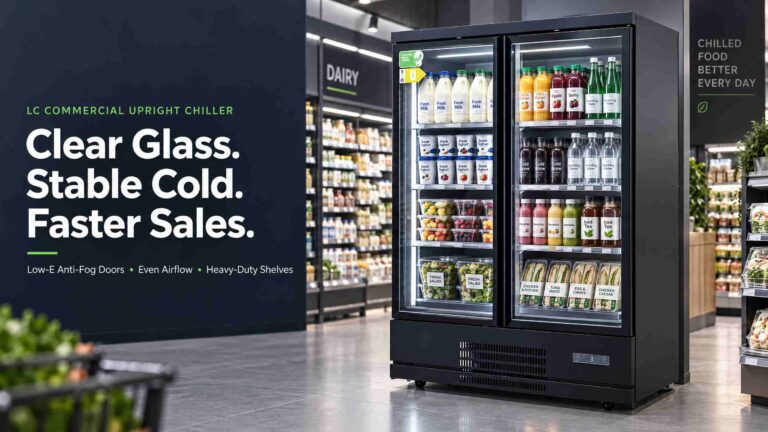
The LC Commercial Upright Glass Door Display Refrigerator is designed for this type of high-turnover retail duty. It combines a tall, visible display volume with insulated glass doors, forced-air cooling, adjustable shelves and an integrated refrigeration package. For a convenience store, supermarket beverage aisle, dairy wall or chilled ready-meal section, the cabinet has to do more than look clean under showroom lighting. It must keep product cold, make labels readable and survive daily loading.
createrefrigeration develops the LC format as a source-factory cabinet rather than a decorative shop fixture. The useful details are found in the door seal, shelf support, condenser access, glass heating control and rear air distribution. Those are the parts that determine whether the cabinet still performs after a year of real store work.
The Backbone of Beverage and Dairy Aisles
A high-transmission supermarket glass door refrigerator is often the main selling equipment in a convenience store. It gives the customer a clear view of cold drinks, milk, yoghurt, bottled water and ready-to-eat products without asking them to search through a deep chest. The vertical format also uses wall height efficiently, leaving the centre of the store open for customer movement and promotional islands.
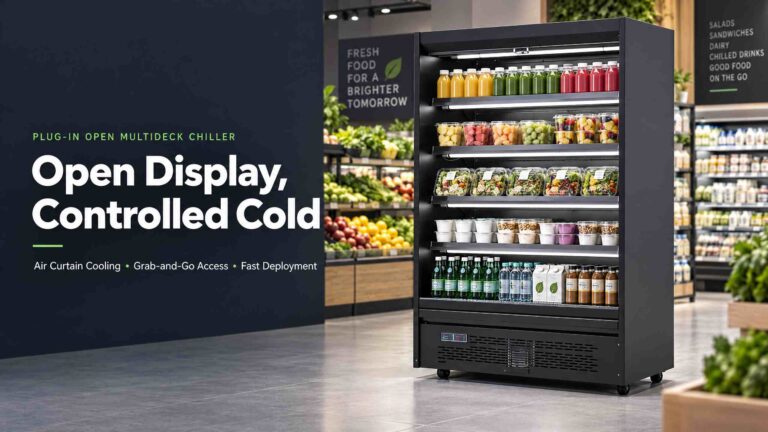
The LC cabinet works best where the product turns quickly and the front row is faced several times a day. A drinks operator can place the highest-margin bottles or cans between eye and hand level, keep larger multipacks lower down and reserve the top shelf for lighter items. Dairy products can be arranged by pack size and expiry date, while the rear rows remain accessible for replenishment.
Do not confuse clear glass with good merchandising. A cabinet may have bright lighting and still sell poorly if the shelves are too deep, the front rail blocks the label or the lower shelf is hidden by a dark plinth. The shelf pitch should be matched to the actual product mix before production. A cabinet designed around small cans may be frustrating when loaded with tall PET bottles and one-litre milk cartons.
In a store-wide layout, supermarket display fridges and supermarket display fridge freezers should not be scattered without a heat-load plan. A row of wall cases can create a strong dairy and beverage destination, but condenser discharge, service clearance and electrical circuits must be coordinated. The LC unit should have enough rear or front access for condenser cleaning and controller service after neighbouring cases are installed.
A well-specified LC cabinet can anchor a high-turnover drinks zone, while lower fixtures and aisle-end promotions guide customers toward it. In a convenience store, the same cabinet may sit beside the payment queue, where the last cold drink is often an unplanned purchase. In a large supermarket, several cabinets can form a consistent wall run with common signage and shelf spacing.
CREATE Refrigerator supplies the LC format for export projects that require defined dimensions, voltage, frequency, colour, door configuration and shelf layout. The cabinet schedule should state the expected ambient condition, product loading, temperature target and available service space. Buyers can request factory technical information and layout support through www.createrefrigeration.com.
Low-E Anti-Condensation Glass and Door Mechanics
Glass doors are exposed to the store atmosphere, so humid weather exposes weak design quickly. During a summer rainy season, warm moist air condenses on a cold pane and can fog the frame, handle side and lower edge. Customers see a grey film instead of a drink label. Staff wipe the glass repeatedly, but the problem returns as soon as the door is opened again.
Double- or triple-glazed Low-E tempered glass reduces heat transfer through the front and limits the amount of cold surface exposed to the room. A controlled anti-condensation heater in the frame helps keep the perimeter clear when humidity rises. The heating system should be matched to the climate and controlled by the cabinet design. Running a high-wattage heater continuously may clear the glass while adding an avoidable electrical load.
Ask for the glass build-up, Low-E specification, frame heater arrangement and ambient test condition. A dry factory room is not a meaningful test for a coastal convenience store in July. The buyer should request photographs or a test record from a humid operating condition where possible.
The door seal matters just as much. Check the magnetic gasket around the top, hinge side, centre mullion and lower corners. A paper-strip test should show reasonably even resistance around the perimeter. Hard spots, twists or loose sections allow warm air to enter continuously. That moisture later appears as condensation, frost or a long compressor recovery cycle.
A self-closing door is helpful only when the cabinet is level and the hinge is correctly adjusted. In a busy store, the customer may open the door 20 or 30 centimetres, pause, then walk away. The door should return smoothly without slamming, rebound or stopping short of the gasket. Heavy-duty hinges and a controlled closing action reduce heat exchange and protect the frame from repeated impact.
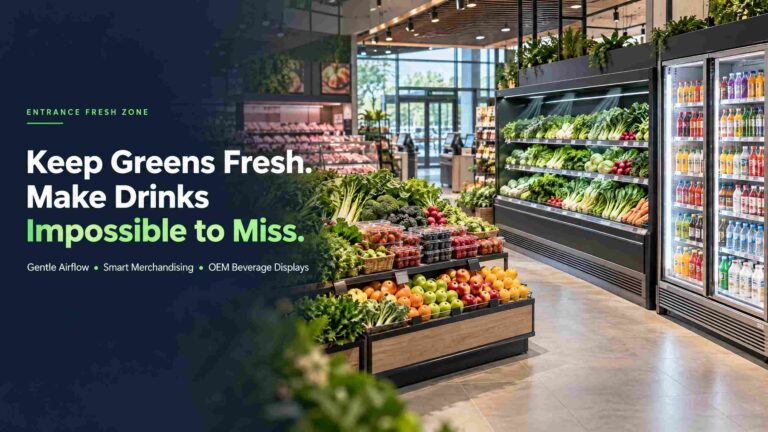
The LC design can use clear, narrow-frame glazing to keep more of the product visible. This is especially useful when building a bright supermarket juice display. Place colourful juice bottles, functional drinks and chilled fruit beverages behind the vertical LED strips, but keep the light source out of the customer’s direct eye line. A bright label sells better than a glare patch.
Forced-Air Uniformity from the Bottom Shelf to the Top
A tall cabinet needs a controlled air path. A rear perforated duct or multi-hole back panel distributes cooled air through the display, while the return path brings warmer air back toward the evaporator. The objective is not to create the coldest possible bottom shelf. It is to hold a stable product zone from the lower milk row to the top beverage shelf.
For general chilled applications, a practical operating range is commonly +2°C to +8°C, subject to the product, ambient condition, loading pattern and local food-safety requirements. The lower shelf should not freeze milk or yoghurt while the top shelf allows drinks to warm. Measure representative product positions with a calibrated instrument after the cabinet has reached stable operation.
Staff loading can break a good air path in minutes. They may push cartons against the rear panel, place a promotional tray over the lower return or stack bottles above the shelf’s intended front line. The cabinet then develops a short circuit: cold air returns too quickly in one section while another section receives too little circulation.
Mark the maximum load line on the shelf or side panel. Keep a narrow gap around the return area and do not use the floor of the cabinet as an extra pallet position. Heavy cases of bottles also need proper shelf support. Low-quality clips can bend under a full carton, leaving the front edge low and making the next shelf difficult to adjust.
A high-quality adjustable shelf should have a defined load rating, secure rear support and a front rail that protects the product without hiding the label. Test the shelf with the actual drink cases, not with empty sample packaging. If a shelf bows after a week, staff will often move the stock to the floor and block the return air instead.
Door-opening tests should reflect real trading. Open the upper, middle and lower doors repeatedly, wait for the door to close and record the temperature recovery at the front and rear of the cabinet. A controller reading near the evaporator does not prove that the upper front shelf is stable.
Balancing the Entire Store’s Temperature Zones
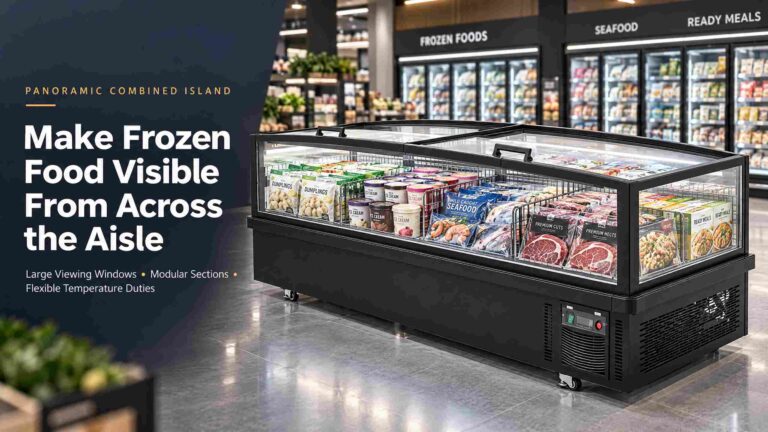
The LC cabinet is part of a larger cold-chain system. A wall-mounted display fridge supermarket line may sit near the dairy aisle, while a frozen zone uses a supermarket commercial display freezer and an island section uses a supermarket freezer island. These units may share a visual language, but they do not share the same duty, defrost load or heat rejection.
The electrical schedule should show compressor load, fan motors, frame heaters, lighting and defrost circuits. If several cases start or defrost together, the branch circuit may experience a peak that was not visible on the sales-floor plan. Balance circuits and label the isolator for each cabinet or cabinet group.
Condenser air is another source of conflict. Do not direct the warm discharge from a freezer toward the intake or glass front of an LC chiller. Do not trap several plug-in cabinets in a decorative enclosure with no path for warm air to escape. Higher condenser temperature means higher head pressure, longer compressor operation and more stress on the electrical components.
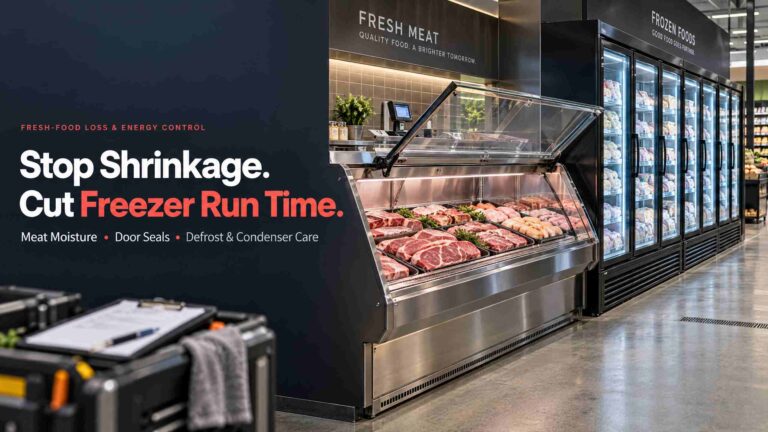
The fresh-food ring may include a supermarket seafood display case and a meat freezer supermarket reserve unit. The seafood case needs cleaning access and finishes suited to wet, salty handling. The meat freezer has a different low-temperature duty and should not be used as a chilled storage cabinet simply because it is nearby. Map the product temperature, cleaning route, replenishment route and service position on the store plan.
A good equipment mix uses the LC cabinet for fast-access chilled products, open or specialised cases for fresh foods and dedicated frozen equipment for deep-frozen stock. This avoids the common mistake of forcing one cabinet type to cover every temperature zone.
Export Build Quality and Service Details
For export procurement, the nameplate is only the beginning. Ask for the compressor model, refrigerant, controller, fans, evaporator construction, heater rating, glass type, shelf load, gasket profile and electrical data. Well-known hermetic compressor options may be specified according to destination service availability and cabinet duty.
R290 is an environmentally preferable refrigerant option for many commercial applications, but the charge, component selection, markings, installation and service procedure must follow the destination market’s requirements. Request the refrigerant charge and safety documentation before approval.
The condenser needs a practical cleaning route. Dust and greasy residue reduce heat transfer, especially in stores close to a loading dock, bakery or busy road. A manager should schedule condenser inspection and cleaning at an interval suited to the store environment rather than waiting for a temperature alarm.
For export shipments, ask for suitable wooden-case protection or approved export packaging that protects the glass, corners, shelves and control panel. If the destination requires fumigated timber, obtain the certificate. If compliant fumigation-free packaging is used, keep the relevant declaration with the shipping documents.
The door, shelf and controller spare-parts list should travel with the cabinet serial numbers. A replacement magnetic gasket is inexpensive compared with a week of excessive compressor operation. A shelf clip is small, but without it staff may overload the wrong shelf and block the airflow.
The source factory can coordinate LC cabinet dimensions, door count, shelf layout, LED position, electrical specification and export packing as one source-factory order. The buyer should still approve a final drawing and request photographs of the actual production batch before shipment.
How to Estimate the Energy Payback
The correct comparison is not a brochure claim against a theoretical cabinet. Measure the existing case before replacement. Record daily kWh, compressor run hours, room temperature, opening hours, product load, setpoint, lighting and defrost or heater operation.
After installation, repeat the measurement under similar trading conditions. A glass-door cabinet may reduce uncontrolled cold-air loss compared with an open case, but its frame heaters, fans and lights also use electricity. The net result depends on the door gasket, opening frequency, ambient humidity, night operation, condenser cleanliness and product loading.
The payback should include product protection as well as electricity. Stable temperature can reduce warm product, frozen milk, shortened shelf life and shrinkage. Clear glass can improve sales of drinks and dairy. Easier shelf adjustment can reduce replenishment time. These benefits belong in the store’s operating review.
Compact Technical Specification Table
| Parameter | LC Commercial Upright Glass Door Display Refrigerator |
| Temperature and airflow | Typically +2°C to +8°C; forced-air circulation; rear perforated duct; controlled return path |
| Glass and doors | Double- or triple-glazed Low-E tempered glass; anti-condensation frame heater; self-closing heavy-duty doors |
| Refrigeration package | Hermetic compressor; R290 option subject to destination requirements; controller, evaporator and condenser matched to duty |
| Display and export build | Adjustable heavy-load shelves; vertical LED lighting; removable magnetic gasket; export wooden-case or compliant fumigation-free packaging |
Final Buying View
The LC cabinet is a practical choice when a store needs tall chilled capacity, clear product visibility and controlled access in a high-turnover aisle. Its performance depends on details that staff and engineers can check: the glass must stay clear in humid weather, the doors must close against the gasket, the shelves must carry real beverage cases and the rear air path must remain open.
Do not judge the cabinet only by the first day’s appearance. Run a door-opening test. Load the actual milk cartons and drink bottles. Measure the upper and lower shelves. Inspect the condenser after a month in the real store. Check the gasket before a rainy season. These simple steps reveal more than a catalogue photograph.
When the LC cabinet is planned beside frozen islands, seafood cases and meat freezers, balance the circuits, heat discharge and replenishment routes across the whole store. The best cabinet can still waste energy if it is installed against a hot condenser outlet or maintained with a leaking door seal.
For quotations, factory specifications, export packaging details and 3D store-layout support, contact createrefrigeration through www.createrefrigeration.com. CREATE Refrigerator can help configure the LC cabinet for beverage, dairy and chilled-food applications, but the final energy return will be determined by the store’s loading, door discipline and maintenance routine.