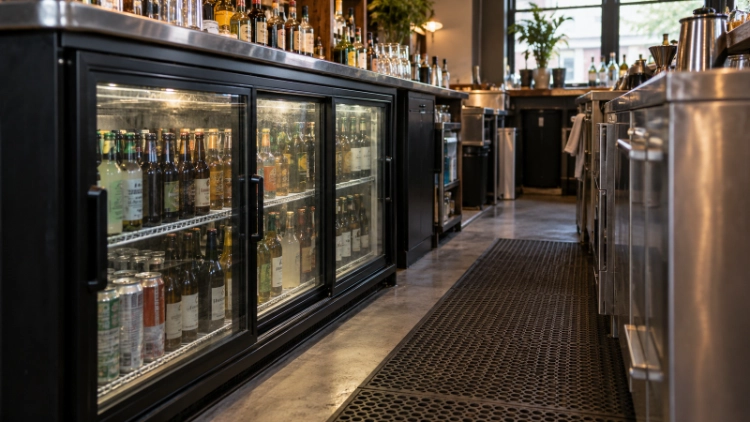
Sliding doors suit a back bar where an open door would interrupt the staff aisle. Hinged doors often give more direct access to an individual compartment, provided there is room for the door and the person loading it. Choosing between these back bar cooler door types starts with the movement in front of the cabinet, rather than its closed dimensions alone.
A refrigerator can fit beneath the counter yet remain awkward during service. A bartender may need to step aside before opening it, or a delivery crate may fit the shelf but not the clear doorway. Those problems become visible when the cabinet is tested with the drinks, people and replenishment routine it will actually serve.
Measure the working aisle with a door open
Measure between the finished cooler front and the nearest obstruction opposite. Include handles, projecting counter edges, waste bins and the places where staff normally stand. A measurement between two walls can overstate the space available once equipment is installed.
For a hinged model, the relevant drawing includes the hinge position, door width and opening angle. The door sweeps through an arc, so a clear rectangle in front of the cabinet does not describe every possible collision. An adjacent return counter can stop the leaf before it reaches a useful loading position.
A simple layout example illustrates the problem. Assume an aisle measures 1,000 mm between equipment fronts and a selected door projects 450 mm into it when open. Only 550 mm remains at that point before allowing for the operator. These are hypothetical planning dimensions, not a recommended aisle width or a clearance specification for any model. Actual circulation and access requirements need separate checking.
Mark the proposed cabinet front and door movement on the floor with tape. One person retrieves a bottle while another follows the normal route past the station. Repeat with a replenishment carton. The test reveals whether the open door interrupts the service path, even when the closed cabinet appears to fit comfortably.
Sliding doors remove the swing arc
A sliding door back bar refrigerator keeps the main door movement along the cabinet face. Staff still need room to bend, carry stock and clean the front, but they do not need to step around a swinging leaf. This is useful opposite an ice well or another station that is occupied throughout service.
Sliding panels also overlap. The accessible opening depends on the panel arrangement and travel stops, and it may expose only part of the interior at one time. Check the clear opening on a drawing or demonstration instead of assuming that the whole cabinet width becomes available.
Hinged doors need a usable opening angle
A hinged door can expose its compartment clearly, making it easier to see the back row or remove a shelf. That advantage disappears if a wall, handle or neighboring cabinet limits the opening. Hinge handing also changes where the operator stands and which hand reaches naturally into the cooler.
Compare access during service and restocking
| Service condition | Sliding doors | Hinged doors |
| Narrow aisle opposite a working station | No door swing across the aisle | Door movement can interrupt passage |
| Loading a wide tray or carton | Opening may be restricted by panel overlap | Compartment access can be more direct |
| Two staff retrieving drinks | Check which sections can open together | Check adjacent leaves and staff positions |
| Cleaning door hardware | Tracks and guides need access | Hinges, gaskets and closing action need inspection |
A busy bar does not retrieve every drink equally often. If the most popular bottles sit behind one panel, staff repeatedly use that opening while the remaining space serves slower lines. On a sliding model, the parked panel may temporarily cover a neighboring selection. On a hinged model, the same repeated opening may block the route to the till.
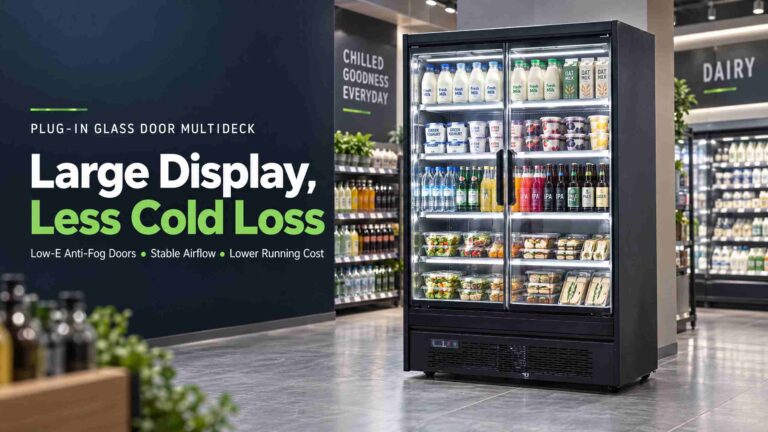
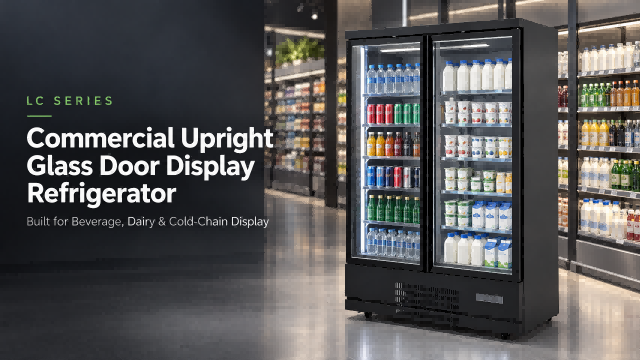
Place high-volume drinks where they can be reached from the normal service position. Reserve harder-to-reach rows for slower products rather than making staff twist around the door for each order. This arrangement is especially worth checking on a 3 door beer cooler serving several workstations.
Restocking creates a different movement. Loading individual bottles through a sliding opening may be straightforward, while placing a whole tray can be awkward. With hinged doors, a wider approach may help, but the operator and carton occupy the aisle for longer. A bar that replenishes before opening can tolerate a different arrangement from one that must replenish continuously.
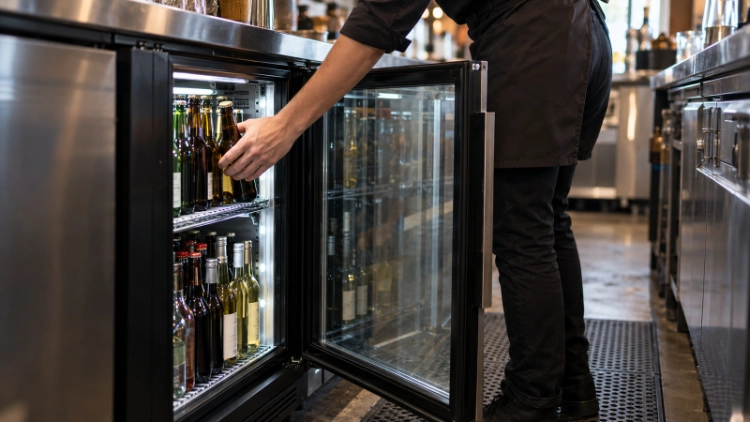
Bottle height matters here too. A tall bottle may clear the shelf above once upright but still need extra room to tilt through the opening. Trial the largest bottle, the widest multipack and the container used for replenishment. Published liters do not answer those access questions.
Closing behavior and maintenance affect the choice
Door style alone does not establish which cooler uses less electricity. Opening duration, room conditions, glass construction, seals and the refrigeration system all influence operation. A door that closes reliably after each retrieval can be more useful than a theoretically preferable design that staff routinely leave open.
Self-closing action is a feature to verify on the selected version. Some sliding doors use a return mechanism, while some hinged assemblies combine self-closing action with a hold-open position. The Krowne sliding-door refrigeration specification includes self-closing doors on that product family. It does not establish that every sliding cooler has the same mechanism.
At a demonstration, open the door by different amounts and release it as directed by the manufacturer. Watch whether it returns fully without a bottle, shelf or loose packaging catching it. A deliberate hold-open function should be distinguished from a door that fails to close because the cabinet is not level or the hardware needs attention.
Sliding tracks can collect spilled drink residue and debris. Cleaning access depends on whether the panels can be safely removed and how the guides are constructed. For hinged units, inspect the accessible gasket surfaces and hinge area. Follow the model instructions before removing glass doors or adjusting hardware.
Replacement parts deserve a place in the purchase discussion. A damaged roller, guide, hinge or gasket needs to match the assembly fitted to the cabinet. Keep the model identification and door version with the service records, especially when several apparently similar coolers are supplied to different sites.
Test the proposed door arrangement before ordering
A useful acceptance trial follows one short service sequence. Retrieve the fastest-selling drink, reach for an item in the back corner, return a misplaced bottle, and load the largest replenishment container. Run the sequence from the position where the bartender will actually stand.
Then repeat it with a second staff member working at the neighboring station. Record specific interruptions: a door touches a counter, the operator blocks the ice well, or a sliding panel covers the next required section. Those observations are more useful to a supplier than a general request for an ergonomic cooler.
For a retrofit, photograph the service area with the current doors open. Add measurements for the counter underside, skirting, nearby sockets and the route used to bring in the new cabinet. Include ventilation and service access from the selected installation instructions. A door change cannot compensate for an enclosure that prevents the refrigeration equipment from rejecting heat.
Apply the layout to a specified back bar model
Create Refrigeration offers back bar cooling with a choice of sliding and hinged doors, alongside adjustable shelving and LED lighting. Those details allow the beverage arrangement and service route to be considered together. The door option should be identified explicitly in the quotation rather than left as an assumption based on a catalog photograph.
The three-door back bar beverage cooler includes BC-349 and BC-349Y versions with listed external dimensions of 1,350 × 520 × 840 mm and 300 L net capacity. These dimensions describe width, depth and height respectively. They establish the closed cabinet footprint, not the clear door opening, bottle count or required operating aisle.
Two adjustable shelf levels help accommodate different bottle formats, while insulating glass and interior lighting support product identification. Before ordering, confirm the selected door arrangement, actual shelf spacing and usable loading aperture. Model suffixes should be matched to an approved drawing; a suffix alone is insufficient evidence of door configuration.
Within the broader glass door cooler range, compare units by their intended placement and access requirements. A tall display cabinet and a low back bar refrigerator solve different working problems even when both show bottled drinks behind glass.
Send a measured sketch and beverage list to plan the back bar door configuration. Include the busiest retrieval position, largest bottle and replenishment container, together with the required power supply. That gives the supplier a practical basis for checking the version before production.
Conclusion
Sliding doors are a strong candidate when the swing arc would interfere with staff movement. Hinged doors remain practical where the opening angle and loading position are clear. The deciding test is whether staff can retrieve, replenish and clean without repeated obstruction. Approve the door arrangement on the drawing and check it against the real service routine before ordering.
FAQs
Q1: Are sliding doors always better for a narrow back bar?
A1: They remove the outward swing, but the remaining opening may limit access to wide cartons or certain shelves. Test the panel travel and staff position with real drinks. A sliding arrangement works well when it resolves an aisle conflict without creating an awkward loading restriction.
Q2: Can hinged back bar cooler doors be changed to sliding doors later?
A2: Do not assume a conversion is available. The frame, tracks, seals and glass assemblies can differ. Ask the manufacturer whether an approved conversion exists for the exact model. Choosing the correct door version before production is usually simpler than investigating a retrofit after installation.
Q3: How much clearance does a hinged bar fridge door need?
A3: Use the model drawing for the opening angle, hinge location and handle projection, then allow for the operator and required passage. There is no single clearance suitable for all hinged bar fridge doors. Ventilation and service clearances are additional requirements in the installation instructions.