
As more businesses evaluate the real expenses behind running a commercial cooler each day, the discussion often shifts from simple electricity estimates toward a broader view of total operating impact. Store owners look not only at power draw but also at long-term reliability, daily workload, and the cooling performance required for different environments. Because of this, many retailers now prefer a clearer method to break down hourly costs. They want something practical, easy to apply, and accurate enough for real-world planning. This growing interest also highlights the value of choosing equipment designed with stable efficiency in mind. That is why companies often turn to Create Refrigeration, whose systems focus on dependable cooling and reduced energy loss. With this context in place, you can now explore the major factors that shape hourly operating cost and how to calculate them correctly.
Key Factors Influencing the Hourly Operating Cost of a Commercial Cooler
Components That Determine Operating Cost
To figure out the hourly running cost of a commercial cooler, consider more than just power use. A full view covers electrical needs, upkeep, wear and tear, and outside conditions.
The main factor right away is power usage. These coolers depend on compressors, fans, and control parts. The listed power input, usually in watts, sets the basic amount. However, the real power pull changes with how the compressor works. For example, a unit rated at 500W that operates 60% of the time uses 0.3 kWh each hour (500W × 0.6). How you use it and the room temperature can boost the running time. As a result, this raises the running cost.
Upkeep matters too. You need to clean condenser coils often. Check fans regularly. Calibrate thermostats. Inspect refrigerants. If small problems go unfixed, they can cause more power use or failures later. So, spread out yearly service costs over the hours the unit works each year.
Wear and tear impacts the overall cost to own. Take a cooler that costs $2,000 and lasts 10 years. Suppose it runs 12 hours a day. That gives 43,800 total hours. It works out to about $0.046 per hour for equipment spread out.
Finally, things like warm room air and doors opening a lot cut down cooling work well. Places with lots of customer activity may need the compressor to turn on more often. This helps keep the set temperatures steady.
Energy Efficiency Ratings and Their Cost Impact
Energy efficiency labels let you compare units. They help predict running costs better. Most commercial coolers show yearly use figures, like kWh per year. Divide that by total hours in a year to guess hourly use.
Newer tech, such as inverter compressors, changes power based on the need. By using the top-tier brand inverter compressor known in the field, we make sure the item saves energy. It runs steady and can cut power bills by up to 50% in one year. Eco-friendly options like R290 boost heat transfer and have less harm to the planet’s warmth.
When you look at coolers of the same size, ones with double-glazed glass doors, LED lighting, and better air flow usually do better. These simple design choices lower the work on the compressor. They also shorten its running time.
Step-by-Step Method to Calculate Hourly Cost of a Commercial Cooler
Power Consumption (kWh) Per Hour
Begin with the power input rating from the specs. For instance, a commercial cooler with a 500W compressor could use 0.5 kWh per hour at full work. But compressors do not run all the time. They turn on and off based on sensors inside for temperature.
If the duty cycle is usually 60%, the actual use becomes 0.5 kWh × 0.6 = 0.3 kWh per hour. This number can change with heat around it and how often stock moves. In warm areas or stores with lots of action, the duty cycle might go up to 80%.
Calculating Energy Cost Based on Local Utility Rates
After you find the hourly kWh use, multiply it by your area’s power price.
For example, 0.3 kWh × $0.12 per kWh equals $0.036 per hour. If your power company charges extra during busy times, adjust for that. You might add smart timers or IoT setups. These help run the cooler less during high-price periods.
Including Maintenance and Depreciation in Hourly Rate
Suppose yearly upkeep costs $240 for the unit. If it runs 12 hours a day, that’s about 4,380 hours per year. Then, $240 divided by 4,380 comes to $0.055 per hour.
Now think about wear and tear. For a $2,000 unit that lasts 10 years, divide $2,000 by (10 × 4,380). That gives $0.046 per hour.
The total for non-power hourly cost is $0.055 plus $0.046, which equals $0.101 per hour. Add the power cost of $0.036 to that. You get a full guess of $0.137 per hour.
Application: Analyzing Create Refrigeration’s Commercial Coolers
SHANDONG CREATE REFRIGERATION CO.,LTD. sits in Xingfu Industrial Park, Binzhou City, Shandong Province, China. Our products fit every country’s market. They reach first-level energy saving and level 1 energy use. The items show steady work, safer food storage. Their builds focus on inverter compressors, R290 refrigerants, LED lighting, and strong insulation. All these help cut hourly costs. At the same time, they keep strong cooling.
Look at their range on the Create Refrigeration site. There, you will see options made for supermarkets and small shops around the world.
2-Door Upright Beverage & Ice Cream Cooler – Performance Overview
This tall cooler has an energy-saving compressor (Secop). It uses a copper tube evaporator, automatic defrost system, and microcomputer-controlled temperature regulation.
LED lighting at 6000K gives clear views inside. It uses little power. The unit picks R404A or R290 refrigerant based on your choice. Both work well, but R290 saves more energy.
Assume a rated input of about 500W and normal use. Then:
- Duty cycle: 60%
- Electricity rate: $0.12/kWh
Energy use is 0.5 × 0.6 = 0.3 kWh per hour. Cost is 0.3 × $0.12 = $0.036 per hour.
Add upkeep at $0.055 and wear at $0.046. The total hourly cost comes to about $0.137 per hour.
See details on the 2 Doors Commercial Upright Beverage & Ice Cream Cooler. It covers exact size and work specs.
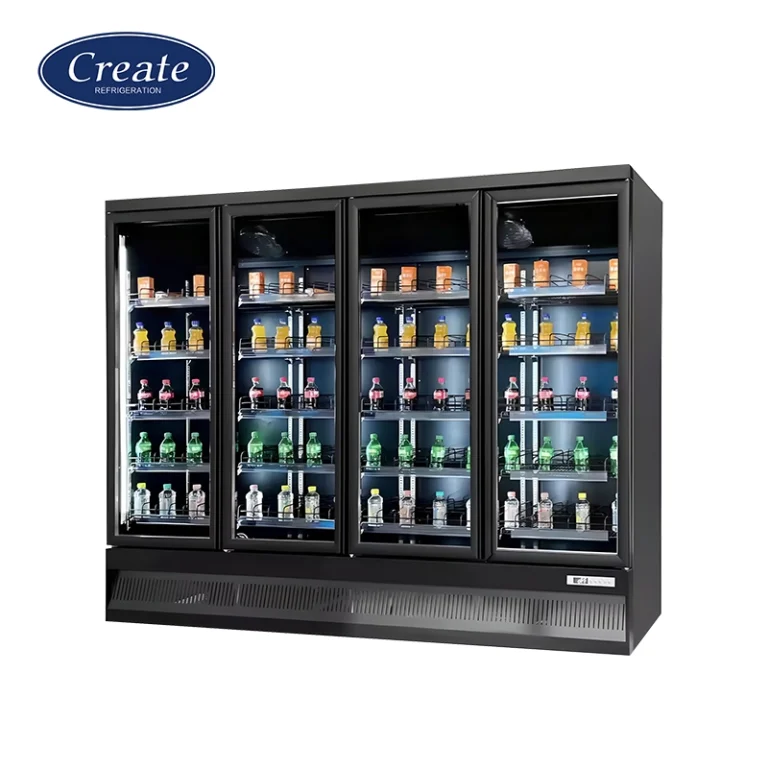
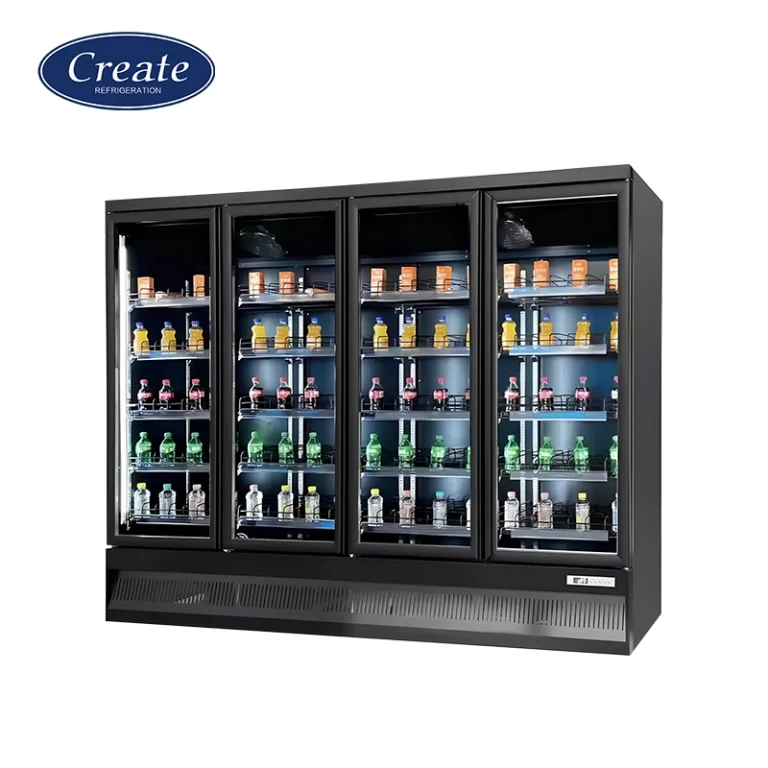
Door Upright Showcase Slim Cold Drink Organizer – Energy-Saving Advantages

This cooler holds more with a thin shape. It suits big display spots with small floor area. Double-layer insulating glass holds inside temperatures even. It cuts loss of cold air.
Doors that close on their own limit extra compressor starts during busy times. Five shelves you can adjust improve air flow inside the unit.
Its use of frequency conversion lowers power needs further. In some cases, it saves up to 55%. This fits stores that stay open long.
In a full supermarket with quick stock changes:
- Duty cycle might reach 75%
- Rated input: ~700W
- Hourly kWh: 0.7 × 0.75 = 0.525
- Cost = 0.525 × $0.12 = $0.063 per hour
- Total with upkeep and wear comes to about $0.164 per hour
Look at full specs for the 4 Door Commercial Upright Showcase Slim Cold Drink Organizer. See how it matches your store’s space and customer movement.
Additional Considerations for Accurate Cost Assessment in 2025 Context
Regulatory Shifts and Refrigerant Compliance
Rules for the environment change fast. They push for refrigerants with low GWP and tough energy rules. Create stays true to using green R290 refrigerants and fresh energy-saving materials in products. We aim for top efficiency and saving power. This leads to a greener way of life.
Check if units meet future rules. This avoids high costs for changes or early swaps due to issues with refrigerants or energy labels.
Leveraging Smart Controls for Operational Insight
Today’s coolers link with IoT systems for live data records and far-off access through digital thermostats. These aids let you set temperatures right for the load or time. They cut power without risking product safety.
Such tools also plan upkeep ahead. This stops breakdowns that raise power use or cause waste from spoilage.
Advantages of Choosing Create Refrigeration Products for Operational Efficiency
Design Innovations That Lower Total Cost of Ownership
By picking the top-tier brand inverter compressor known in the field, we make the product save energy. It runs steady and can reduce power bills by up to 50% in one year. Shelves in modules let you set up per product size. Easy-to-use access speeds up adding stock.
Strong parts cut how often you replace them. This stretches your return on money over years. It also lowers service costs.
Proven Stability in Real Retail Environments
The steady work under changing loads, like in supermarkets or small stores, means fewer issues. It handles tough heat spots or places with many customers.
No matter seasonal high times or uneven stock patterns, these coolers keep temperatures firm. They ensure safe food and control costs well.
Comprehensive Support Services from Create Refrigeration
img.OEM/ODM custom work.webp
Full Lifecycle Support from Installation to Maintenance
We keep a skilled service team. They offer OEM/ODM custom work, standard items, changed products, and made-to-order ones. This meets all customer wants fully. Their after-sales setup includes shipping cover and parts supply for big orders. It cuts store stoppages during fixes.
Tech experts help with first setup. They place units to get the best air flow in your shop area.
Easy Contact Channels for Expert Assistance
Reach their group by phone or email. Or send questions through the site form. Get advice on picking models or saving-energy plans fit for your business.
FAQ
Q: What factors have the biggest impact on my cooler’s hourly operating cost?
A: Power use from compressor on-off times drives it most. Upkeep costs and wear over time follow close.
Q: How can I lower my commercial cooler’s electricity usage?
A: Pick units with inverter compressors, double-glazed doors, LED lighting, and R290 refrigerant. All these cut running time and power pull.
Q: Can I monitor my cooler’s energy use remotely?
A: Yes, many new units have digital thermostats. Or they link with IoT setups for far-off checks and power tweaks.