
By an industry reporter and refrigeration energy auditor
October 2026
The Retail Margin Squeeze
Independent grocers are discovering that the refrigeration line has become a profit-and-compliance issue at the same time.
For many small supermarkets and food markets, refrigeration can account for more than half of the store’s electricity use, especially where open cabinets, frozen-food cases, beverage coolers, and older plug-in units operate around the clock. The exact share varies with the building, climate, lighting load, and kitchen operation. The bill is still clear: a poorly sealed cabinet keeps drawing power long after the sales floor has emptied.
European non-household electricity prices averaged €0.1837 per kWh in the second half of 2025 for the Eurostat medium-consumption band of 500 to 2,000 MWh a year. Prices differed sharply by country, from €0.2552 per kWh in Ireland and €0.2264 in Germany to €0.0748 in Finland. 1 A small store does not buy power on the same tariff as that statistical band, but the figures show why peak-demand utility bills remain a boardroom concern.
The refrigerant clock is also moving. Under the EU F-gas framework, new stand-alone commercial refrigeration equipment has been pushed toward refrigerants with a GWP below 150 in several equipment categories. The European Commission lists R-290 propane, R-600a isobutane, and R-744 carbon dioxide among the non-fluorinated alternatives, while noting the associated safety classifications. 2 The regulation also restricts the use of high-GWP gases for servicing existing refrigeration equipment, with important dates and exemptions that operators must check with a qualified contractor. 3
In the United States, the EPA’s Technology Transitions program sets a GWP limit of 150 for retail-food stand-alone refrigeration products manufactured and imported from January 1, 2025. Other food-processing and dispensing categories have later dates and different limits. 4 The rule is not a blanket instruction to replace every cabinet tomorrow. It does change the replacement decision when an old compressor, leaking R-404A circuit, or obsolete controller is already consuming the maintenance budget.
That is the calculation behind the latest retrofit work. Store owners are no longer asking only, “What is the cheapest replacement?” They are asking how much energy the cabinet will use at the summer design temperature, whether the refrigerant can be legally charged and serviced, and how many years the investment needs to repay itself.
Upgrading High-Load Aisle Categories
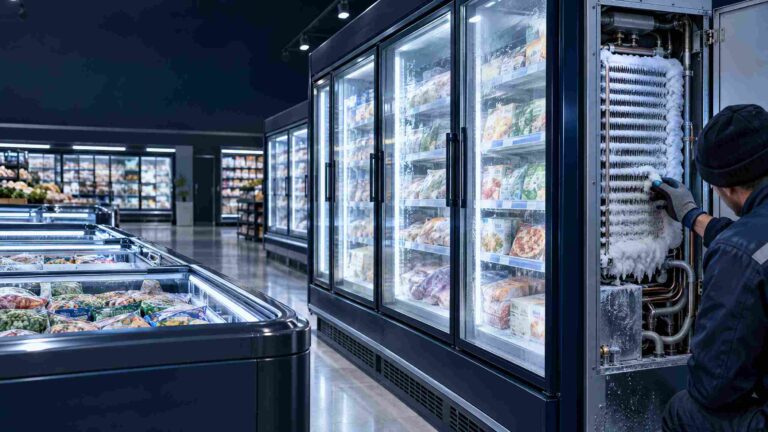
The first targets are the cabinets with the longest running hours and the heaviest air-infiltration load. An old open-front beverage case leaks cold air into the aisle all day. A freezer with a warped lid or weak door seal works harder to hold ice cream below temperature. A poorly positioned display cabinet can reject heat into the same room where another unit is trying to absorb it.
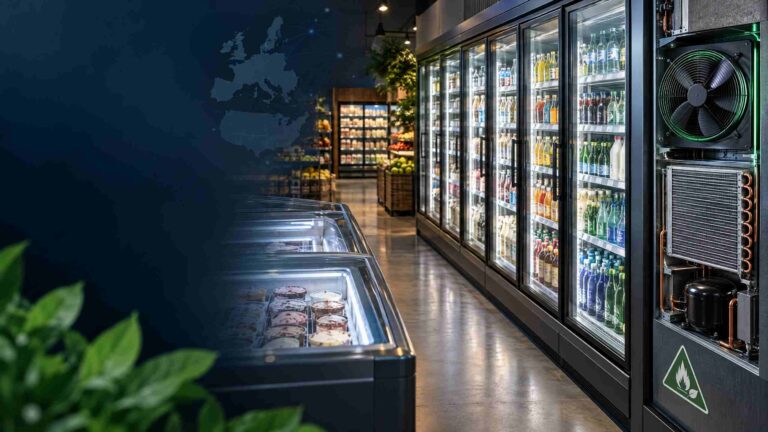
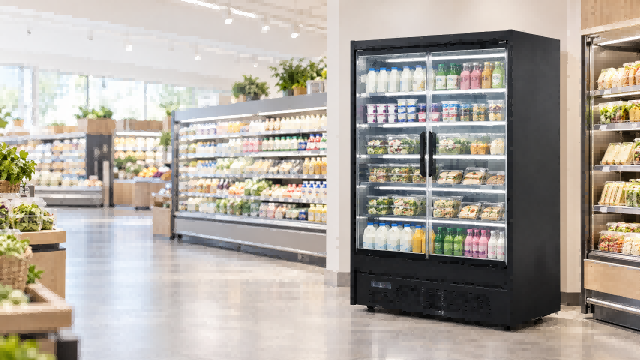
This is why operators are replacing older open cases with Low-E electrically heated doors on the supermarket beverage display line. The glass keeps the merchandise visible without allowing as much warm room air to reach the refrigerated space. The perimeter heater must be correctly controlled; excessive heat can erase part of the expected saving.
The same logic applies to a supermarket ice cream freezer. Better insulation, a tighter lid or door, and a stable electronic controller reduce pull-down time and limit compressor run hours. The upgrade is less dramatic than a new sales fixture, but the electricity meter notices it every night.
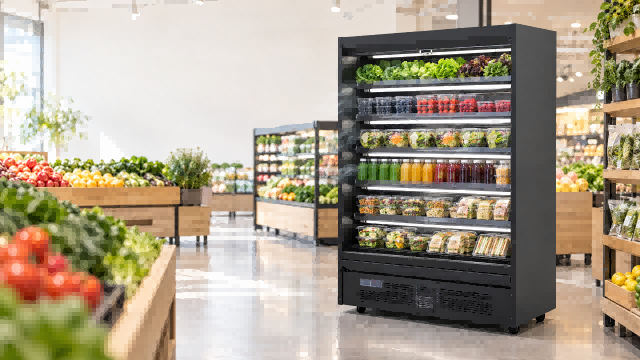
Fully enclosed doors are also changing the economics of the supermarket refrigerator showcase. A high-use cabinet that once relied on an open air curtain can move to a closed display format with heated glass, EC fans, electronic expansion control, and night setback. The store keeps the product visible while reducing infiltration at the busiest aisle.
The equipment category itself is not enough. A freezer supermarket replacement should be evaluated against door-opening frequency, ambient temperature, defrost method, condenser access, and the distance from the nearest heat source. A fridge for supermarket use may look efficient on a factory test sheet but lose that advantage if staff leave the doors open during replenishment or if the condenser is packed with dust.
Factory retrofit estimates from createrefrigeration put the potential operating-power reduction at roughly 35% to 45% for selected cabinet replacements, when the new insulation package, glass doors, controls, condenser, and operating schedule are matched to the store load. That range is a project estimate, not a universal guarantee. Site humidity, opening patterns, electricity tariff, product loading, and maintenance quality decide the result.
The proposed cabinet construction uses high-pressure foamed polyurethane insulation, tighter door frames, Low-E heated glass, and electronic temperature control. CREATE Refrigerator presents these changes as a factory-level response to the combined energy and compliance problem rather than as a cosmetic cabinet refresh. Technical specifications and application information are available through www.createrefrigeration.com.
Precision Cooling for Perishables
Fresh food gives the retrofit a second test: temperature stability must improve without drying product or creating hot spots.
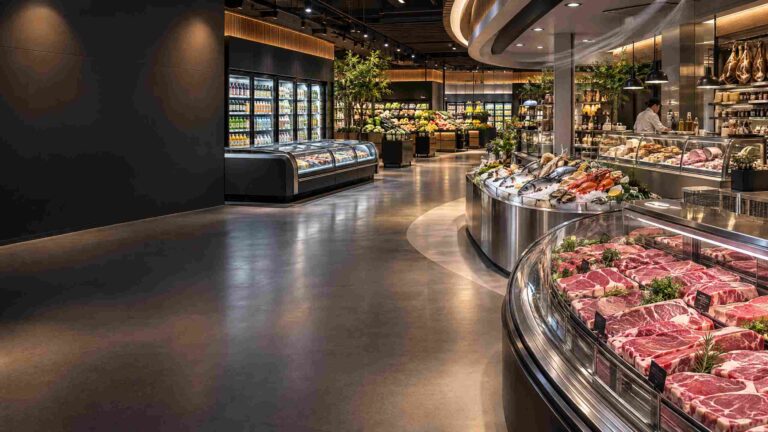
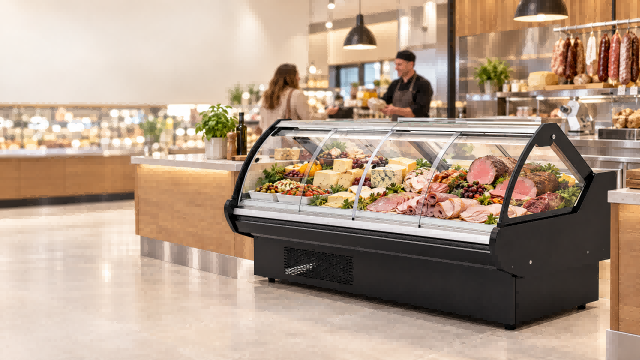
A supermarket meat display case needs steady air movement and a controlled product temperature. Excessive fan speed can increase dehydration and case noise. Too little air movement creates warm pockets behind a loaded tray. The correct setting depends on the cabinet geometry, product depth, and loading discipline.
A supermarket seafood chiller faces a different moisture and sanitation burden. Condensate management, drain access, and coil cleanliness matter as much as the nameplate compressor capacity. A cabinet that is energy-efficient when clean can become an expensive heater when its coil is coated with dust, salt residue, or packaging debris.
R-290 is gaining ground in smaller self-contained commercial cabinets because its GWP is extremely low. The trade-off is its A3 flammability classification. Charge limits, electrical component selection, leak testing, ventilation, service training, and applicable national standards must be part of the specification. A contractor cannot treat propane charging like a routine high-GWP HFC top-up.
Variable-speed compressors and EC condenser fans add another layer. Instead of running full capacity whenever the thermostat calls, the system can reduce speed after the cabinet reaches its holding load. In a beverage cabinet with long periods of partial load, this can lower cycling losses and improve temperature control. The payback depends on run hours and the local tariff.
The same analysis is being applied to mainline supermarket equipment refrigeration, where operators are weighing a repair against a cabinet replacement. A leaky old circuit may still cool, but the cost of repeated service, lost refrigerant, restricted parts supply, and inefficient compressors can exceed the value of keeping the box in place.
The factory layout team reviews cabinet placement, condenser exhaust, aisle traffic, door swing, service clearance, and refrigerant safety before final equipment selection. That review is particularly important where a new cooling equipment for supermarket package will sit beside a bakery, hot-food counter, or south-facing glass wall.
The procurement brief is becoming more specific. Buyers now ask for compressor efficiency at the store’s actual ambient condition, the EC fan control range, the microchannel condenser design, the insulation density, the glass-heater wattage, and the controller’s defrost logic. Those details affect the return on investment far more than a broad label such as “energy-saving.”
What the Retrofit Numbers Actually Show
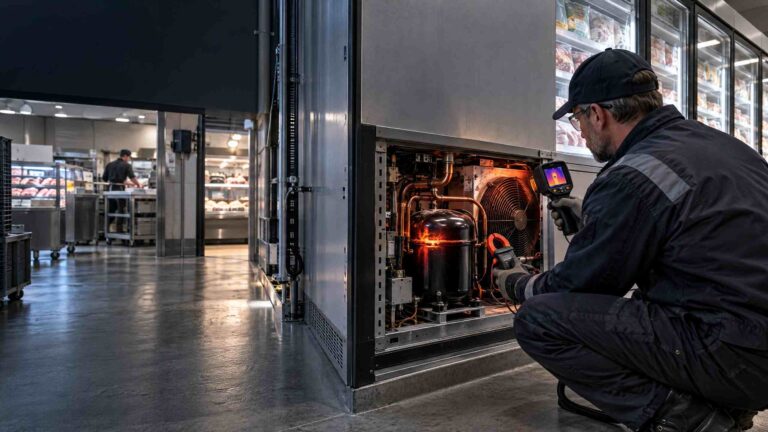
A typical independent-store audit starts with a two-week interval of meter data and cabinet measurements. The team records cabinet temperature, room temperature, door-open time, compressor current, condenser temperature, defrost duration, and peak demand. The figures are then compared with product temperature requirements and the store’s electricity tariff.
One European food-market retrofit found that the old open cases had been responsible for a disproportionate share of the evening load. Adding night covers reduced overnight infiltration. Replacing the most heavily used cases with heated Low-E doors lowered compressor run hours. Cleaning and opening the condenser path prevented hot discharge air from returning to the intake.
The savings did not come from refrigerant choice alone. R-290 helped the replacement cabinets meet the low-GWP direction, but the practical energy result came from the whole cabinet: insulation, doors, fans, condenser, controls, defrost, and maintenance access. That is the point many replacement budgets miss.
For the chain operator, the financial model is usually a simple ROI payback period. Divide the installed cost by the annual energy saving, then add the avoided emergency repairs and refrigerant work. If a cabinet has a short remaining life, a repair may still be sensible. If the compressor, controller, doors, and refrigerant circuit are all near the end of their service life, a staged replacement can protect cash flow better than another isolated repair.
2026 Supermarket Procurement Benchmark Table
| Equipment approach | Typical energy and refrigerant position | Practical ROI payback period |
| Older open cabinet or legacy HFC case | High infiltration load; older high-GWP refrigerant may face supply and servicing pressure; energy use depends heavily on doorless operation | Often difficult to justify when repairs, leaks, and peak demand are included |
| New closed-door cabinet with heated Low-E glass | Lower infiltration; R-290 or another compliant low-GWP option subject to charge, safety, and local rules; EC fans and electronic controls reduce part-load waste | Commonly modelled at 2–5 years, depending on tariff, run hours, and installed cost |
| Integrated high-efficiency cooling equipment for supermarket package | High-pressure polyurethane insulation, microchannel condenser, variable-speed compressor, smart temperature control, and planned service access | Best assessed from measured store load; supplier retrofit estimates may target 35%–45% operating-power reduction on suitable cabinets |
The table is a buying framework, not a promise of identical results in every country. A proper comparison must include the refrigerant charge, A3 safety requirements for R-290, local electrical codes, technician qualifications, disposal cost, and the cabinet’s real operating schedule.
The Manufacturer Move Behind the Market Shift
CREATE Refrigerator is positioning its commercial equipment around the same questions now being asked by independent grocers: how much heat does the cabinet reject, how much cold air does it lose, and how easy is it to service without closing an aisle?
The createrefrigeration approach combines insulated cabinet construction, heated Low-E doors, low-GWP refrigerant options, EC fan motors, microchannel condensers, and intelligent temperature control. The design work is aimed at the full store rather than a single product code. A counter supermarket format, a beverage wall, a meat case, and a seafood cabinet will not have the same load profile.
That matters when a chain is planning a replacement program across stores with different climates and tariffs. A supermarket equipment refrigeration package that performs well in a cool northern site may need a different condenser, fan setting, or ventilation plan in a hot southern market. The procurement team should request performance data at the expected ambient condition, not only a laboratory point.
For product specifications, energy data, and a store-by-store retrofit review, operators can consult www.createrefrigeration.com. The useful documents are the ones that show refrigerant type and charge, glass-heater load, compressor control range, insulation details, condenser airflow, defrost method, service clearance, and the assumptions behind the claimed saving.
The market is not waiting for one dramatic technology to fix the margin problem. Store owners are replacing the cabinets that leak the most cold, run the longest, and cost the most to keep legal. The winning retrofit is usually a measured combination of closed doors, better insulation, low-GWP refrigerant, variable-speed controls, clean heat rejection, and a realistic payback calculation.
For an independent supermarket, that is how a compliance expense becomes a margin decision.
References