
An industry report for supermarket operations directors, convenience-chain executives and beverage channel managers
The most valuable metre in a supermarket is not always the longest one. It may be the short stretch beside the checkout, the first sightline after the entrance, or the end of an aisle where a customer has already decided to slow down. Functional drinks, craft beverages, cut fruit and ready-to-eat produce are now competing for those small pieces of floor space.
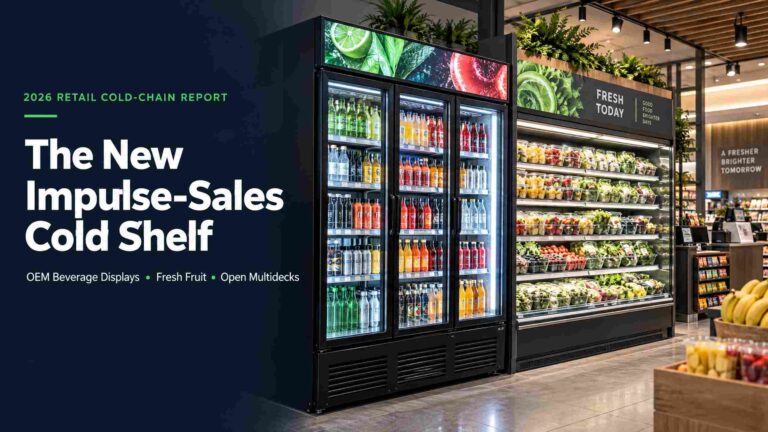
The equipment is changing with the competition. Retailers are moving away from anonymous black boxes and plain shelving. They are ordering branded upright display chillers with illuminated canopies, custom colours and product-specific shelf layouts. At the same time, open multideck cases are appearing near entrances and fresh-food routes, where access matters more than a fully enclosed front.
The commercial argument is direct: a chilled drink or a cup of prepared fruit can become an unplanned purchase if it is cold, visible and within arm’s reach. But the cabinet must earn that sale without creating a large energy or maintenance problem.
The High-Margin Beverage Display Battle
Energy drinks have become a fixture of the eye-level strike zone. A shopper may walk past a full grocery shelf without stopping, then reach for a cold can positioned beside the payment queue. In a busy convenience store, staff may refill the same beverage cabinet several times per shift. The front row has to remain faced, the doors must close properly and the product temperature must recover quickly after repeated openings.
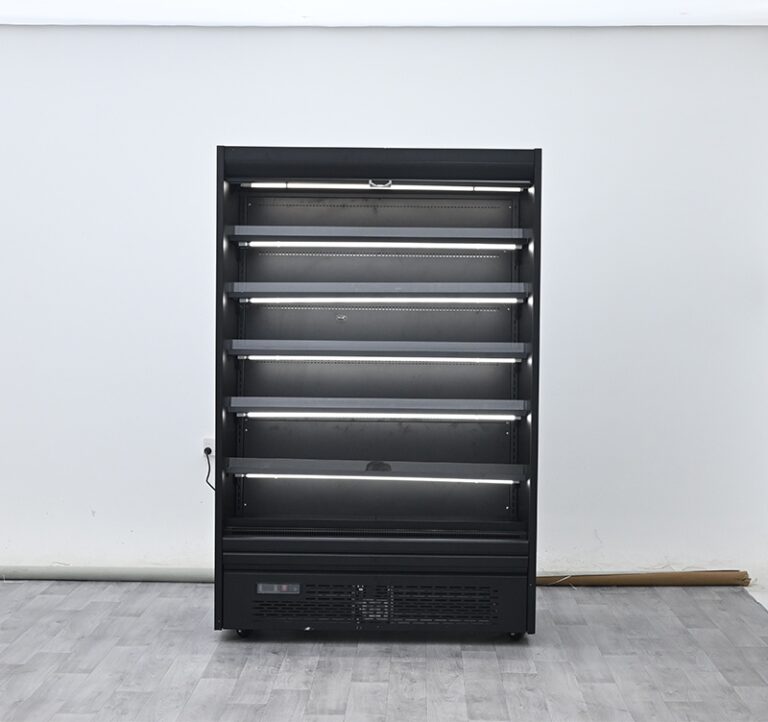
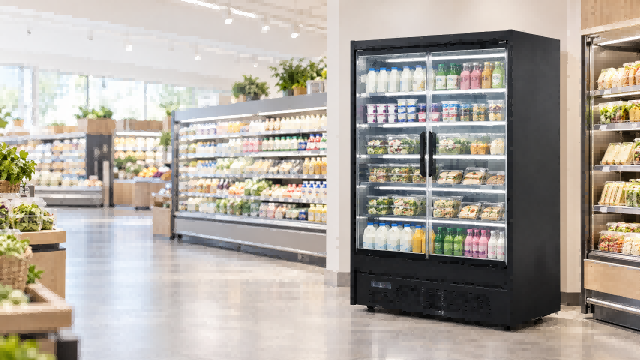
That is why operators are installing a branded supermarket monster energy drink display fridge rather than relying on a generic drinks case. The difference is visible from a distance: a defined canopy, a high-contrast lightbox, a dedicated colour scheme and LED lighting that makes the can graphics readable through the glass.
A high-transmission supermarket fridge vertical gives the brand more height to work with. The top shelf can carry premium or limited-edition packs, the centre shelves can hold the highest-volume cans, and the lower shelves can handle larger bottles or multipacks. The shelf pitch needs to match the real pack mix. A beautiful cabinet with shelves too close together becomes a daily replenishment nuisance.
Retailers are also asking for narrower frames and cleaner glass. In summer, especially in humid coastal markets, a door can fog around the frame within minutes if the anti-condensation heater is poorly controlled or the gasket does not compress evenly. A clear front is not a cosmetic detail. It determines whether a passing customer can read the label and whether the cabinet still looks open for business.
This is where OEM work has moved beyond a logo sticker. Beverage companies and supermarket groups want the canopy height, door count, lightbox, side graphics, handle colour, LED tone and shelf configuration specified together. createrefrigeration has been supplying OEM programmes that combine the brand’s visual rules with the cabinet’s refrigeration duty, rather than treating the graphics as an afterthought.
The better projects begin with the sales data. The channel manager identifies the top-selling pack, the peak hour, the expected door-opening frequency and the required replenishment route. The equipment team then sets the shelf pitch, lighting and controller parameters around those facts. A drink cabinet beside a checkout queue is not designed the same way as a six-door wall in a hypermarket beverage aisle.
A properly specified supermarket commercial display fridge should also be judged on its back-of-house behaviour. Does the condenser have room to breathe? Can staff clean the grille without moving another cabinet? Is there a replacement gasket in the local spare-parts list? Can the cabinet run on the store’s actual voltage and frequency? These questions rarely appear in a social-media product photograph, but they show up on the maintenance report.
CREATE Refrigerator is being positioned by the factory as a source for this kind of OEM project, including branded facias, custom cabinet widths, vertical LED layouts and high-efficiency refrigeration packages. For a beverage company comparing a standard reseller unit with a branded rollout, the relevant figure is not only the purchase price. It is the cost per selling metre, the number of units sold per day and the time required to service each cabinet.
Custom display cases and product catalogues are available through www.createrefrigeration.com.
Fresh Produce Moves Toward the Entrance
The entrance zone has its own rules. Customers are still drawn to loose produce and visible colour, but many stores now combine a traditional rack with chilled cut fruit, salad bowls, washed vegetables and prepared snack packs. The result is a fresh-food statement that starts before the customer reaches the main grocery aisle.
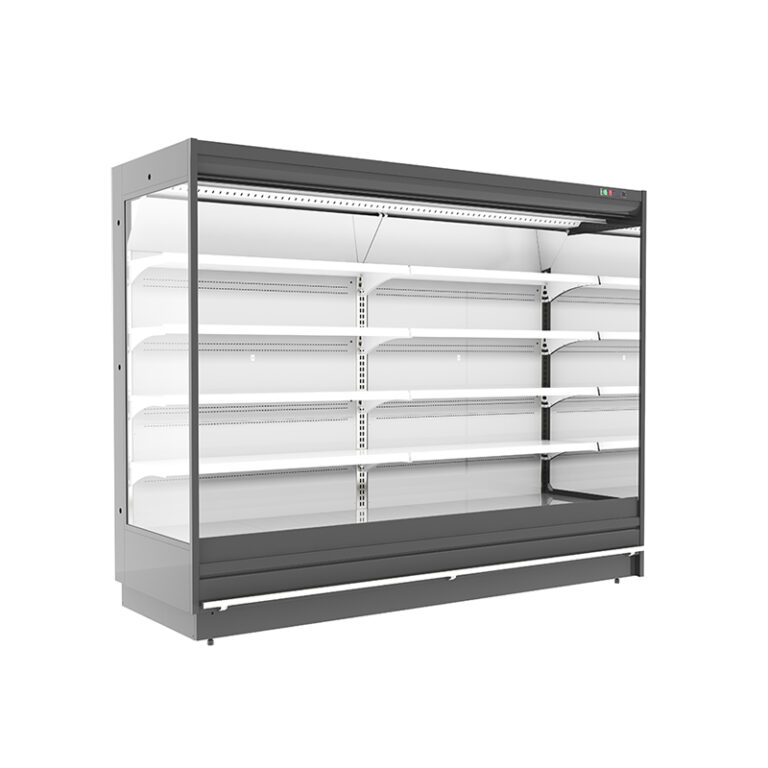
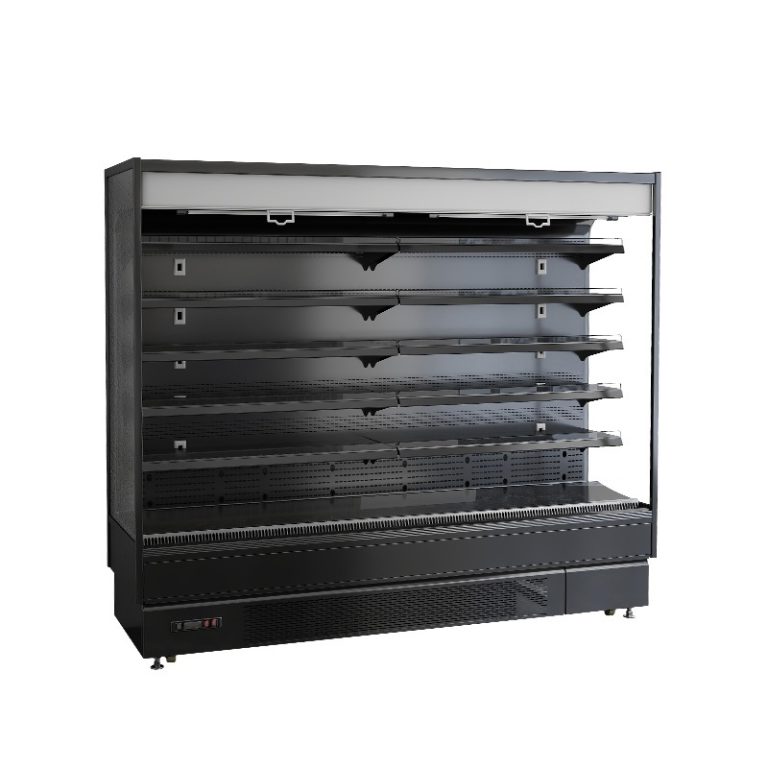
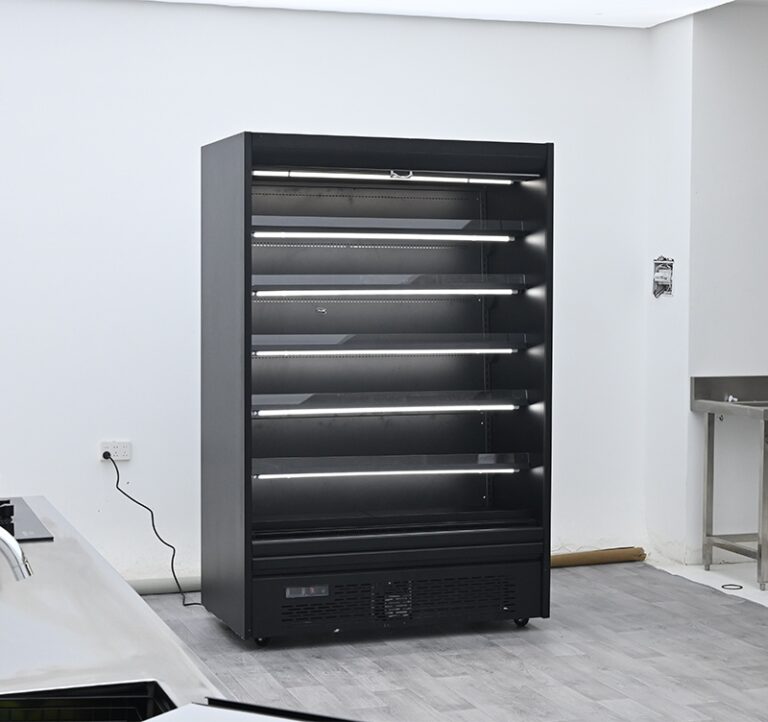
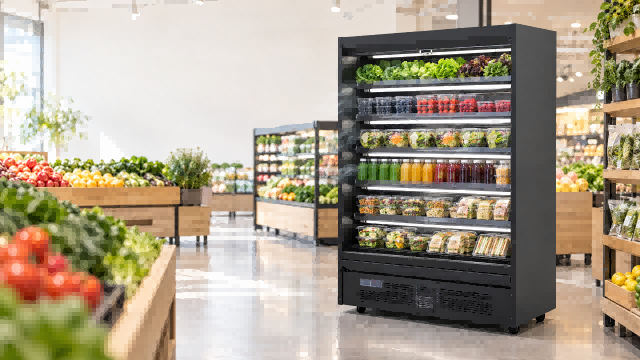
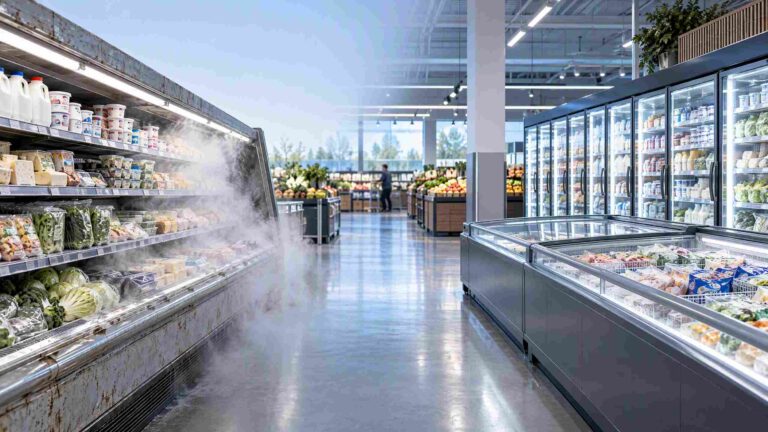
An open supermarket multideck open chiller removes the handle-and-door delay. A shopper can see the top row of berries, take a cup of pineapple and keep moving. Staff can face the trays quickly during a busy morning. The downside is familiar to every refrigeration engineer: the open front releases cold air, and a strong ceiling draft can push the air curtain into the customer path.
The product label used in some equipment schedules—vegetable refrigerator supermarket fruit and vegetab—may look awkward in English, but it reflects a real buying category: a dedicated produce refrigerator intended for supermarket fruit and vegetable merchandising. The specification behind that label should state the product range, temperature target, tray depth, humidity expectation, airflow velocity and cleaning routine.
For cut fruit and leafy products, the coldest possible airflow is not automatically the best airflow. A strong jet can dry lettuce edges, dull berries and increase weight loss before the produce reaches the evening markdown window. The honeycomb stabiliser, perforated rear panel and lower return grille need to work as one system. Staff must not fill the return path with spare cartons.
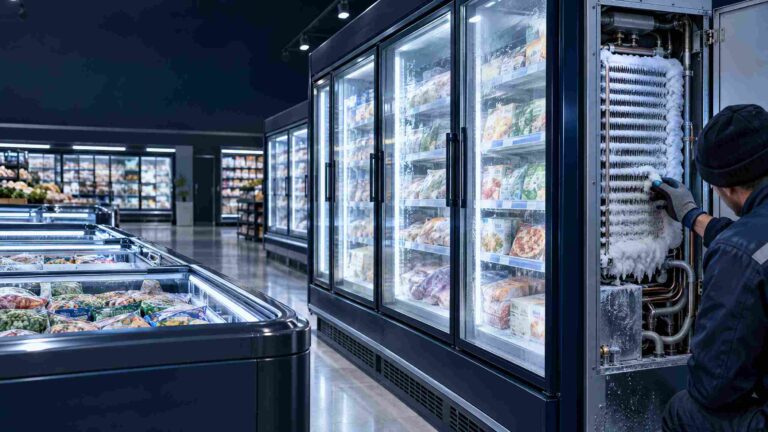
The store’s chilled and frozen equipment may be linked visually, but not every cabinet should share the same operating duty. A supermarket freezer air curtain refrigerator can be used where an air-curtain design is required for a cold display zone, but the project schedule must define whether the cabinet is handling frozen, chilled or mixed-temperature products. The name alone does not establish the safe operating range.
Night protection is becoming more common on open cases. A slow-closing insulated curtain after trading hours reduces warm-air exchange, shortens overnight compressor recovery and helps the cabinet start the morning with a smaller thermal deficit. The saving depends on ambient temperature, curtain fit, product loading and the hours of closure. It should be measured at the meter rather than assumed from a brochure.
The Middle of the Store Becomes a Traffic Engine
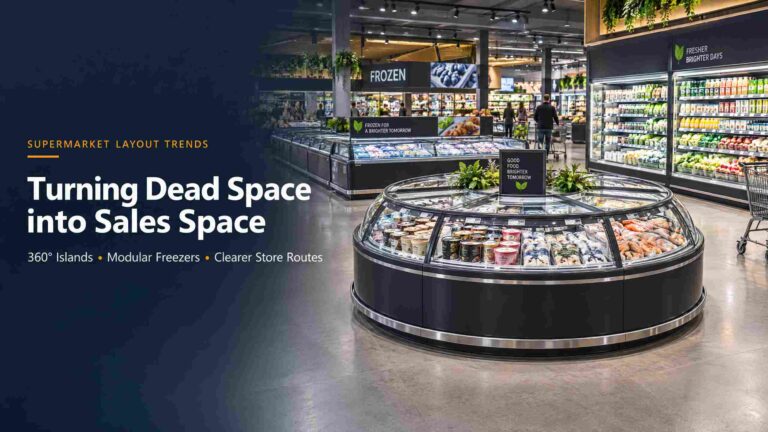
The centre aisle is no longer reserved for slow-moving bulk promotions. Retailers are using low islands, upright drink cases and fresh-food displays to create a series of short decisions: a cold bottle near the queue, a snack beside the beverage case, a cup of fruit near the entrance and a frozen treat at the end of the main route.
A row of refrigerators supermarket showcase units can form the taller wall layer. These cabinets are useful for drinks, dairy and ready meals, but height must be handled carefully. Too many tall cases in the central field create blind corners for staff and security cameras. The more successful layouts keep the centre lower and use vertical equipment along selected walls or aisle ends.
A high-efficiency supermarket equipment display chiller can sit between the entrance produce zone and the beverage run. Its role is not only to hold product. It can bridge two shopping missions: fresh food for the immediate meal and a cold drink for the journey home. Lighting, shelf pitch and signage should help the customer understand that connection without covering the air path.
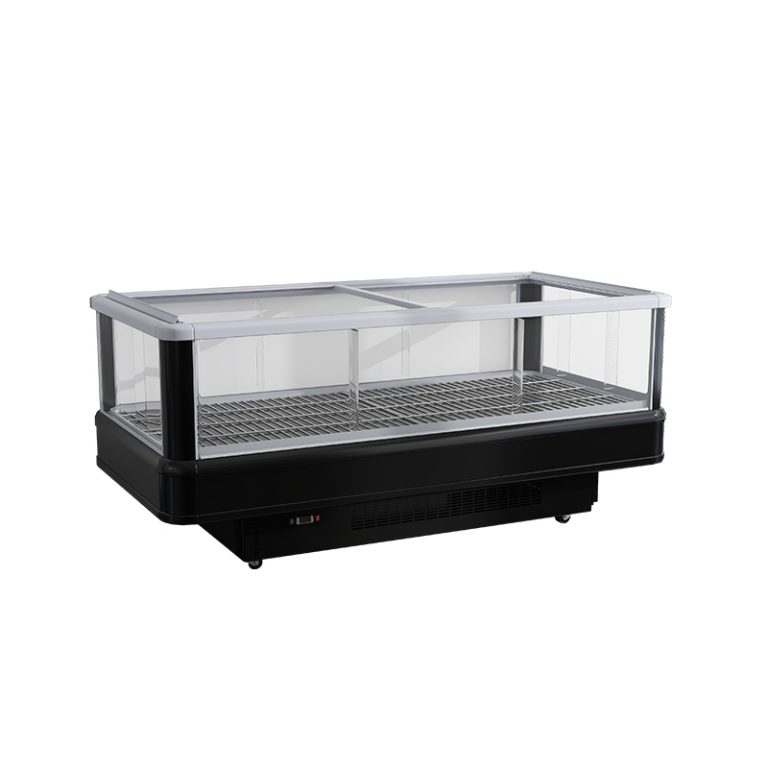
At the centre, a round island supermarket display freezer can create a natural pause. Its circular or rounded footprint softens the turning movement and gives several approach angles. The store still needs to verify trolley clearance, replenishment access and condenser ventilation. A round footprint does not remove the need for a service plan.
A larger supermarket combined type freezer can carry frozen family packs, ice cream, prepared meals and seasonal promotions. It should be kept away from an open produce case if its condenser discharge heats the entrance route. Where several plug-in cabinets are used, the electrical schedule should account for compressor starts, defrost heaters, frame heaters and lighting loads.
Together, these fixtures form a more connected supermarket cold chain equipment plan. The aim is not to make every product visible from every angle. The aim is to give each zone a clear job, keep the customer route comfortable and prevent one cabinet’s heat or airflow from undermining another cabinet’s performance.
What Operators Are Measuring in 2026
The strongest operators are moving past simple unit sales. They are tracking sales per metre, average basket value, door-opening patterns, product temperature, shrinkage, kWh per trading day and the time required to replenish. A display cabinet that sells well but causes repeated service calls is not a good store asset. A cabinet that uses little energy but hides the product is not a good selling fixture either.
In the drinks category, the eye-level strike zone remains the most valuable part of a vertical case. The retailer wants the highest-margin or highest-repeat products where the customer’s gaze naturally lands. In fresh produce, the emphasis is different: the front tray must look full without being overstacked, and the air must cool without stripping moisture from the leaves.
For glass-door units, operators are checking the frame heater during humid weather, not only on a dry commissioning day. They are checking the magnetic gasket with a paper strip and watching whether a door rebounds open after a rushed refill. For open multidecks, they are checking the night curtain, the lower return grille and the position of the nearest HVAC diffuser.
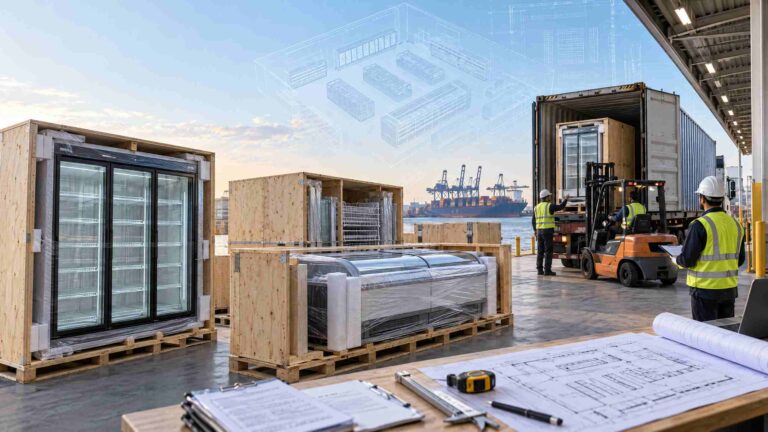
This level of detail is changing procurement conversations. Retailers increasingly ask manufacturers for a three-dimensional layout, a heat-load review and a cabinet schedule before they approve a chain rollout. They want to know where the customer will stand, where the employee will replenish and where the service technician will place a ladder or vacuum.
createrefrigeration has responded to that demand with source-factory OEM support covering cabinet dimensions, colour packages, lighting, shelving and layout coordination. The value of the factory relationship is strongest when the brand owner, retailer and equipment engineer agree on the same drawing before production begins.
2026 Investment Return Comparison
The figures below are operating benchmarks rather than universal guarantees. Actual results depend on store traffic, climate, product mix, opening hours, loading discipline and the condition of the refrigeration system.
| Display option | Floor productivity | Typical operating profile | Likely commercial effect |
| Standard ambient shelving | Low equipment cost; limited chilled impulse range | Minimal electricity, but no cold-product conversion | Lower basket impact near checkout and entrance |
| Conventional generic cold cabinet | Moderate display capacity; limited brand presence | Moderate power use; variable door, lighting and airflow control | Some temperature protection, modest impulse lift |
| OEM branded vertical / open display system | Higher planned investment; stronger use of golden zones | Managed lighting, airflow, night protection and service specification | Higher selling visibility, stronger drink/fruit conversion and better control of operating cost |
The Retail Story Behind the Hardware
The current display-equipment market is not simply about adding more refrigeration. It is about assigning scarce floor space to products that can repay it quickly. Functional drinks need recognition and cold availability. Craft beverages need presentation and a reason to stop. Fresh fruit needs access without dehydration. Each category makes a different demand on the cabinet.
The stores gaining the most from the change are not necessarily the ones with the largest equipment budgets. They are the ones measuring the right details: what sells at eye level, how long a door stays open, whether the night curtain is used, where the HVAC draft crosses the case and how many minutes the morning team spends cleaning and refacing.
CREATE Refrigerator is presenting OEM display refrigeration as part of that operating discussion, not as a decorative add-on. Retailers and beverage channel managers seeking branded upright cases, open multidecks or combined cold-chain planning can request product information through www.createrefrigeration.com. createrefrigeration can provide the equipment catalogue, OEM configuration options and layout discussion needed before the next golden aisle is committed to steel and glass.