
An industry trend report for food retailers, fresh-market owners and commercial space designers
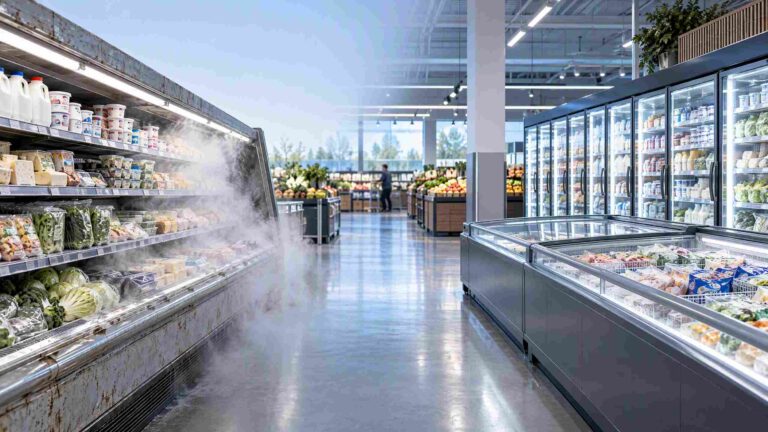
The straight aisle still does most of the work in a supermarket. It carries the trolley, holds the planogram and makes replenishment predictable. But it also leaves awkward corners, blank intersections and centre-floor spaces that customers cross without stopping. Increasingly, retailers are using shaped refrigeration to give those spaces a job.
Circular display islands, modular frozen cabinets and upright air-curtain cases are changing the way shoppers move through the centre of the store. They create shorter sightlines, more approach angles and more reasons to pause at an aisle crossing. The calculation is practical: if a customer stops for six or eight seconds at a centre display, the store has another chance to sell a frozen dessert, seafood pack, prepared meal or seasonal promotion.
The shift is not a matter of adding unusual shapes for decoration. The equipment still has to hold temperature, survive trolley traffic, allow fast replenishment and leave the technician enough space to work. The more interesting layouts are the ones where the visual change is backed by a service plan.
The 360-Degree Focus at the Aisle Intersection
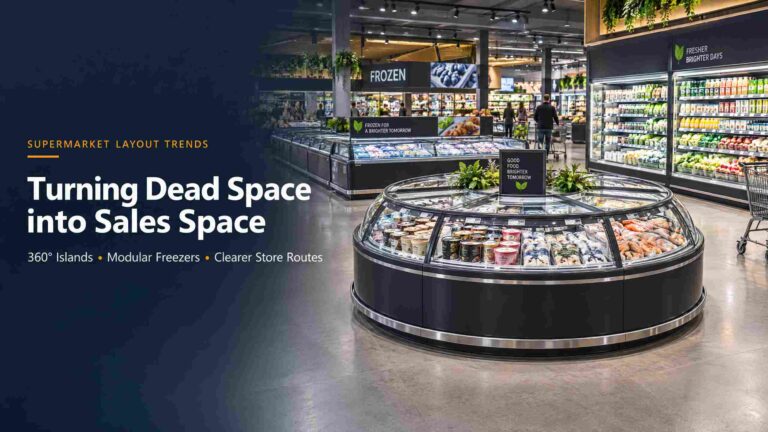
At a main aisle junction, a compact round island supermarket display freezer can be seen from several directions. A straight cabinet often presents a strong face in one direction and a dead side in the other. A rounded island turns that dead side into another selling surface.
Retailers use these islands for fast-moving ice cream, frozen seafood, discounted meat packs, seasonal desserts and limited-time offers. The product does not need a long explanation. It needs to be visible as the customer turns, easy to reach without blocking the intersection and simple for staff to refill from the service side.
The best location is not always the geometric centre of the store. It is the point where two customer flows cross without creating a trolley bottleneck. Measure the approach from the main door, the end of the produce route and the checkout queue. Record how long customers stand there during the evening rush. A cabinet that produces a five-second pause but forces every trolley to swerve may create more frustration than sales.
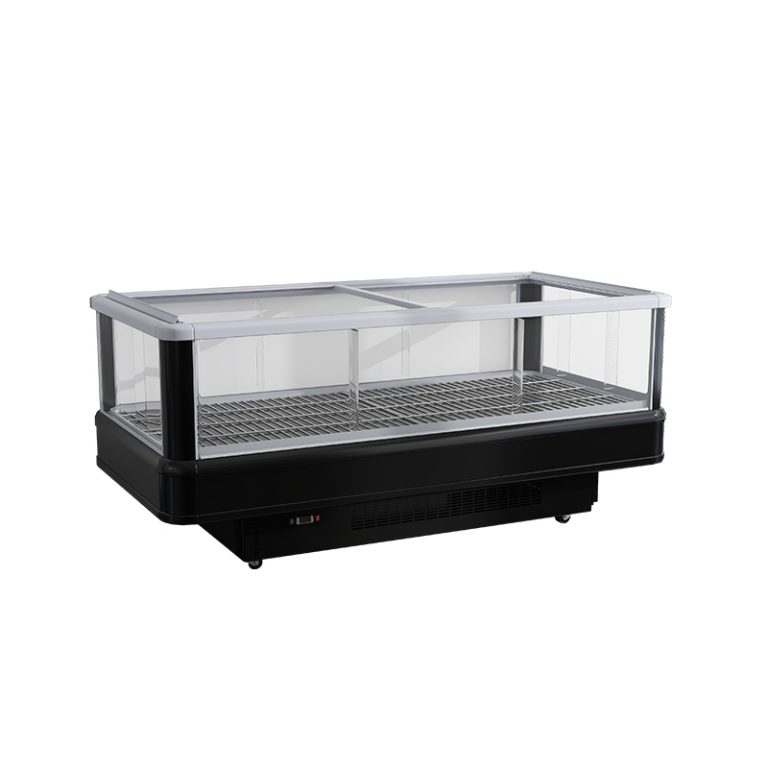
A circular unit can work as the low visual anchor of a larger centre display. Behind it, a longer supermarket combined type freezer can carry family packs, frozen vegetables, dumplings and bulk promotions. The low rounded island catches the eye; the longer cabinet holds the volume. The two should share a visual language but retain clear service and temperature information.
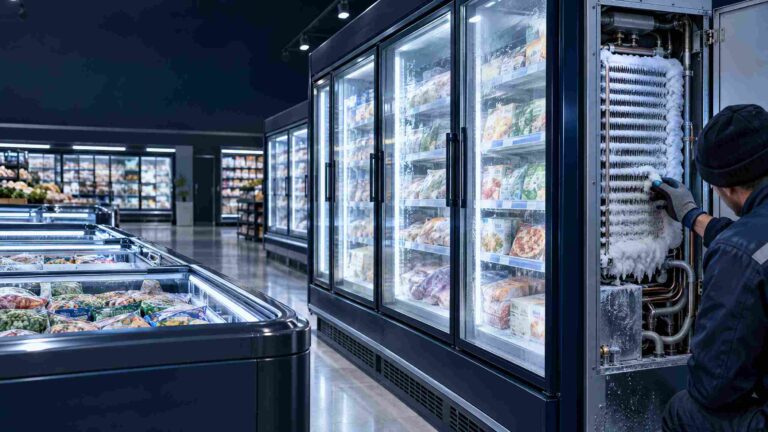
Modular construction matters when the promotion changes. An end module may face the principal aisle, while straight sections extend along the secondary route. If one section has its own controller and refrigeration protection, a fault can be isolated instead of taking the full island out of service. The maintenance benefit is easy to understand: one failed module becomes a repair job, not a whole-centre sales shutdown.
The hardware needs protection at the turning point. Shopping carts do not approach a centre island in a straight line. They clip corners, catch handles and sometimes strike the lower panel with a loaded basket. An aluminum alloy bumper strip around the exposed base can distribute the impact and protect the glass or painted cabinet skin. The strip should have a replaceable corner section and a fixing method that does not pull the cabinet frame apart after repeated contact.
The operator should also check the lid or door movement. A sliding lid that opens into the trolley path will remain half closed during busy periods. A door that rebounds open after a customer takes one pack creates a steady heat load. Small mechanics can decide whether the attractive island works in practice.
Building the Outer Ring with Air-Curtain Equipment
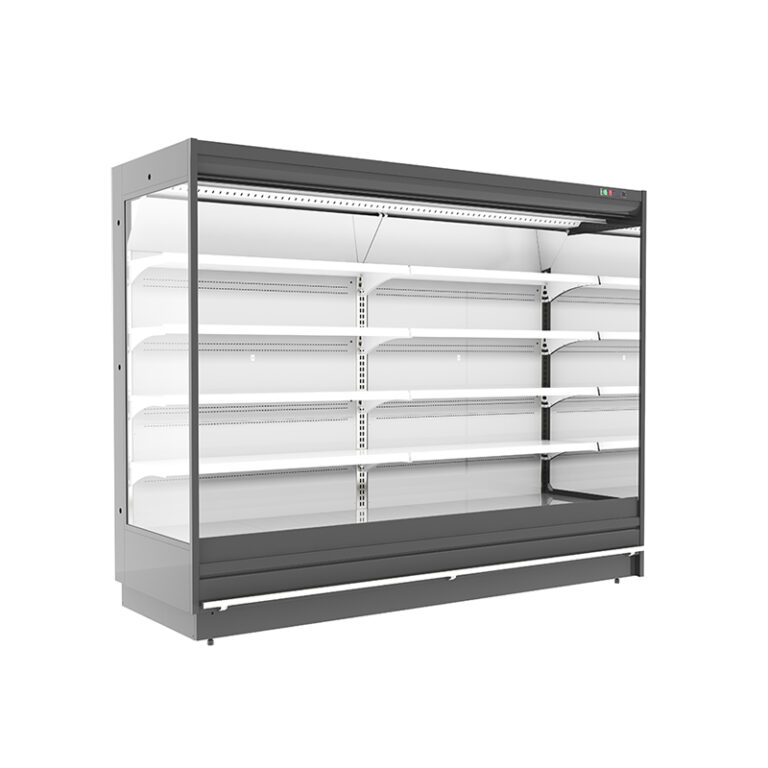
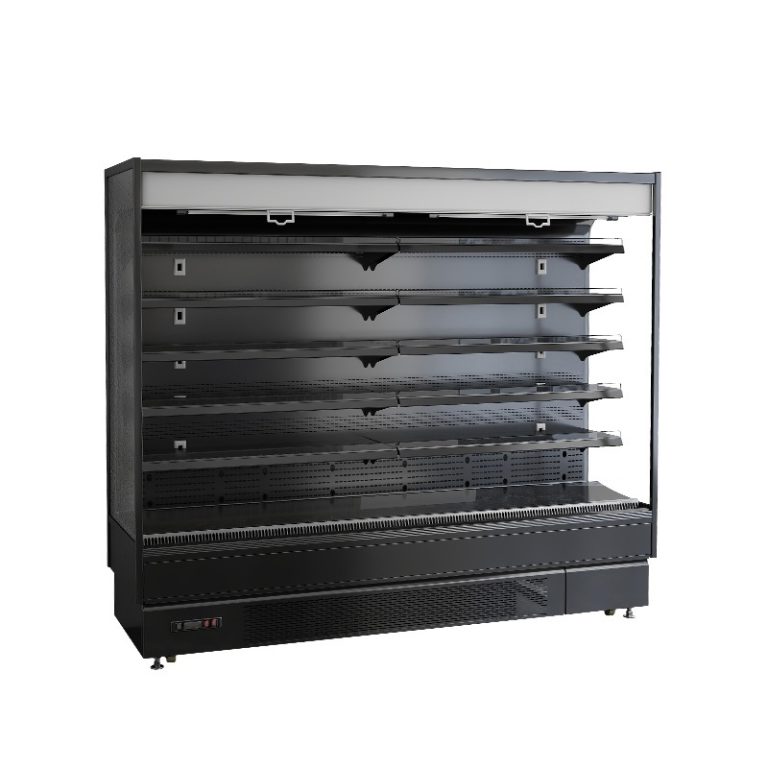
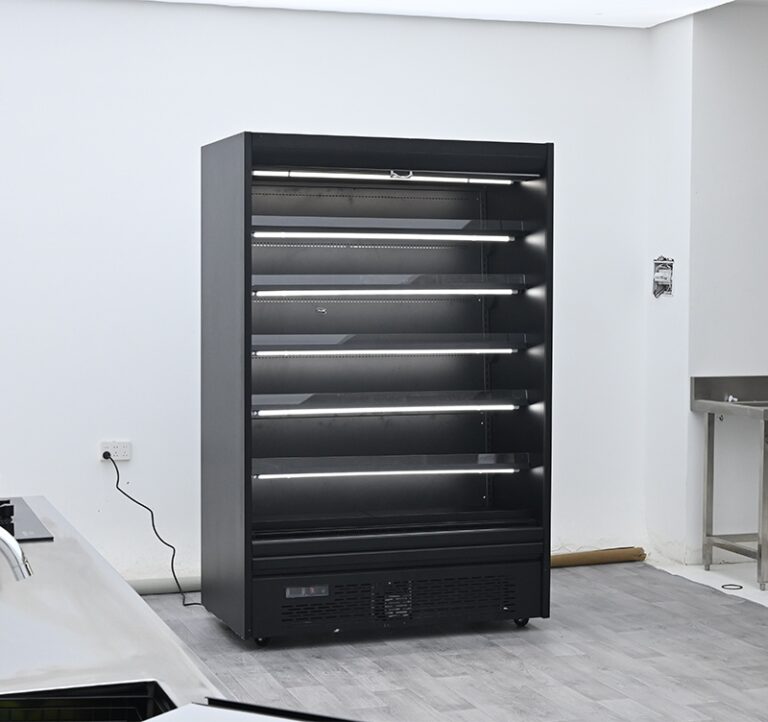
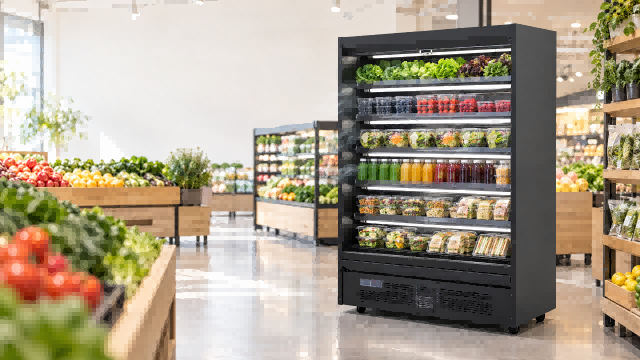
Once the centre has a low, rounded focus, the perimeter can carry the taller equipment. A wall-mounted supermarket multideck open chiller can hold dairy, prepared food, packaged salads and chilled drinks. Its open access supports quick selection, but the air curtain must be protected from the store’s own HVAC system.
A ceiling diffuser aimed across the front can push cold air out into the aisle. An entrance door can send warm humid air in. A promotional sign can block the lower return grille. These are common reasons for a case that feels cold at the bottom and warm at the top.
A supermarket freezer air curtain refrigerator can be specified for a store that wants an air-curtain presentation with a defined frozen or chilled duty. The schedule must state the operating range, product category, defrost method and airflow arrangement. A name that includes both “freezer” and “refrigerator” does not remove the need to define the actual temperature application.
The produce ring may use a category-specific cabinet described in procurement files as vegetable refrigerator supermarket fruit and vegetab. The wording is awkward, but the buying need is familiar: a produce refrigerator for cut fruit, berries, herbs, salad bowls and washed vegetables. The cabinet should use gentle, even airflow rather than a cold jet aimed at the front tray.
Leaves lose water when the air is too fast or too dry. The store may see a full display at opening and wilted edges by the evening markdown. A honeycomb stabiliser, rear perforated panel and lower return path can produce a calmer air sheet. Staff must keep cartons below the loading line and clear of the return.
The internal finish matters in fresh areas. Salt, moisture, dressings and repeated wash-down attack poor coatings. createrefrigeration specifies food-contact options such as equipped stainless steel plates, including SUS 304 where the product duty and approved material schedule require it. The useful question is not whether the steel looks bright on day one. It is whether the corners, seams, drain edges and concealed base remain cleanable after months of real service.
The outer ring should not become a wall that hides the centre. Mix cabinet heights and maintain a sightline across the store. A low produce fixture can sit near a tall case, but do not place two high cases opposite each other at a narrow crossing. Customers need to see where the next aisle begins, and staff need to see what is happening around the island.
Branded Beverage Corners and a More Unified Store Image
The checkout area is another place where shaped equipment is gaining ground. Young, urban supermarkets are inserting branded beverage cases into the queue approach rather than hiding every drink on a standard wall. The aim is a quick, recognisable choice while the customer is already waiting.
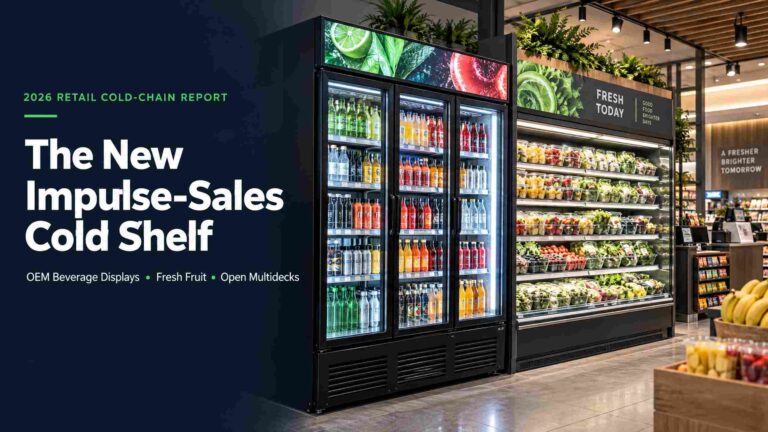
A supermarket monster energy drink display fridge can use a canopy, edge lighting and a strong colour block to make the product visible from the queue. The cabinet should still have high-load shelves, clear doors and a serviceable condenser. A bright fascia does not compensate for a shelf that bows under a full case of bottles.
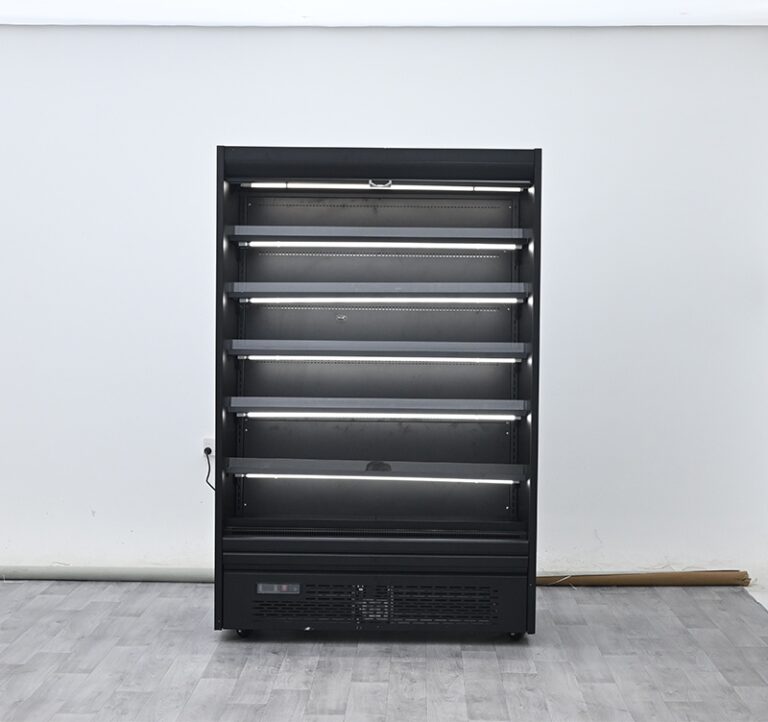
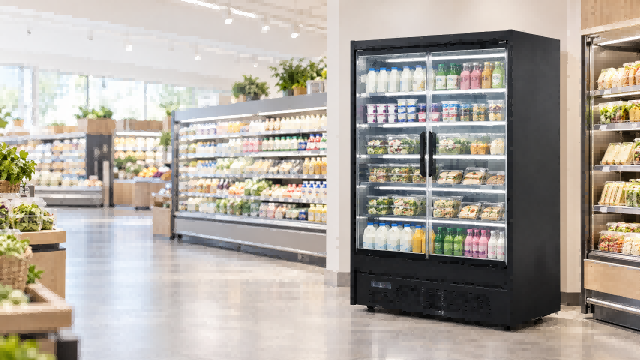
A standard supermarket fridge vertical can continue the drink route along a wall or at an aisle end. The upright unit is useful for a broader product range, while the branded case can focus on a hero line. A panoramic refrigerators supermarket showcase may then connect the beverage zone to dairy, prepared meals or chilled snacks without making the store look like a patchwork of unrelated suppliers.
Visual consistency is becoming a procurement issue. Retailers want the same black finish, handle detail, LED tone and bumper treatment across the circular island, perimeter multideck and beverage case. The equipment may have different temperature duties, but the customer should see one store rather than three dealer catalogues.
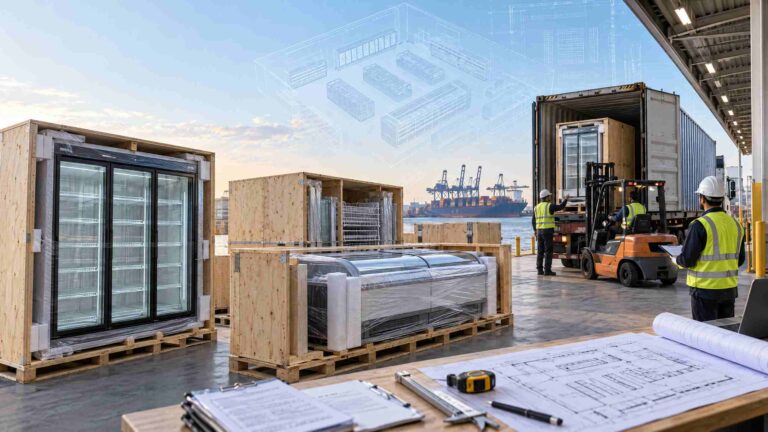
This is where 2D-to-3D planning has gained value. Before ordering a supermarket equipment display chiller or a supermarket commercial display fridge, a retailer can place the equipment into a three-dimensional store view. The owner can see whether the drink lightbox blocks the checkout sightline, whether the island creates a blind corner and whether the replenishment trolley has a route that does not cross the customer queue.
CREATE Refrigerator is being presented by the source factory as a partner for this type of layout-led project. Its proposed workflow starts with the floor plan, product categories, entrance position and customer route, then tests cabinet dimensions, end modules, graphics and service clearances in the store view.
For a free 2D-to-3D store rendering discussion and equipment layout review, buyers can visit www.createrefrigeration.com.
What the Store Manager Sees on the Floor
A good centre layout changes behaviour in small ways. Customers stop at a rounded island instead of walking around a blind corner. A family sees ice cream from the cross-aisle. A shopper waiting to pay notices a cold branded drink. A produce customer can reach a salad bowl without opening a door.
A bad layout also reveals itself quickly. The island blocks the emergency route. Staff refill it from the customer side. The condenser exhaust heats the next cabinet. The bumper strip catches baskets. The nearest HVAC diffuser cuts through the air curtain. A product that looked clear in a rendering becomes inaccessible after the promotional stock is loaded.
Retailers should measure the centre zone before and after the change. Count stops per hour, dwell time, units sold per display metre, markdowns, replenishment minutes, energy use and service calls. The circular cabinet has to produce more than a photograph for the investment to make sense.
Independent controls help that calculation. If the circular island, the long frozen section and the perimeter chiller each report their own temperature and alarms, the manager can identify the problem section quickly. A single shared control can appear cheaper at purchase but create wider disruption when one sensor or compressor fails.
For a complete supermarket cold chain equipment plan, the schedule should show each cabinet’s product duty, temperature range, defrost method, refrigerant, electrical load, condenser clearance, drain strategy and service position. The shape of the case may attract attention, but the data keeps the store open.
Store-Zone Refrigeration Configuration Matrix
| Store zone | Recommended equipment approach | Selection and operating standard |
| Main-aisle end-cap promotion | Round island display freezer with protected corners and independent control | 360-degree visibility, trolley clearance, fast replenishment, replaceable aluminum alloy bumper strip |
| Centre frozen-food zone | Modular combined freezer with separate sections and defined service access | Independent temperature control, clear lid or door movement, balanced electrical load and isolated fault response |
| Perimeter fresh and vertical zone | Open multideck, air-curtain produce cabinet and upright branded display cases | Gentle produce airflow, SUS 304 food-contact option, clear HVAC path, door/gasket checks and 3D sightline review |
The Direction of Travel
The centre of the supermarket is becoming a managed sales surface rather than leftover floor space. Circular islands give frozen promotions more approach angles. Modular sections let operators adjust the offer and contain technical faults. Upright air-curtain and beverage cases build a perimeter that supports the centre without closing the store in.
The strongest projects begin with a route, not a cabinet catalogue. Where does the customer first see the island? Where does the trolley turn? Where does the employee refill it? Where does the condenser discharge? What happens when one module stops? Those are the questions that decide whether a shaped fixture improves the store or simply occupies it.
createrefrigeration is offering source-factory support for irregular promotional cabinets, combined islands, stainless-steel fresh displays and full-store 3D traffic planning. CREATE Refrigerator can help turn the 2D floor plan into a more realistic equipment proposal, including centre islands, perimeter chillers, branded beverage displays and service clearances.
Retailers and designers planning a centre-floor redesign can submit their store drawings to www.createrefrigeration.com for a customised layout discussion. The next generation of supermarket refrigeration will not be defined by unusual shapes alone. It will be judged by how much useful selling time, product visibility and operating control those shapes create.