
Industry news analysis for supermarket buyers, convenience-store operators and beverage distributors
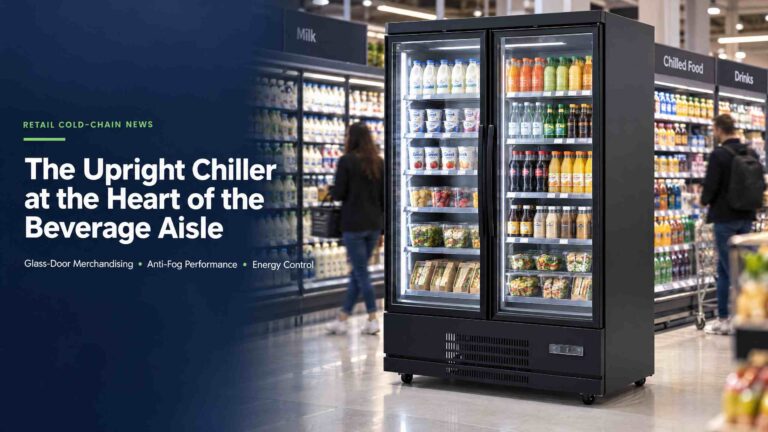
The busiest chilled aisle is no longer judged by cabinet height alone. Store managers are looking at how quickly a customer can read a label, how often a door is left ajar, and how much power disappears through a poor gasket during the evening rush. In convenience stores and high-turnover supermarkets, the upright glass-door chiller has become a daily operating tool rather than a passive piece of furniture.
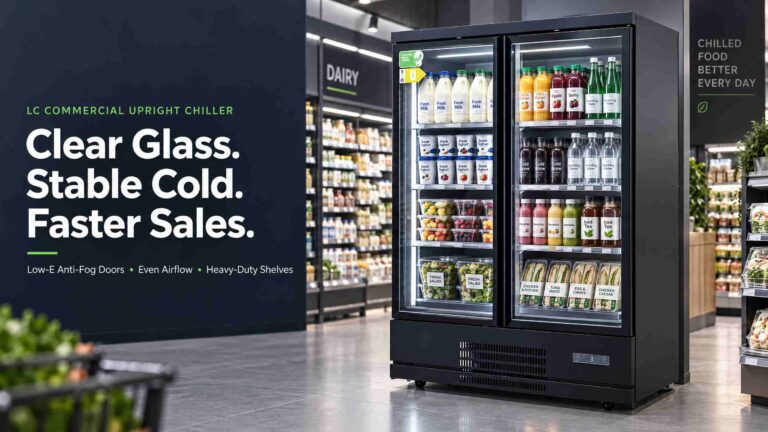
The LC Commercial Upright Glass Door Display Refrigerator is entering this market with a simple proposition: keep the product visible, keep the cold inside and make the cabinet strong enough for repeated commercial loading. createrefrigeration presents the LC range as a factory-direct platform for drinks, dairy, juice, prepared food and other chilled categories.
Why Vertical Glass-Door Merchandising Is Getting More Attention
A supermarket glass door refrigerator gives operators wall-height capacity without turning the centre of the store into a visual barrier. Milk, yoghurt, bottled drinks and ready-to-eat meals can be grouped by category, while the clear front lets customers compare products before opening the door.
That matters during peak periods. A customer may open a door every minute, take one bottle, change their mind and leave another product in the wrong position. Each incomplete closing cycle allows warm air into the cabinet. Over a full trading day, small leaks become compressor hours, frost and higher electricity consumption.
The LC format uses self-closing doors, magnetic gaskets, insulated glazing and adjustable shelves to deal with this routine. The shelf system must be judged with actual beverage cases, not empty cartons. A weak shelf clip or thin panel can bend under a full case of bottles, forcing staff to place stock on the cabinet floor and obstruct the return-air path.
In a wider store plan, supermarket display fridges should be grouped according to product temperature, replenishment route and condenser ventilation. A continuous beverage wall is useful, but only if technicians can still reach the controller, condenser and door hardware after neighbouring cases are installed.
CREATE Refrigerator has positioned the LC series for export projects that require cabinet dimensions, door count, electrical data, colour, shelf pitch and OEM branding to be agreed before production. Technical drawings and store-layout support are available through www.createrefrigeration.com.
Low-E Glass and the Rainy-Season Condensation Test
Humid weather exposes poor glass design quickly. In a summer rainy season, warm air meets a cold front pane and produces condensation around the frame, handle side and lower edge. Staff may wipe the glass several times an hour, yet the haze returns as soon as the next customer opens the door.
Double- or triple-glazed Low-E tempered glass reduces heat transfer through the door. A controlled frame heater helps keep the perimeter clear in humid conditions. The heater must be matched to the climate, because an oversized heater may solve fogging by adding unnecessary electrical load.
Buyers should ask for the glass build-up, Low-E specification, heater arrangement and ambient test condition. A dry factory showroom does not represent a coastal convenience store in July. The door gasket also deserves a physical inspection: top corners, hinge side, centre meeting rail and lower seals must close evenly.
A paper-strip test is a useful field check. If the strip pulls out easily at one section, the cabinet may be losing cold air continuously. The compressor then works longer to recover temperature, and moisture can build up around the evaporator. A well-made door is not a cosmetic detail; it protects both the product and the refrigeration system.
Lighting Turns the Cabinet into a Selling Surface
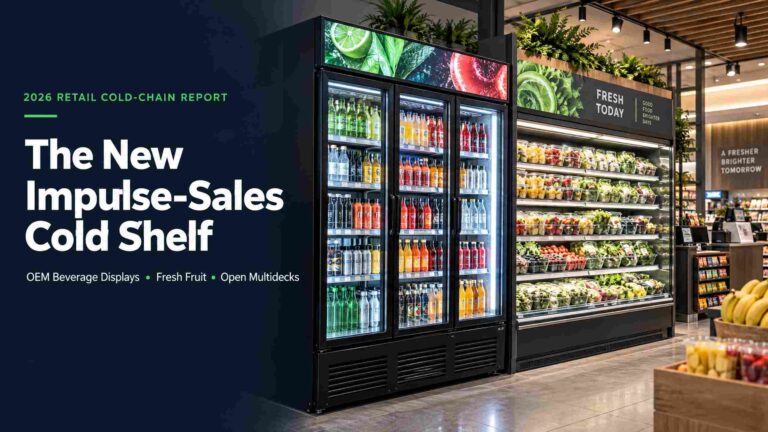
A high-quality supermarket juice display needs more than shelf space. Vertical LED strips without dark zones allow shoppers to see the colour, size and label of the product from the aisle. The light should be bright enough for product recognition but controlled enough to avoid reflections in the glass.
The same principle applies to dairy. White milk bottles can disappear against an over-bright back panel, while coloured yoghurt and functional drinks may look dull under poor colour rendering. Test the lighting with the real products, the doors closed and the store’s ceiling lights switched on.
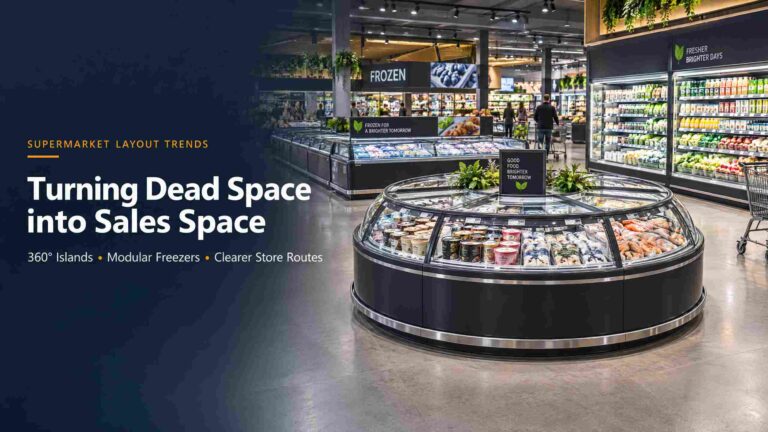
The LC cabinet can work beside a display fridge supermarket zone for packaged chilled food, while a separate supermarket commercial display freezer handles frozen products. The visual language may be consistent, but the temperature duty, defrost system and electrical load must remain separate in the engineering schedule.
Airflow, Loading and Store-Wide Heat Balance
A tall display cabinet needs a defined supply and return path. A rear perforated duct should distribute cooled air through the product zone, while the return opening collects warmer air without being blocked by cartons. For general chilled applications, the cabinet is commonly specified around a +2°C to +8°C product range, subject to local regulations, ambient conditions and the goods being sold.
The bottom milk shelf should not freeze while the top drink shelf warms. This requires more than a cold controller reading near the evaporator. Test the front and rear of the lower, middle and upper shelves after the cabinet reaches stable operation.
Do not direct warm condenser discharge from a supermarket freezer island toward the LC cabinet. In a compact store, several plug-in cases can heat one another if the rear clearances are ignored. Balance circuits for compressors, fans, frame heaters, defrost and lighting. A cabinet that is efficient in isolation can consume far more power when installed in a hot, poorly ventilated row.
The wider fresh-food plan may also include a supermarket seafood display case, a meat freezer supermarket reserve unit and supermarket display fridge freezers for mixed merchandising. Each unit needs its own product duty, service space and cleaning route. Full-store procurement is useful only when the heat load and electrical schedule are reviewed together.
Export Build and Energy Payback
The LC specification should identify the hermetic compressor, refrigerant, controller, evaporator, condenser, fan motors, glass heater, shelf load and gasket profile. R290 can be selected where the destination market, charge and service rules permit it. Nameplates and wiring diagrams must match the delivery voltage and frequency, whether the store uses 110V/60Hz or 220V/50Hz.
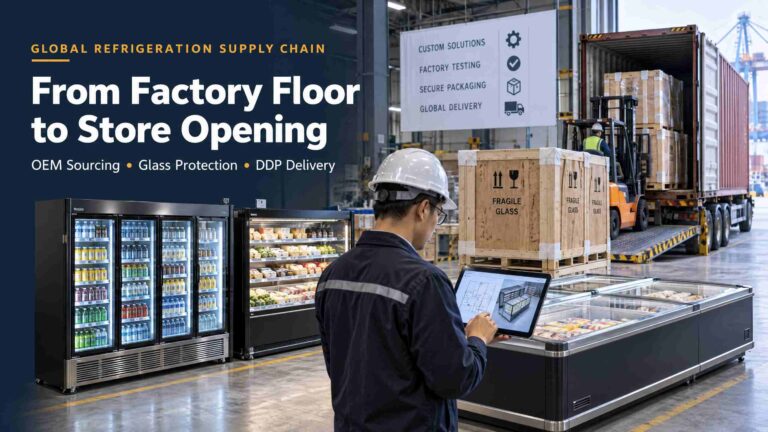
Export packaging should protect the glass corners, doors, shelves and controller. Buyers should request a serial-number list, spare-gasket codes, shelf clips and approved wooden-case or compliant fumigation-free packaging details before shipment.
Energy payback should be measured against the existing cabinet. Record kWh, opening frequency, ambient temperature, setpoint, lighting and condenser condition before replacement. After installation, repeat the measurement under similar trading conditions. A closed glass door may reduce cold-air loss compared with an open case, but frame heaters, fans and lighting also consume power.
The business return includes fewer warm products, lower spoilage, clearer labels and faster replenishment. These operational gains should be reviewed alongside the electricity meter rather than hidden inside a general efficiency claim.
LC Technical Specification Snapshot
| Parameter | LC Commercial Upright Glass Door Display Refrigerator |
| Product duty | Chilled beverages, dairy, juice and ready-to-eat products; typical +2°C to +8°C range |
| Door and glass | Double/triple Low-E tempered glass; anti-condensation frame heater; self-closing doors |
| Air and refrigeration | Rear perforated air duct; forced-air circulation; hermetic compressor; R290 option subject to market rules |
| Display and export | Heavy-load adjustable shelves; vertical LED lighting; magnetic gaskets; export protective packing |
For factory pricing, OEM dimensions and 3D store planning, buyers can contact createrefrigeration through www.createrefrigeration.com. CREATE Refrigerator can configure the LC cabinet for beverage, dairy and chilled-food projects, but the final return will still depend on loading discipline, gasket checks and condenser maintenance.